You sign the contract, the agent shakes your hand, and then the doubt kicks in. The cooling-off period by state decides what happens next. In some states you get five business days and a small fee to walk away. In others you get nothing. So here is each state’s rule as of October 2026, the cost and the exceptions.
This article was produced and reviewed by the Australia Develops editorial team. See our Editorial Policy for sourcing standards and methodology.
Cooling-off period by state: the quick comparison
A cooling-off period lets you cancel a private sale contract shortly after signing. But the length, cost and trigger differ in every jurisdiction.
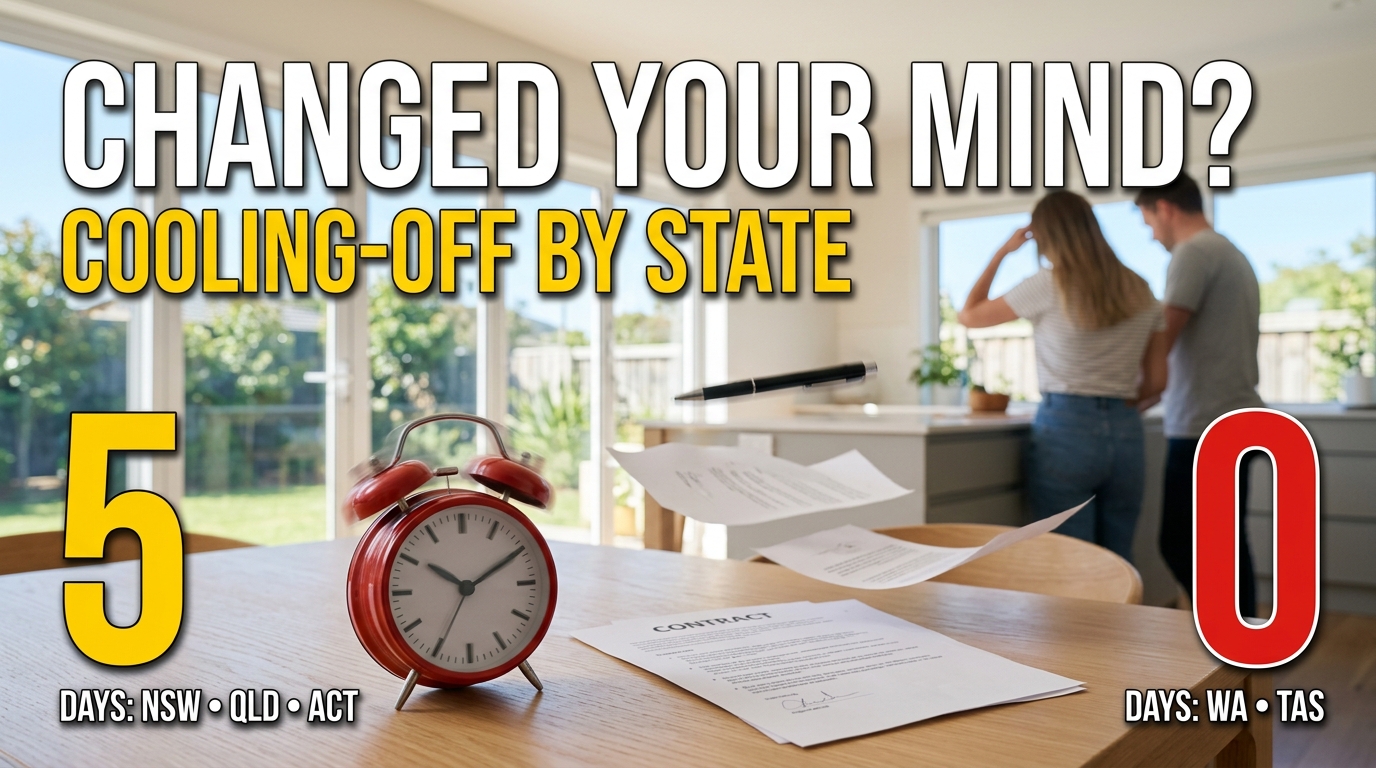
- NSW: 5 business days after exchange (10 for off the plan). You pay the vendor 0.25% of the price if you pull out.
- VIC: 3 clear business days from when you sign. The seller keeps $100 or 0.2% of the price, whichever is greater.
- QLD: 5 business days from when you receive the contract signed by both parties. The seller may deduct up to 0.25%.
- ACT: ends at 5pm on the 5th working day. You forfeit 0.25% of the price.
- SA: two clear business days after you receive the Form 1. Any deposit above $100 must come back to you.
- NT: 4 business days, and you can cancel without penalty.
- WA: no mandatory cooling-off period.
- TAS: no statutory cooling-off period, although the contract can include one.
Those penalties scale with the price. On an $800,000 house, 0.25% is $2,000. That beats losing a 10% deposit, but it’s still real money.
NSW: five business days and a 0.25% cost
In NSW, the clock starts the moment you exchange contracts. It ends at 5pm on the fifth business day after the day of exchange. So if you exchange at 10am on a Tuesday, you have until 5pm the following Tuesday. To get out, you give written notice. Then you pay the vendor 0.25% of the price, which the NSW Government notes works out to $250 for every $100,000.
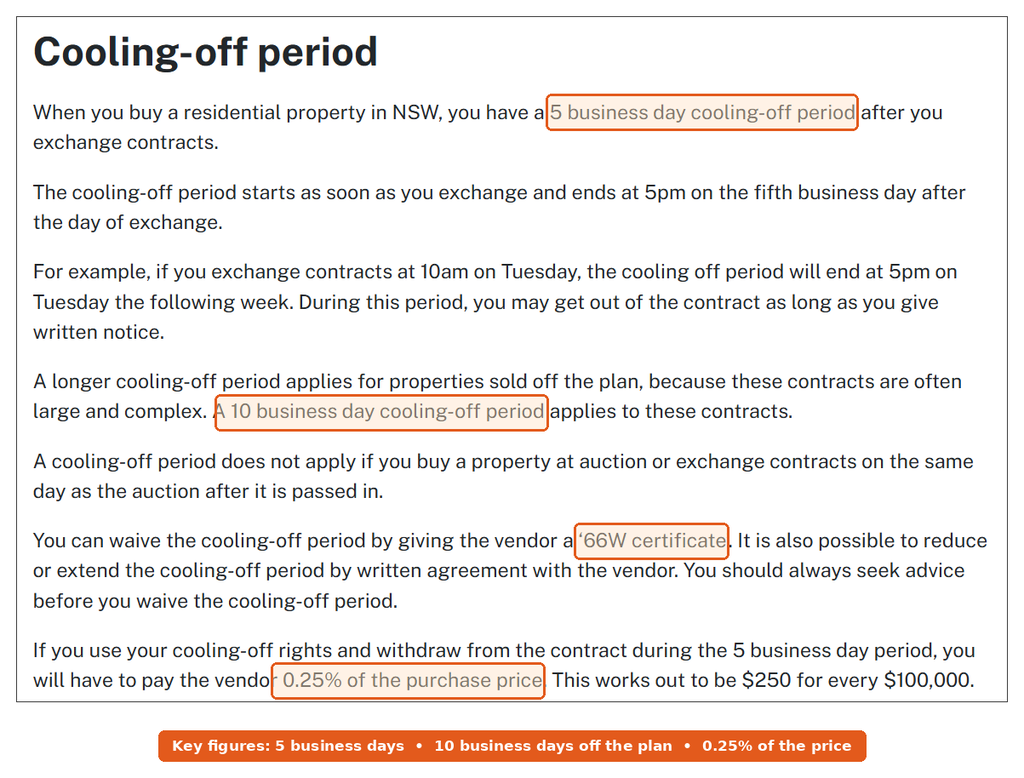
There are three ways you lose the right. First, there’s no cooling-off if you buy at auction. Second, the same applies if you exchange on the same day as an auction after the property is passed in. Third, you can waive it by handing the vendor a “66W certificate”. You can also shorten or extend the period by written agreement with the vendor.

One paperwork change landed this year. The NSW Registrar General says a 2025 amendment bill updated the prescribed cooling-off notice for residential contracts. After a transition, contracts exchanged from 1 June 2026 must use the new form. The length and cost stay the same.
Victoria: three clear business days
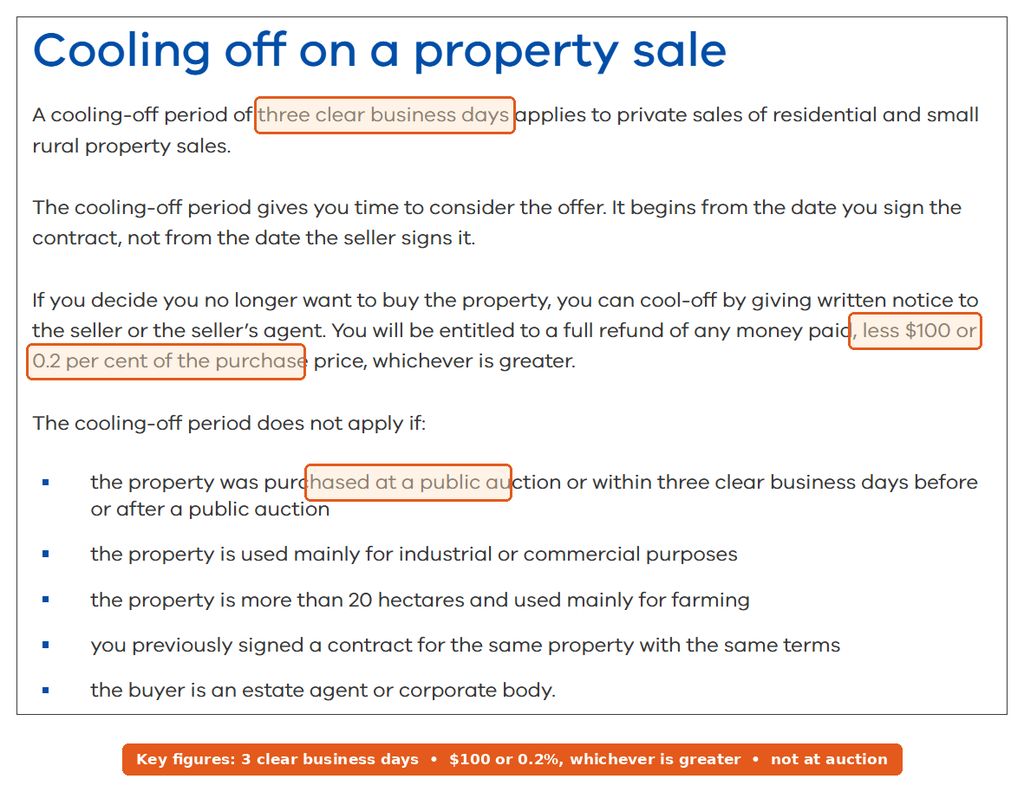
Victoria gives the shortest statutory window on the east coast. Consumer Affairs Victoria says it lasts three clear business days and covers private sales of residential and small rural property. Unlike NSW, it runs from the date you sign, not from when the seller signs. If you cool off, you get a full refund less $100 or 0.2% of the price, whichever is greater.
The exceptions are wider than most buyers expect. There’s no cooling-off if you buy at a public auction. The same goes for a purchase within three clear business days before or after a public auction. It also doesn’t apply to mainly commercial or industrial property, or to farms over 20 hectares. Finally, it’s off the table if the buyer is an estate agent or a company.
Queensland: five business days and new seller disclosure
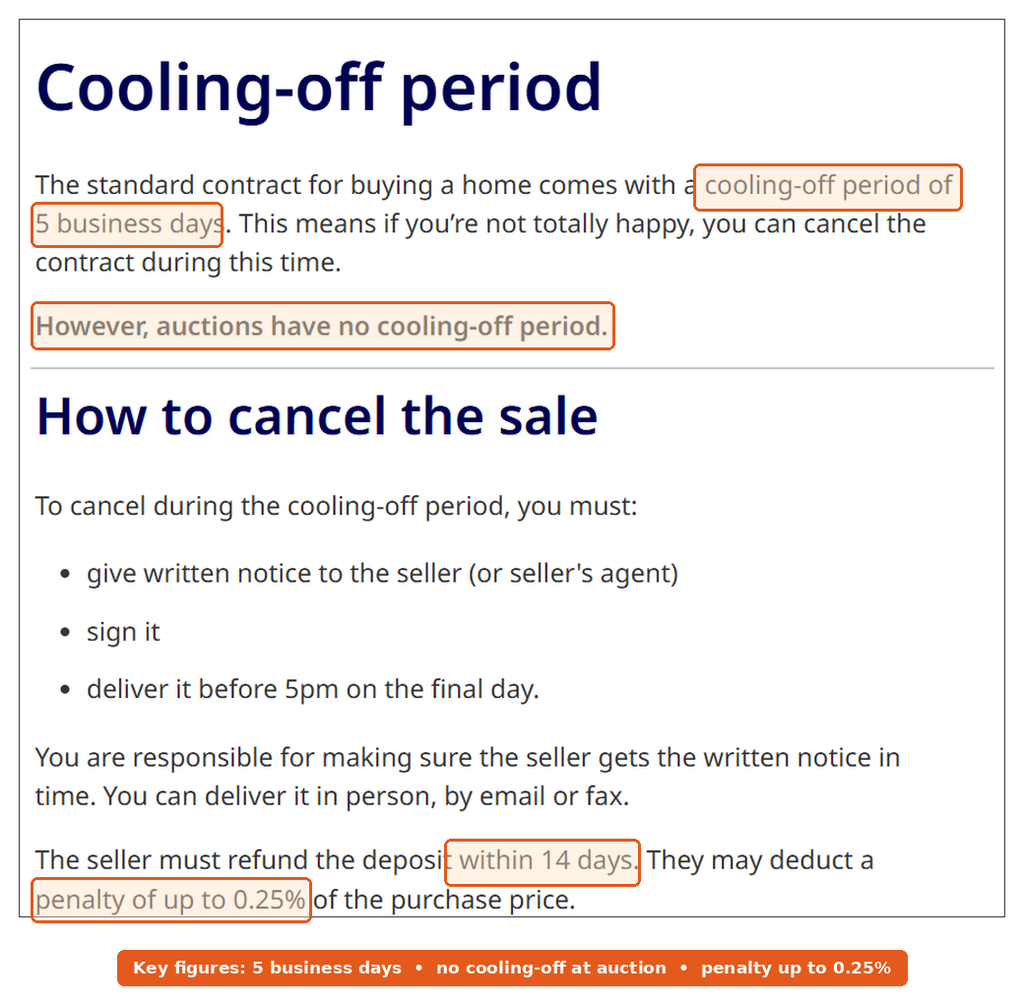
Queensland’s standard contract comes with five business days. The period starts on the day you get a copy of the contract signed by both parties. To cancel, deliver a signed written notice before 5pm on the fifth day. The seller then has 14 days to refund your deposit, less a penalty of up to 0.25% of the price.
Auctions have no cooling-off period. Neither does a private contract signed within 2 business days of a failed auction, if you were a registered bidder. Also, you can waive or shorten the period with written notice.
The bigger change sits alongside it. From 1 August 2025, Queensland’s seller disclosure scheme under the Property Law Act 2023 started. Sellers now must hand over a disclosure statement and prescribed certificates before you sign. This applies at auction too. If the seller skips it, or makes material errors you didn’t know about, you can terminate at any time up to settlement. That’s a much stronger exit than five days.
Cooling-off period by state: ACT, SA and NT
ACT. Under the Civil Law (Sale of Residential Property) Act 2003, the period starts when the contract is made. It ends at 5pm on the 5th working day. If you rescind, you forfeit 0.25% of the price. It doesn’t apply to auction or tender sales, or to corporate buyers. To waive it, you need legal advice and a certificate signed by an independent lawyer.
South Australia. The clock starts once the seller serves the Form 1 vendor statement on you. It ends after the second clear business day, says the SA Legal Services Commission. If you cool off, the vendor must refund any deposit above $100. There’s no cooling-off at auction. Waiving it also requires a solicitor’s certificate saying they advised you of the risks.
Northern Territory. NT buyers get four business days, starting the day the contract is last signed and exchanged. You can cancel without penalty or explanation. But it only covers properties not sold at auction. Buyer and seller can also agree to waive, reduce or extend it.
WA and Tasmania: where the cooling-off period by state hits zero
Western Australia is the outlier. The WA Consumer Protection Commissioner states there’s “no mandatory cooling-off period for real estate contracts in WA”. So WA buyers put their protection into the offer itself, through finance, building inspection and other conditions.
Tasmania is similar. Consumer Affairs Tasmania says cooling-off periods aren’t a requirement under the Property Agents and Land Transactions Act 2016. Vendor disclosure and cooling-off are now options parties can add to the contract. Still, the official advice is “buyer beware”, so don’t assume your contract has one.

Off the plan and land: where the cooling-off period by state shifts
NSW is the clearest. Since 1 December 2019, off-the-plan contracts carry a 10 business day period, and the deposit sits in a controlled account until settlement. Sellers also must give you the proposed plan, by-laws and a schedule of finishes before you sign. Then in January 2025 the government began reviewing sunset clauses. It targets developers who “try to run down the clock” to resell.
The ACT doesn’t lengthen cooling-off for off the plan. Instead, its Act stops a seller rescinding an off-the-plan contract without your consent or a Supreme Court order. For vacant land, none of the official pages we used carves it out. But each state defines residential property differently, so ask your conveyancer whether your block counts. If you’re buying an unregistered lot, read our guide on why off-the-plan land can go wrong first.
How to use the cooling-off period well
The cooling-off period by state is short everywhere. So line everything up before you sign, then use the window to confirm rather than start.

- Building and pest. Book the inspector before exchange, so the report lands on day one or two. That leaves time to get a quote on anything serious.
- Finance. Pre-approval isn’t formal approval. Send your lender the contract at once and ask for a valuation.
- Strata. For units, order the strata report early and look for special levies and defect claims.
- Contract review. Have your conveyancer check the title, the planning certificate and any easements on the property.
- Hazards and costs. Check the flood and bushfire maps and confirm your stamp duty by state, because insurance and duty both hit your budget.
What’s still missing or not confirmed
The NSW sunset clause review has been running since early 2025, but we couldn’t find a commencement date for any new law. Also, we couldn’t confirm a separate off-the-plan cooling-off period in Victoria, Queensland or SA from the official pages. So treat the standard period as the default there until your lawyer says otherwise.
Our take: the cooling-off period by state matters less than what you do before you sign. A 0.25% fee is cheap insurance in NSW, Queensland and the ACT. So we wouldn’t sign a 66W certificate or waiver to win a deal unless inspections and finance were done. In WA and Tasmania, where no statutory right exists, we’d treat a finance and building condition as non-negotiable. And in Queensland, the new seller disclosure regime gives buyers a stronger exit than the five days ever did.
Buying your first home with a small deposit? Then check how the 5% deposit scheme works before you sign anything.
This article is general information based on NSW, Victorian, Queensland, ACT, SA, NT, WA and Tasmanian government and legislation sources available at publication. It isn’t legal advice. Cooling-off rules, notices and exceptions can change, so check your contract with a conveyancer or solicitor before you sign.