If you bought land a year ago and still haven’t signed a build contract, you’ve probably noticed the quotes creeping up. The official data says you’re not imagining it. As of November 2026, house construction costs in Australia are still rising at about 5.7% a year, according to the latest ABS figures for the September quarter. So here is what the ABS numbers show by state, what’s pushing them up, and how to protect yourself before you sign.
This article was produced and reviewed by the Australia Develops editorial team. See our Editorial Policy for sourcing standards and methodology.
House construction costs: the headline numbers
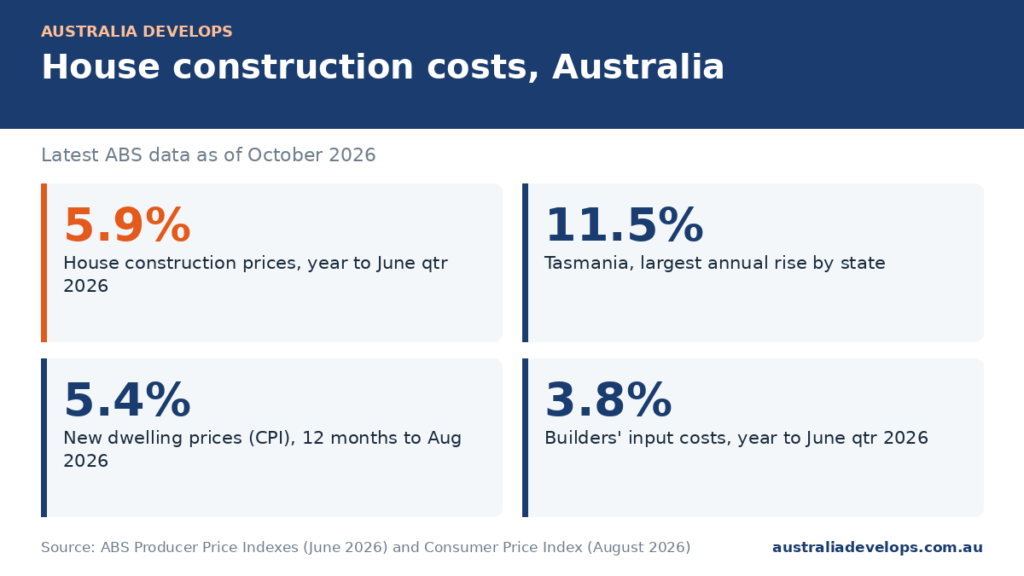
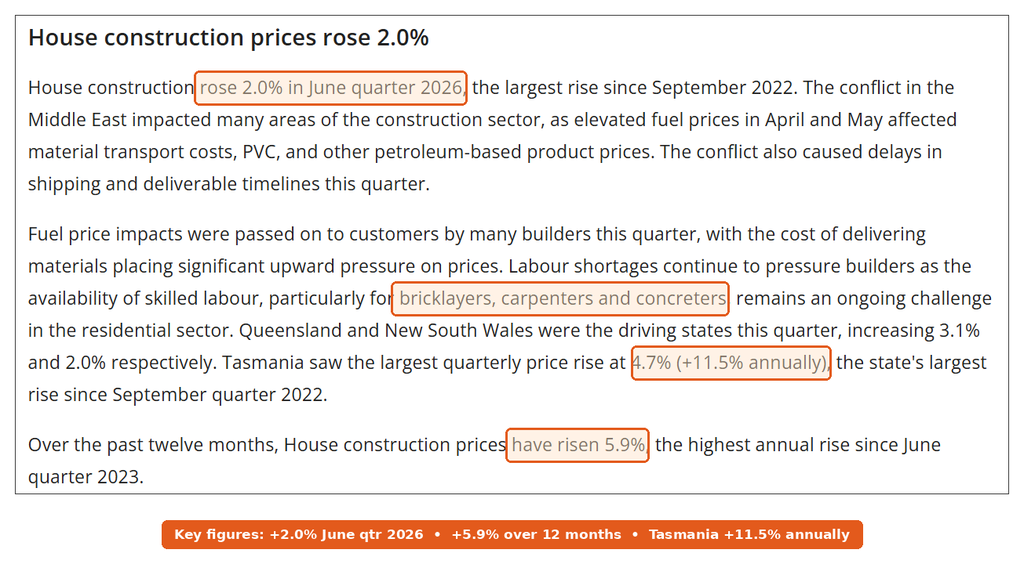
The best single measure is the ABS Producer Price Index for house construction. It tracks what builders charge for a new house, not what they pay for materials. In the June quarter 2026, that index rose 2.0%. The ABS says it was the largest quarterly rise since September 2022.
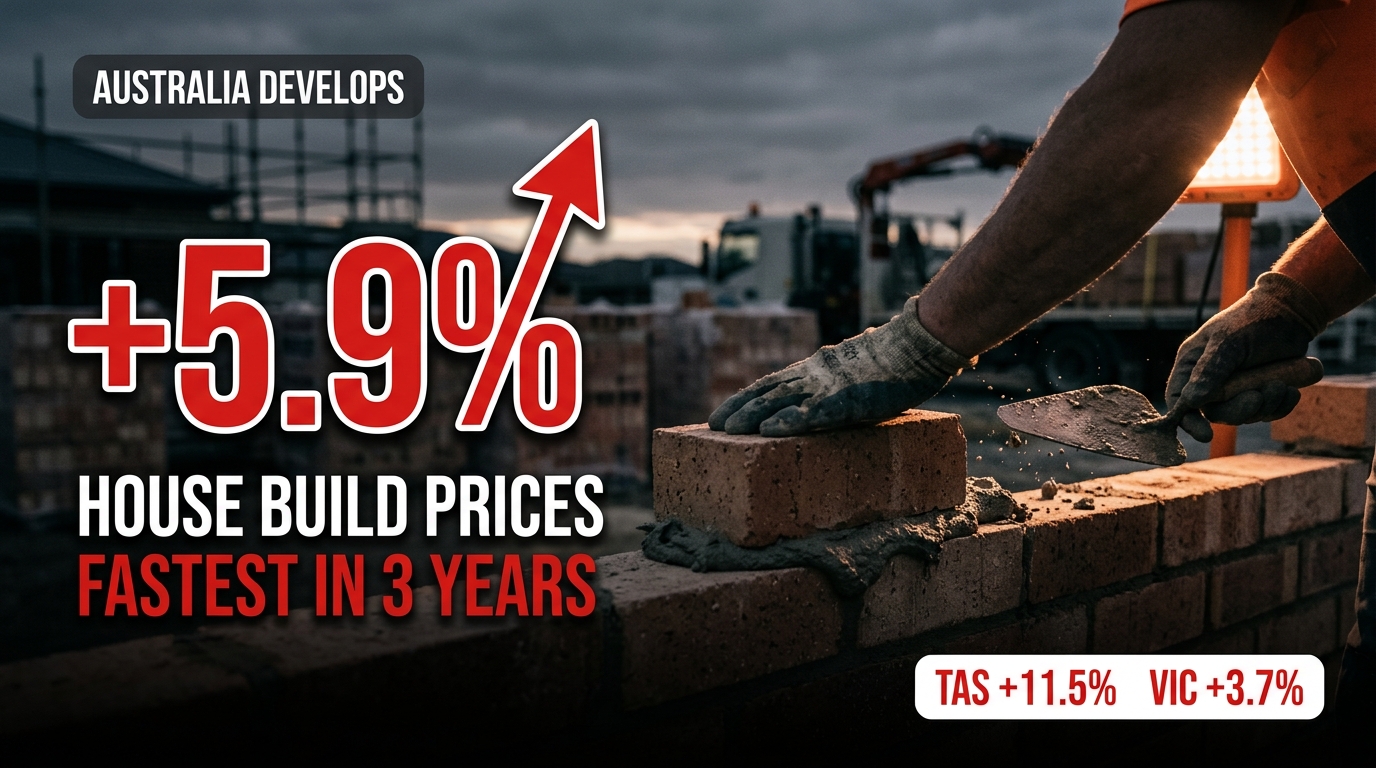
Over the year to June, prices climbed 5.9%. That’s the highest annual rise since June quarter 2023. For comparison, final demand prices across the whole economy rose 3.6% over the same year. So building a house is getting dearer faster than the average business price.
The latest data, for the September quarter 2026 (released by the ABS on 30 October 2026), shows the pace easing slightly. House construction output prices rose 1.0% in the quarter and 5.7% over the year, against 2.0% and 5.9% in June. Input costs for house construction rose 1.0% in the quarter and 3.9% over the year. Final demand prices across the whole economy rose 1.1% in the quarter and 3.6% over the year. The state figures and charts below are still for the June quarter.
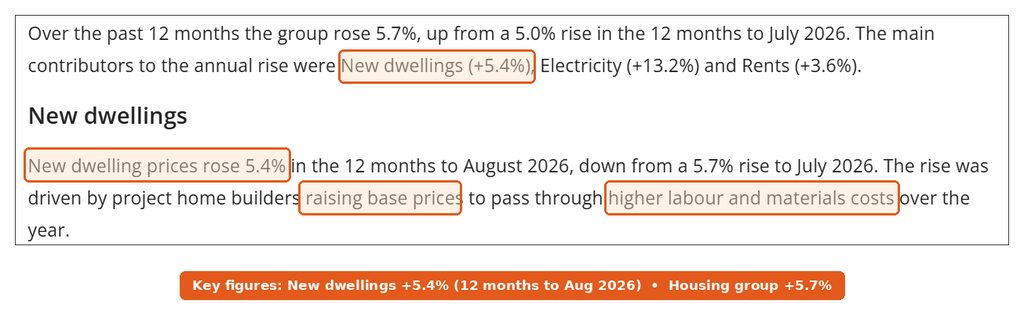
The CPI tells the same story from the buyer’s side. Its “new dwelling purchase by owner-occupiers” measure follows what households pay project home builders. The ABS monthly CPI shows new dwelling prices rose 4.7% in the 12 months to September 2026. That’s down from 5.4% in the year to August. Even so, new dwellings were one of the three main contributors to housing inflation, alongside electricity and rents.
House construction costs by state
The ABS now publishes the house construction output index by state. And the spread is wide. Here is the annual change to the June quarter 2026, with the quarterly move in brackets:
- Tasmania: 11.5% (4.7% in the quarter), the state’s biggest rise since September quarter 2022
- Western Australia: 8.8% (2.6%)
- South Australia: 8.5% (3.4%)
- Queensland: 8.0% (3.1%)
- ACT: 5.0% (2.9%)
- New South Wales: 4.8% (2.0%)
- Northern Territory: 4.6% (1.4%)
- Victoria: 3.7% (0.7%)
Two things stand out about house construction costs by state. First, the smaller and mid-sized markets are running hottest. Our read is that demand for new homes there is outrunning trade capacity. Second, Victoria is the clear laggard. Its quarterly rise of 0.7% was less than half of every other state’s. That looks like a market with less pressure on builders right now.
Sydney buyers sit in the middle. NSW rose 4.8% over the year, but 2.0% of that came in the June quarter alone. So the pace picked up sharply in autumn. The ABS named Queensland and NSW as the “driving states” this quarter.
What’s driving the rise: fuel, materials and trades
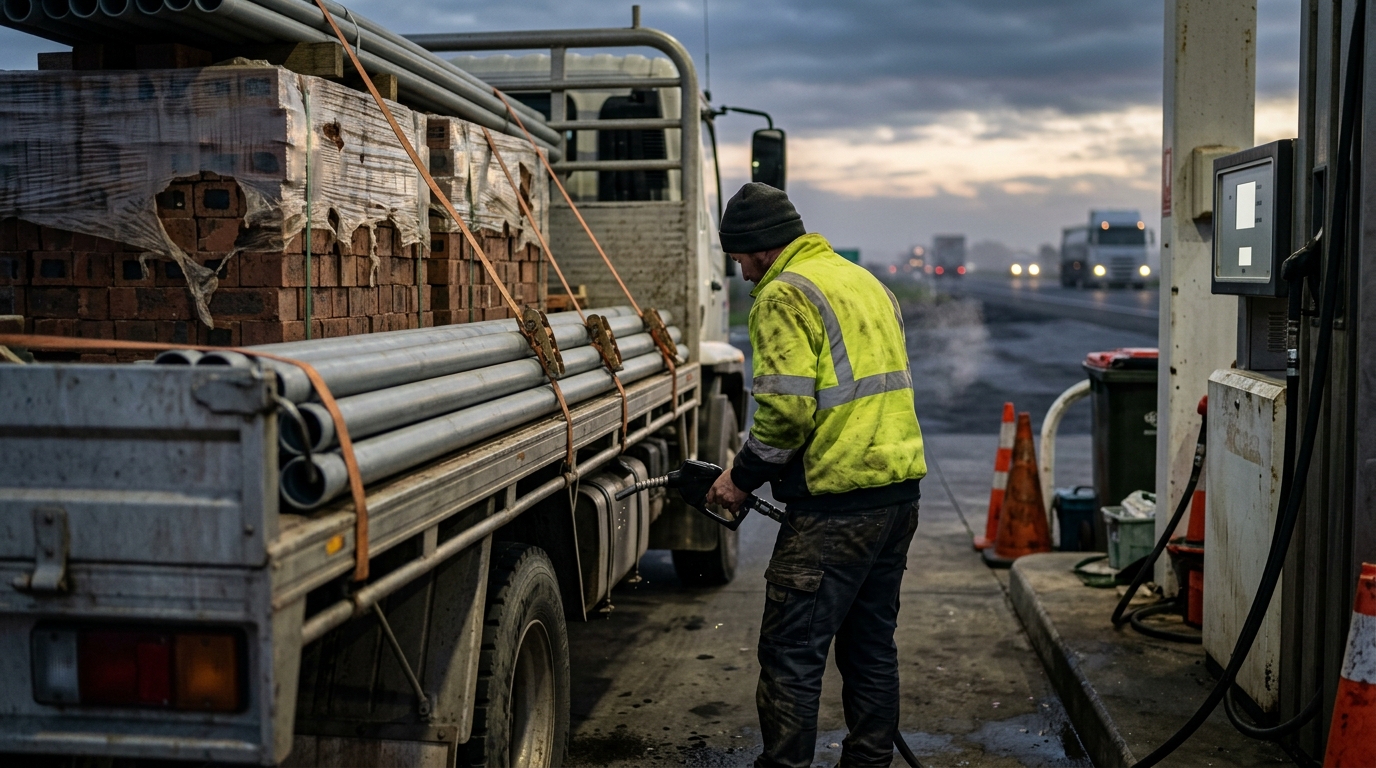
The ABS gave three clear reasons. The first is fuel. The conflict in the Middle East pushed fuel prices up in April and May. That lifted the cost of moving materials, plus anything made from petroleum, such as PVC pipe. It also caused shipping delays. Many builders passed those fuel costs straight on to customers.
The second is materials. The ABS input price index for house construction rose 2.1% in the quarter and 3.8% over the year. Metal products led the way because aluminium and steel got dearer. After that came electrical equipment, with copper and PVC costs rising.
The third is labour. The ABS says skilled labour is still hard to find, “particularly for bricklayers, carpenters and concreters”. That matters because a trades shortage doesn’t fix itself in a quarter. It takes years to train a bricklayer.
Why this isn’t 2022 again (yet)
It helps to look back. In June 2022, input costs to house construction were up 17.3% over the year. That was the peak of the post-COVID building boom. By comparison, today’s 3.8% input rise looks modest.
But the gap between inputs and outputs is the part to watch. Builders are now charging 5.9% more while paying 3.8% more for materials. Part of that gap is labour, which the input index doesn’t fully capture. Part is likely margin rebuilding after a few lean years. Either way, house construction costs as quoted to you are rising faster than the bricks and pipes behind it.
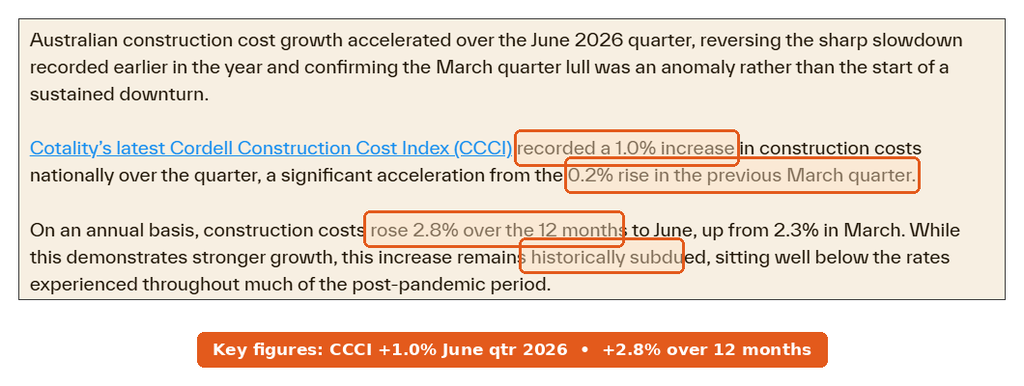
Cotality tells a calmer story. Its Cordell Construction Cost Index rose 1.0% nationally in the June quarter, up from just 0.2% in March. Over the year to June, it rose 2.8%. NSW led with 1.1% for the quarter, while Queensland, SA and WA each rose 1.0%. Victoria was again the lowest at 0.9%.
So the two sources disagree on size. The ABS says 5.9% a year, while Cotality says 2.8%. The two indexes use different methods and samples, so they rarely match. The ABS figure tracks the output prices builders charge for houses. Cotality’s John Bennett still called the March slowdown “an anomaly” rather than the start of an easing cycle. Both point the same way: up.
What rising house construction costs mean if you’re building
If you’ve bought land and plan to build, the contract matters more than the quote. Here’s what to check.
- Fixed price really means fixed. Ask whether the price can change before work starts. Some contracts let the builder re-quote if you don’t start within a set period. Read our guide to fixed-price contract exclusions in NSW before you sign.
- Watch for rise-and-fall clauses. These let the builder pass on cost increases during the build. If you see one, ask for a cap or have it removed.
- Check provisional sums and prime cost allowances. Low allowances make a quote look cheap. Then the real bill arrives as variations. So compare allowances line by line across builders.
- Price the site, not just the house. Fuel and freight hit earthworks and concrete hard. If your block slopes, see our breakdown of sloping block site costs.
- Check the builder’s track record. When costs rise, fixed-price jobs squeeze weaker builders. Run a licence and disciplinary check first.
Timing also matters. If your quote is from last year, it’s probably stale. Ask for an updated price before you commit, and get it in writing.
Are there cheaper ways to build?
Some buyers are looking at factory-built homes to dodge the trades shortage. Modular and prefab builders still pay more for steel and freight. But they rely less on bricklayers and carpenters on site. Our guide to modular, kit and transportable home costs compares the options. Still, the savings depend heavily on transport distance and site work.
What’s still missing / not confirmed
The state figures and charts above run to the June quarter. The September quarter Producer Price Indexes came out on 30 October 2026 (house construction output up 1.0% in the quarter and 5.7% over the year), and the state breakdown for September has not been reviewed here, so check the ABS release before relying on a state figure.
Nobody knows how long the fuel shock lasts, or how much of it stays in house construction costs. If fuel prices ease, freight and PVC costs should follow. But builders rarely cut base prices once they’ve raised them. The state figures also hide big local differences. Your own suburb and block can move differently from the state average. Finally, the national housing target adds pressure on trades. Our look at the 1.2 million homes target tracks the build rate against that goal. If governments push harder to catch up, demand for bricklayers and carpenters only grows.
Our take: house construction costs aren’t going back down in 2027, and we wouldn’t plan around a fall. The fuel spike may fade, but the trades shortage won’t. So if you hold land and have finance approved, locking a fixed price with a sound builder now beats waiting. Just make sure “fixed” holds up when you read the fine print.
Before you sign anything, read our guide to fixed-price contract exclusions so you know exactly what your quote leaves out.
This article is general information based on ABS Producer Price Index and Consumer Price Index releases and Cotality data available at publication. It isn’t financial or legal advice. Build prices and contract terms vary by builder and location, so get independent advice on your contract before you sign.