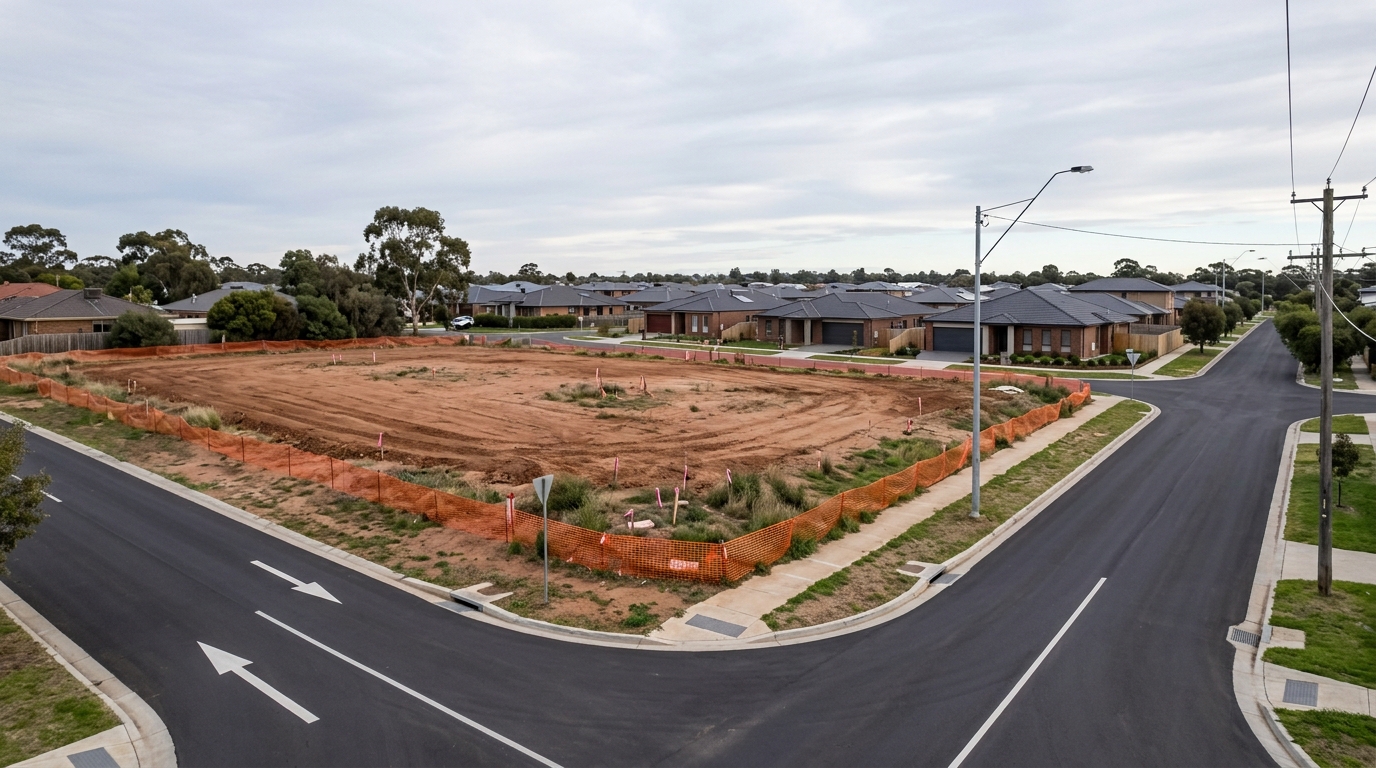
Unregistered land Australia purchases carry risks that few buyers fully understand before signing. The dream is frequently pitched by slick property marketers as a no-brainer.
It promises a slice of Australian real estate today, locking in current market prices with a modest 10% deposit.
Then, take time saving money while the developer handles the civil works.
Written by Daniel Whitfield, founder of Australia Develops, who has personally bought, subdivided, and built property across Australia.
Thousands of Australian property buyers face this decision. This is particularly true across the booming growth corridors of Western Sydney, South West Sydney, Hunter Region, and South East Queensland.
For many, buying unregistered land off the plan sounds like the ultimate sweet deal. Growth precincts such as Austral and Leppington illustrate both the opportunity and the registration-timing risk at play.
Beneath the polished master-planned estate brochures, though, unregistered land Australia contracts conceal a complex, highly volatile legal framework. Buying unregistered land is not buying a tangible piece of dirt ready to build on tomorrow.
It means buying a developer’s legal promise to create a block of land in the future.
That promise can derail due to council delays, civil construction blowouts, shifting planning laws, or developer insolvency. When it does, the buyer’s sweet property dream can rapidly morph into a financial nightmare.
—
The Short Answer: What is the Unregistered Land Trap?
> The Short Answer: Buying unregistered land means purchasing a block of land before its legal title exists. The individual lot description has not yet been formally created or registered with the state government.
The primary danger is time and volatility: because. Months or years can pass between signing the contract and final settlement.
During this time, buyers face interest rate hikes, falling bank valuations, developer bankruptcy, and contract termination via sunset clauses.
Leaving them empty-handed in a completely different property market.
—
Registration Delay Risk Snapshot
| Risk trigger | What changes for the buyer | Practical response |
|---|---|---|
| Plan registration slips by 3-6 months | Loan pre-approval can expire before settlement | Request lender policy on re-assessment and keep a finance buffer |
| Interest rates rise before title issue | Borrowing capacity may fall at settlement | Ask the broker to model higher repayment scenarios |
| Valuation comes in below contract price | Extra cash may be needed to settle | Keep savings outside the deposit and avoid maximum borrowing |
Documents To Request Before Exchange
| Document | Why it matters | Who reviews it |
|---|---|---|
| Draft deposited plan | Shows proposed lot shape, dimensions, roads and services | Solicitor or conveyancer |
| Draft Section 88B instrument | Shows easements, restrictions and positive covenants | Solicitor or conveyancer |
| Subdivision approval conditions | Shows what must happen before registration | Solicitor, planner or buyer adviser |
| Finance expiry terms | Shows whether approval survives registration delays | Broker or lender |
Understanding Unregistered Land Australia: The Core Concepts
Buyers need to safely navigate this market. Doing so requires understanding the foundational legal difference between a registered block of land and an unregistered one.
Unregistered Land Meaning
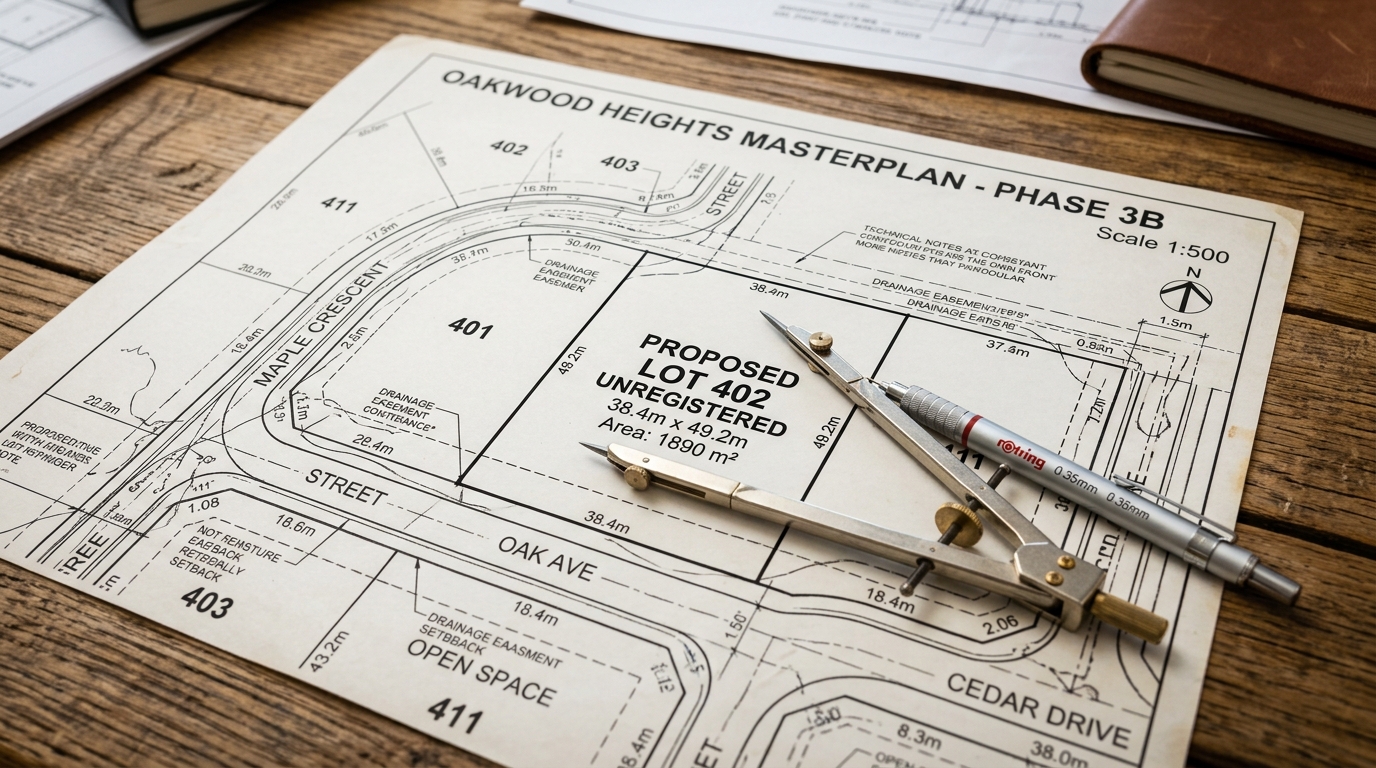
Unregistered land refers to an allotment within a proposed subdivision that exists only on a draft plan. Indeed, it does not yet possess its own distinct legal identity or reference folio at the state land titles registry.
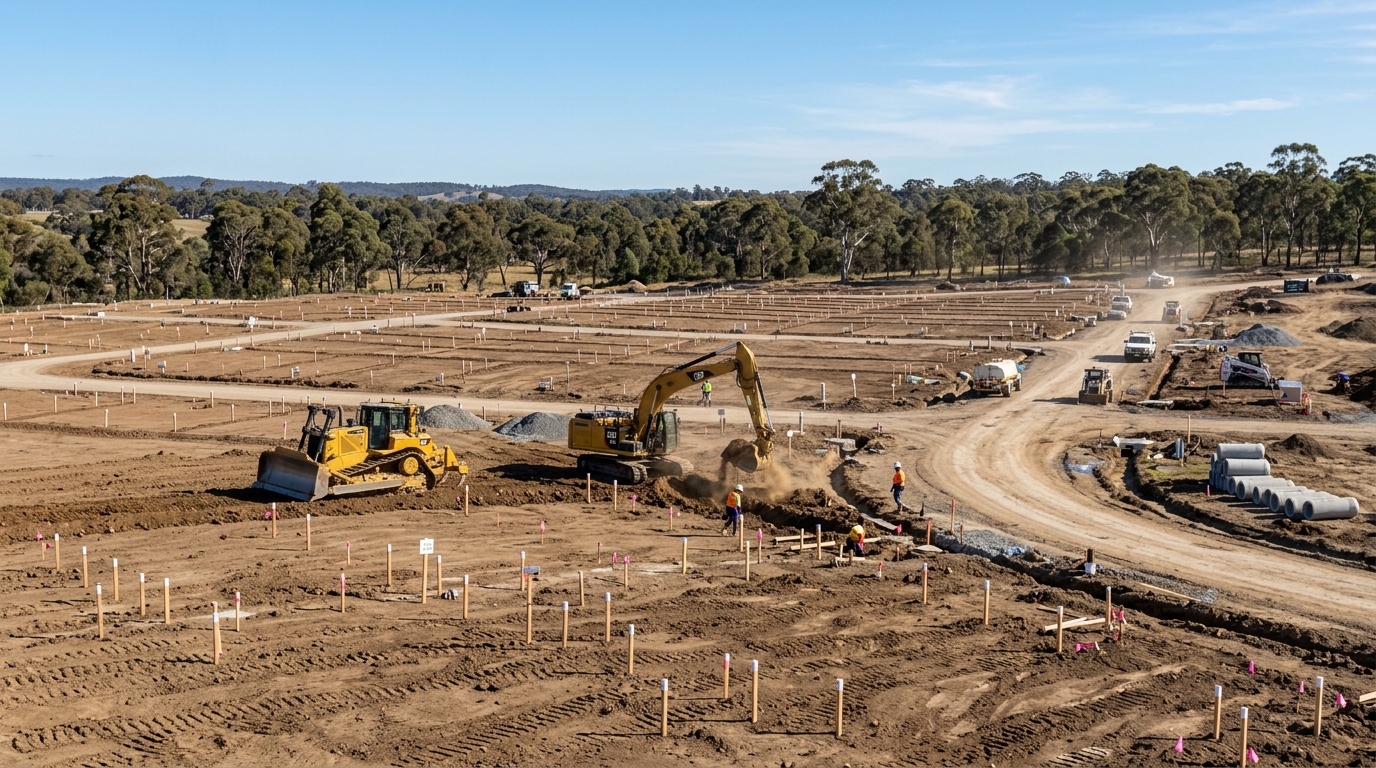
When buyers purchase it, buyers are signing an “off the plan” land contract. The vendor (developer) must legally complete civil works. Clearing vegetation, laying asphalt roads, installing electricity sub-stations, and connecting sewer lines.
Before they can apply to have the final plan registered.
Registered Land vs Unregistered Land
The practical differences between these two states affect legal rights, finance structure, and the construction timeline for the buyer.
| Feature / Metric | Registered Land | Unregistered Land |
|---|---|---|
| Legal Existence | Formally registered with state land title authority. Unique Title reference exists. | Exists only as a proposed lot number on a draft plan of subdivision. |
| Settlement Timeline | Standard 28 to 42 days from the date of contract exchange. | Delayed; usually 14 days after the developer achieves plan registration. |
| Finance Structure | Unconditional bank loan can be formally approved and settled immediately. | Conditional approval only; formal valuation and final approval occur post-registration. |
| Risk Exposure | Low. The land is ready for purchase, valuation, and immediate building approvals. | High. Subject to planning changes, developer insolvency, and sunset clauses. |
| Construction Start | Buyers can submit architectural plans to council or a private certifier immediately. | No building can commence until registration occurs and civil services are live. |
—
Why Buyers Choose Unregistered Land (The Allure)
The risks are pronounced. So why do thousands of everyday Australians still line up at estate launch days to buy unregistered allotments? The market dynamic thrives on several perceived advantages:
- Buying Time to Save: Buyers only need a 10% deposit at the initial point of contract exchange. The remaining 90% is not due until the land registers, which could be 12, 24, or even 36 months away. This gives first-home buyers an extended window to save additional cash for construction without paying interest on a massive mortgage.
- Locking in Today’s Prices: In a rapidly rising property market, securing a block at today’s fixed valuation means buyers stand to gain free equity by the time the land registers years later.
- Developer Incentives: Volume builders and developers frequently offer enticing structural rebates, landscaping packages, or stamp duty concessions to off-the-plan buyers to secure the pre-sales required to fund their construction loans.
—
The Major Risks of Unregistered Land Australia Purchases
The benefits sound appealing on paper. However, the real-world operational journey of an unregistered land development is fraught with friction points.
1. Protracted Registration Delays
Developers routinely underestimate how long civil works and government bureaucracies take. A project advertised to settle in “mid-next year” can easily stretch into the following year or beyond. Delays typically stem from:
- Unfavorable weather conditions (prolonged rain events stopping civil earthworks).
- Supply chain shortfalls for crucial infrastructure like concrete and electrical conduits.
- Protracted approval bottlenecks with local councils, water authorities, and state planning offices.
2. Finance and Valuation Expiry
This is the single biggest financial trap for everyday retail buyers. When buyers sign an unregistered land contract. The buyer’s bank cannot issue an unconditional loan approval because the security asset (the specific title) does not yet exist.
Instead, they provide a conditional approval, or an “approval in principle.”
These bank assessments typically expire within 3 to 6 months. For instance, if the land takes 18 months to register, buyers will have to re-apply for finance multiple times.
If a buyer’s personal financial situation changes in that window. A job change, parental leave, or a significant rise in interest rates. The bank may refuse to clear the loan when settlement is finally called.
3. Devastating Valuation Shortfalls
The broader property market may cool down during the buyer’s waiting period. Alternatively, the estate may fail to hit its premium targets.
Either way, the bank’s valuer may assess the land as worth less than the buyer’s agreed contract price upon registration.
For example: Contract Purchase Price: $450,000. Bank Valuation at Registration: $390,000. Shortfall to be paid by Buyer: $60,000.
Banks will only lend a set loan-to-value ratio (LVR) against the *lesser* of the purchase price or the current market valuation.
Buyers must make up that entire shortfall in cold, hard cash out of the buyer’s own pocket.
If the shortfall cannot be produced in cash, the contract goes into default, the entire 10% deposit is lost. The developer can sue for further damages.

4. Skyrocketing Interest Rates and Building Costs
A lengthy delay between exchange and settlement is common. As a result, the mortgage will likely settle in a completely different interest rate environment than the one originally planned for.
While buyers wait for the land title to register, building material and labor costs can surge. Fixed-price building contracts signed concurrently with the buyer’s land purchase often feature expiry clauses of their own.
The buyer’s land may finally register two years late. When it does, the buyer’s builder may demand an extra $50,000 to execute the build, or walk away completely.
For deeper insight into managing unexpected building budget issues, see Australia Develops’ comprehensive breakdown on Hidden building costs in Australia.
5. The Dangerous Sunset Clause Trap
A sunset clause is a vital provision in an off-the-plan contract. It sets a definitive calendar deadline by which the developer must register the final plan of subdivision.
If registration does not occur by that date, either party can theoretically rescind the contract, returning the deposit to the buyer.
Historically, some unscrupulous developers intentionally dragged their heels on civil works to trigger the sunset date, rescind the contract, return the buyer’s 10% deposit, and immediately list the exact same block back on the open market for an extra $150,000.
While legislative intervention across various states has significantly curtailed this predatory behaviour, the systemic risk remains high. If a legitimate delay occurs and the contract is rescinded, the deposit is returned.
The buyer is forced to re-enter a property market where land prices may have outpaced their savings capacity completely.
6. Forced Material Plan Changes, Easements, and Covenants
When buyers purchase unregistered land, buyers are buying based on a *proposed* plan. Therefore, during construction and council sign-off, though, things often change.
The local council or water authority might mandate that a major stormwater easement be cut directly across the buyer’s backyard to manage regional runoff.
The developer might need to alter the exact boundary dimensions, reducing the buyer’s total square meterage or shifting the orientation of the buyer’s block.
Most off-the-plan contracts contain clauses allowing the developer a margin of error (often up to 5%) in area reduction without triggering a right to compensation or rescission for the buyer.
Buyers could end up with a smaller, awkwardly shaped block that cannot accommodate the house design buyers already purchased.
To understand how land restrictions can derail the buyer’s house configuration, read Australia Develops’ detailed guide on Property Easements NSW guide.
Easements and covenants are not only a risk on unregistered land. They shape what can be built once titles do issue, including on blocks bought with subdivision in mind.
For buyers planning to subdivide a larger block into two titles, the video below breaks down dual occupancy subdivision in detail, including DA versus CDC approval pathways and real construction costs.
7. Critical Infrastructure and Services Delays
Even if the plan gets registered at the land registry, the actual connection of critical modern utilities—including underground electrical grids, mains water, sewer infrastructure, and National Broadband Network (NBN) fibre lines — can face lengthy delays.
Without active service connections, the buyer’s local council will not issue a construction certificate to begin building. Checking whether a block sits within a flood or bushfire overlay is worth doing alongside these infrastructure checks, since either can add further delay and cost.
See Australia Develops’ guide to flood and bushfire maps in Australia.
8. The Nightmare of Developer Insolvency
The civil construction sector operates on tight credit margins. If the developer encounters financial distress, goes into voluntary administration, or enters liquidation midway through civil works, the entire project grinds to an immediate halt.
Checking a builder’s licence and disciplinary history before signing is one way to screen for this risk in advance, as covered in Australia Develops’ guide to checking the worst builders in Australia.
The buyer’s deposit is generally held in a secure real estate or legal trust account. This means buyers should eventually get it back. That legal recovery process, however, can take months or years of stressful litigation.
During this time, the capital sits idle, earning minimal interest, while the property market moves out of reach.
—
The Contractual Mechanics: From Deposit to Settlement
Navigating the financial timeline of an unregistered land Australia deal requires strict discipline. The transaction unfolds across four distinct phases:
[Phase 1: Contract Exchange] -> Paid 10% Deposit (Held in Trust Account) ↓ [Phase 2. However, development Window] -> Civil Works, Council Audits, Title Creation ↓ [Phase 3.
Plan Registration] -> Government Authority Issues Individual Titles ↓ [Phase 4. Compressed Settlement] -> Strict 14-Day Window to Pay Remaining 90%
The Transaction Flow Detailed
| Stage | Action Required | Critical Pitfall to Watch For |
|---|---|---|
| 1. Deposit & Exchange | Pay holding deposit (usually 10%) into a joint trust account. Sign and exchange contracts. | Ensure the deposit is held securely in an interest-bearing trust account, not released directly to the developer for working capital. |
| 2. Development Phase | The developer carries out physical site works and seeks final council clearances. | Complete lack of communication or visibility regarding physical civil milestones. |
| 3. Plan Registration | Developer submits final plans to state land registry to create official titles. | The 14-day settlement countdown clock starts ticking the minute registration hits. |
| 4. Settlement | Pay remaining 90% via the buyer’s lender. Legal ownership transfers to the buyer’s name. | Severe delays in getting bank valuers on-site, leading to costly late-settlement penalties. |
The Compressed Settlement Pressure Cooker
Once the state land registry approves the subdivision plan, the developer’s solicitor will formally notify the buyer’s legal representative. This triggers a strict contract countdown—typically giving buyers exactly 14 days to settle the remaining 90% of the purchase price.
This period is notoriously stressful. Within these 14 days, the buyer’s bank must dispatch a physical valuer to the freshly registered plot, finalise the internal mortgage paperwork, issue formal loan documents, allow buyers time to sign them, and coordinate the digital settlement exchange.
If the buyer’s bank slips up and misses the deadline, the developer can charge steep daily penalty interest or cancel the contract entirely, keeping the buyer’s deposit.

—
State-Specific Legal Protections for Unregistered Land Australia Buyers: Focus on NSW
Because land administration is managed at the state level, statutory consumer protection safeguards depend entirely on which state the land sits in.
Sunset Clause Protections in NSW
In response to widespread developer exploitation of sunset clauses, the New South Wales Government introduced strong legislative amendments under the *Conveyancing Act 1919*.
Under these rules, a developer must give buyers at least 28 days’ written notice before attempting to rescind a contract via a sunset clause.
This notice must clearly explain why the land wasn’t registered on time and justify the proposed rescission.
More importantly, the developer cannot automatically rescind the contract unless: 1. Furthermore, the buyer explicitly gives written consent to the rescission; or 2. The developer obtains a formal order from the Supreme Court of NSW permitting the rescission.
To win a Supreme Court order, the developer must prove that the delay was outside their reasonable control and that the rescission is fair and equitable to the buyer.
This law significantly protects NSW buyers, though it does not completely eliminate the risk of a project failing for genuine reasons.
Disclosure Requirements
Developers in NSW are legally required to attach a formal Disclosure Statement to the front of the contract. This statement must clearly show:
- The proposed lot layout, site dimensions, and orientation.
- Draft plan schedules showing proposed easements or restrictive covenants.
- The sunset date and estimated construction timelines.
If the developer makes a major change to the plan during development that negatively impacts the buyer’s lot, they must notify buyers at least 21 days before settlement.
If significantly prejudiced by the alteration, the buyer may hold a statutory right to rescind the contract and claim the deposit back.
To review official state standards or verify a parcel of land, buyers can use these government portals:
- Verify formal land titles, ownership frameworks, and plan rules via the NSW Land Registry Services.
- Review broader title insurance requirements, administrative guidelines, and statutory regulations via the NSW Registrar General.
- Check regional planning rules, zoning maps, and master development requirements across local government areas on the NSW Planning Portal.
- Calculate the buyer’s upfront state tax liabilities and check concessions for off-the-plan properties via the Revenue NSW transfer duty.
- Track external corporate appointments or search for active administration actions affecting corporate property developers on the ASIC published notices.
—
Crucial Questions to Ask Before Buyers sign Any Documents
Before signing any unregistered land Australia contract, do not rely on the verbal assurances of a real estate agent or estate project manager.
Take a draft copy of the contract of sale straight to an independent property solicitor or licensed conveyancer.
Then, ask them to evaluate it using this checklist:
Questions for The buyer’s Solicitor or Conveyancer
- What is the exact definition of the Sunset Date? Is there a single realistic date, or does the contract contain clauses allowing the developer to automatically extend the sunset window due to ambiguous “inclement weather” or “unavoidable delays”?
- Can the deposit be released to the developer? Ensure the contract strictly mandates that the deposit remains safely inside an independent legal trust account until final settlement.
- What is the allowed margin of error for land area changes? Does the contract allow the developer to shrink the block size by more than 5% without offering any financial compensation?
- What are the consequences if the developer adds new easements? Can I rescind the contract if an ugly sewer main or electrical transformer box is placed directly across my primary building envelope?
Questions for The buyer’s Mortgage Broker or Bank Lender
- How long is this specific pre-approval valid for? Will my borrowing capacity be re-assessed from scratch if this estate takes more than 12 months to achieve registration?
- What is the buyer’s bank’s policy on property valuation shortfalls? Do I have access to emergency capital or alternative loan products if the final valuation comes in significantly under the agreed purchase price?
- How quickly can the buyer’s valuation team get on-site once registration occurs? Can the buyer’s internal processing teams comfortably guarantee a full unconditional loan turnaround within a tight 14-day window?
—
Alternatives to Unregistered Land Australia Contracts
If the systemic risks of buying an off-the-plan block seem too high for the buyer’s financial comfort level, buyers can explore several alternative property pathways:
- Buying Fully Registered Land: This is the cleanest route. The title exists, buyers can run an instant valuation, settle within a standard 30-day window, and start building the buyer’s home immediately.
- Established Homes: Buying an existing house eliminates construction wait times and material cost blowouts completely. If buyers are exploring cost-effective ways to add living spaces down the track, look over Australia Develops’ Granny flat NSW approval and costs.
- Prefabricated and Modular Housing: Buyers can purchase an affordable piece of regional land and install a modern factory-built home, which dramatically compresses the buyer’s build timeline. For a clear look at pricing frameworks, browse Australia Develops’ Modular homes Australia cost guide.
- Dual Occupancy Developments: Investors looking to maximize yield can target blocks optimized for multiple dwellings. Discover the zoning and planning details in Australia Develops’ Dual occupancy Australia guide.
—
Unregistered Land Australia: Final Signing Checklist
Before buyers authorise the buyer’s legal representative to exchange contracts and pay the buyer’s 10% deposit on an unregistered block of land, run through this final checklist:
- Independent Legal Review: The buyer’s independent solicitor must review every page of the contract of sale and confirm that all sunset clause adjustments offer robust consumer protection.
- Financial Stress Testing: Realistic budgeting numbers should show the mortgage remains comfortably affordable even if interest rates increase by 2.00% to 3.00% during the civil construction delay.
- Valuation Buffer Ready: An emergency cash buffer should be set aside outside of the deposit to cover a potential 10% valuation shortfall if the market cools down.
- Builder Contract Synchronisation: The buyer’s preferred builder has verified the draft plan of subdivision and confirmed that their fixed-price tender remains valid for the projected development timeline.
- Trust Account Verification: Buyers have verified that the buyer’s 10% deposit will be securely held inside a regulated legal trust account, and will never be accessible to the developer for project construction costs.
—

Summary
Buying unregistered land Australia remains a legitimate tool for experienced investors and patient home buyers looking to enter the Australian property market. It should never be approached as a simple, risk-free shortcut to wealth.
By conducting thorough due diligence, partnering with experienced property professionals, and protecting yourself with strong contract conditions, buyers can stop the sweet property dream from turning sour.
—
This article is general information only and is not financial, legal or planning advice. See the Disclaimer for details.