Stamp duty by state now varies more for first home buyers than at any point in the last decade. Since May 2025, Queensland and South Australia have charged no duty on an eligible first new home, whatever it costs. WA lifted its thresholds in May 2026, and the ACT dropped its price cap entirely on 1 July 2026. But NSW and Victoria haven’t moved their lines in years. So here is what each state charges a first home buyer right now, with a worked example for each one.
This article was produced and reviewed by the Australia Develops editorial team. See our Editorial Policy for sourcing standards and methodology.
Stamp duty by state in 2026: the thresholds at a glance
Some states say transfer duty and the ACT says conveyance duty, but the idea is the same. So when you compare stamp duty by state, look for two lines. Below the first, you pay nothing. Then up to the second, you pay a reduced amount.
- NSW. No duty on a new or existing home up to $800,000, then a concessional rate below $1 million. For vacant land, the lines are $350,000 and $450,000.
- Victoria. No duty up to $600,000, then a sliding concession up to $750,000.
- Queensland. No duty on an established home up to $700,000, with the concession gone at $800,000. A new home or vacant land to build on pays nil at any value.
- Western Australia. No duty up to $600,000 and a concessional rate up to $800,000. For vacant land, those lines are $450,000 and $550,000.
- South Australia. Full relief on a new home, an off-the-plan apartment or land to build on, regardless of value. But there’s no first home relief on an established home.

NSW: $800,000, and no change since 2023
NSW runs the First Home Buyers Assistance scheme. Under Revenue NSW’s current thresholds, a home valued at $800,000 or less is exempt. Then up to $1 million, you pay a concessional rate.
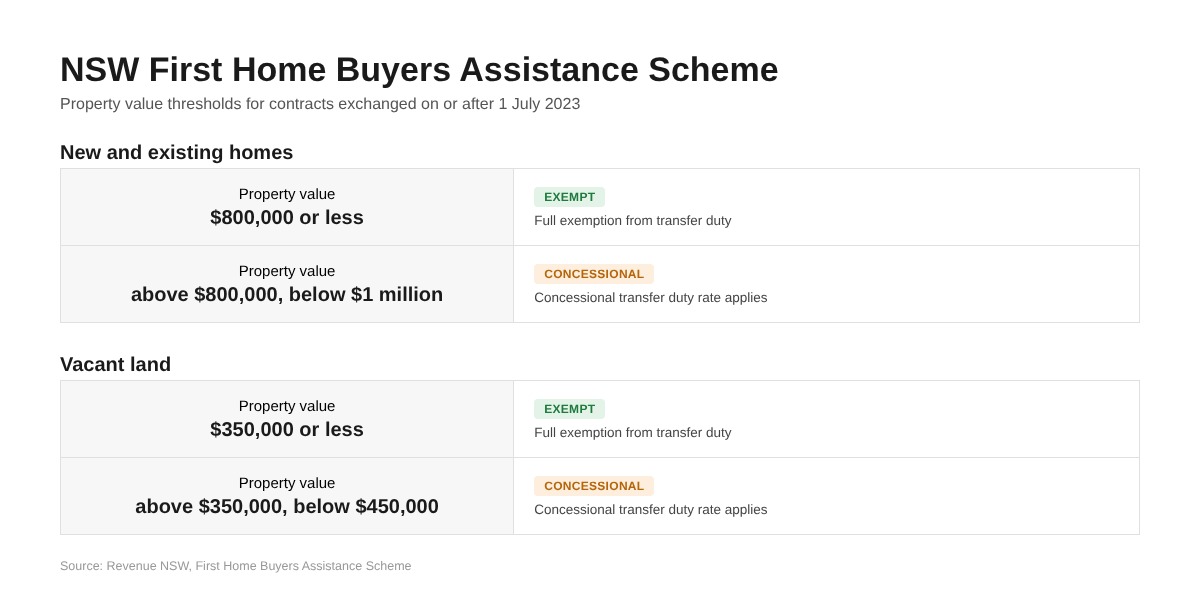
Those lines date from 1 July 2023. That’s when NSW lifted the exemption from $650,000 and the concession ceiling from $800,000. Since then, Revenue NSW has published a fresh general rate table every financial year, but the first home lines haven’t moved.

You also need to move in within 12 months of settlement and stay for at least 12 continuous months. If the home is new, the $10,000 First Home Owner Grant (New Homes) can sit on top. That grant caps the value at $600,000, or $750,000 for a house and land package with a building contract.
Victoria: the same $600,000 line since 2017
Victoria abolished duty for first home buyers on homes of $600,000 or less, with a concession that tapers out at $750,000. The government announced it in March 2017, and vic.gov.au still quotes the same two numbers today.
New homes valued at $750,000 or less can also attract the $10,000 First Home Owner Grant. Also, watch the date on the off-the-plan concession. The state extended it for contracts entered into between 21 October 2024 and 20 October 2026. That window closed the day before this article went up.
Queensland and South Australia: no cap on new homes
Queensland made the biggest move in 2025. For contracts signed on or after 1 May 2025, a first home buyer of a new build pays nil duty, and the Queensland Government says that applies “regardless of the home’s value”. The same goes for vacant land you plan to build your first home on.
Established homes still have caps, though. You get a full concession at $700,000 or less, and the concession disappears at $800,000. Yet the Queensland Revenue Office rate table keeps the full $17,350 concession up to $709,999.99. So the two official pages describe the edge slightly differently.

On top of that, the $30,000 First Home Owner Grant applies to new homes valued under $750,000, including land. Queensland says the $30,000 amount continues for eligible contracts signed from 1 July 2026. There’s no grant for an established home.
South Australia goes further on value but narrower on property type. For contracts from 13 February 2025, RevenueSA gives full relief “regardless of the property value” on a new home, an off-the-plan apartment or land to build on. Yet an established home gets no first home relief at all. The First Home Owner Grant of up to $15,000 also has no value cap for contracts from 6 June 2024.
Stamp duty by state: WA lifted its thresholds in May 2026
Western Australia’s 2026-27 Budget raised the first home owner rate thresholds for transactions from 7 May 2026. Now, RevenueWA’s summary of the package says no duty applies to new or established homes up to $600,000, up from $500,000. A concessional rate then runs to $800,000, up from $700,000. For vacant land, the lines rose to $450,000 and $550,000.

The same package lifted the grant cap south of the 26th parallel from $750,000 to $800,000. Before May, WA used different thresholds for Perth and Peel than for the regions. Now one set applies statewide. The government puts the saving at up to $22,515 when buying a home, and up to $25,390 when building one.
Tasmania, the ACT and the NT
The ACT is now the most generous. From 1 July 2026, its Home Buyer Concession Scheme has no income threshold and no property value limit. So an eligible buyer pays $0 duty on a home or vacant land. It isn’t strictly a first home scheme, but you can’t have held a property interest in the previous five years, and you must live in the home for at least a year.
Tasmania went the other way. Its 100% exemption on established first homes up to $750,000 ran from 18 February 2024, but it isn’t available for transactions settling after 30 June 2026. Its First Home Owner Grant also fell from $30,000 to $20,000 for transactions from 1 July 2026. Up north, the NT’s HomeGrown Territory Grant offers up to $50,000 for new homes from 1 October 2024 to 30 September 2027.
Stamp duty by state: worked examples
These examples assume you meet every eligibility rule, so run the official calculator before you sign.
- NSW, $800,000 existing home. You pay $0. By contrast, Revenue NSW’s 2026-27 general rates work out to $30,187 at that price ($11,602 plus $4.50 per $100 over $387,000).
- Victoria, $600,000 apartment. You pay $0. But at $750,000 or more, the concession is gone and you pay full duty.
- Queensland, $700,000 established house. The home concession rate gives $17,350, and the first home concession takes off $17,350. So you pay nil. Buy a $720,000 new build instead and you still pay nil, plus you can claim the $30,000 grant.
- WA, $700,000 established house. The first home rate charges $16.15 per $100 above $600,000. That’s $16,150.
- SA, $650,000 new house and land. You pay $0 and can claim up to $15,000 in grant money. Buy an established home at the same price, though, and you pay full duty.
Duty is only one part of the upfront bill. If your deposit is the bigger hurdle, the 5% deposit scheme and the Help to Buy shared equity scheme both work alongside these concessions. Also, if you carry a study loan, check how HECS debt affects your borrowing power first.
Stamp duty by state: what’s still missing or not confirmed
- Victoria’s off-the-plan concession. The published end date was 20 October 2026. No extension was found on the official page.
- Victoria’s concession formula. The State Revenue Office calculation page could not be loaded. So no dollar figure is shown between $600,000 and $750,000.
- NT stamp duty. The HomeGrown grant was confirmed, but not the current NT duty concessions. So check those with the Territory Revenue Office.
- Tasmania after 30 June 2026. No replacement was found for the established home exemption.
Editorial take: the real story is indexation. Queensland, South Australia, WA and the ACT have all moved their rules since early 2025. Victoria, though, still uses a $600,000 line it announced in 2017, and NSW’s $800,000 line hasn’t changed since 2023. A line that never moves covers less of the market every time prices rise. A first home buyer in either city should assume the concession covers an apartment or an outer-ring house and land package, and plan for full duty on anything else.
Also, Queensland and South Australia now reward buying new over buying established. That pushes first home buyers towards growth-area estates. But the same buyer can pay nil on a new townhouse and full duty on an older one down the street.
Still deciding whether to buy in NSW this year? Then read the take on whether to buy now or wait in 2026.
Related guide: Land Tax by State: Thresholds, Rates and a $700k Test
This article is general information based on Revenue NSW, Victorian Government, Queensland Government, RevenueWA, RevenueSA, ACT Revenue Office, State Revenue Office Tasmania and NT Treasury pages available at publication. It isn’t financial or legal advice. Thresholds, grants and eligibility rules change often, so check current details with your state revenue office and conveyancer before you sign a contract.