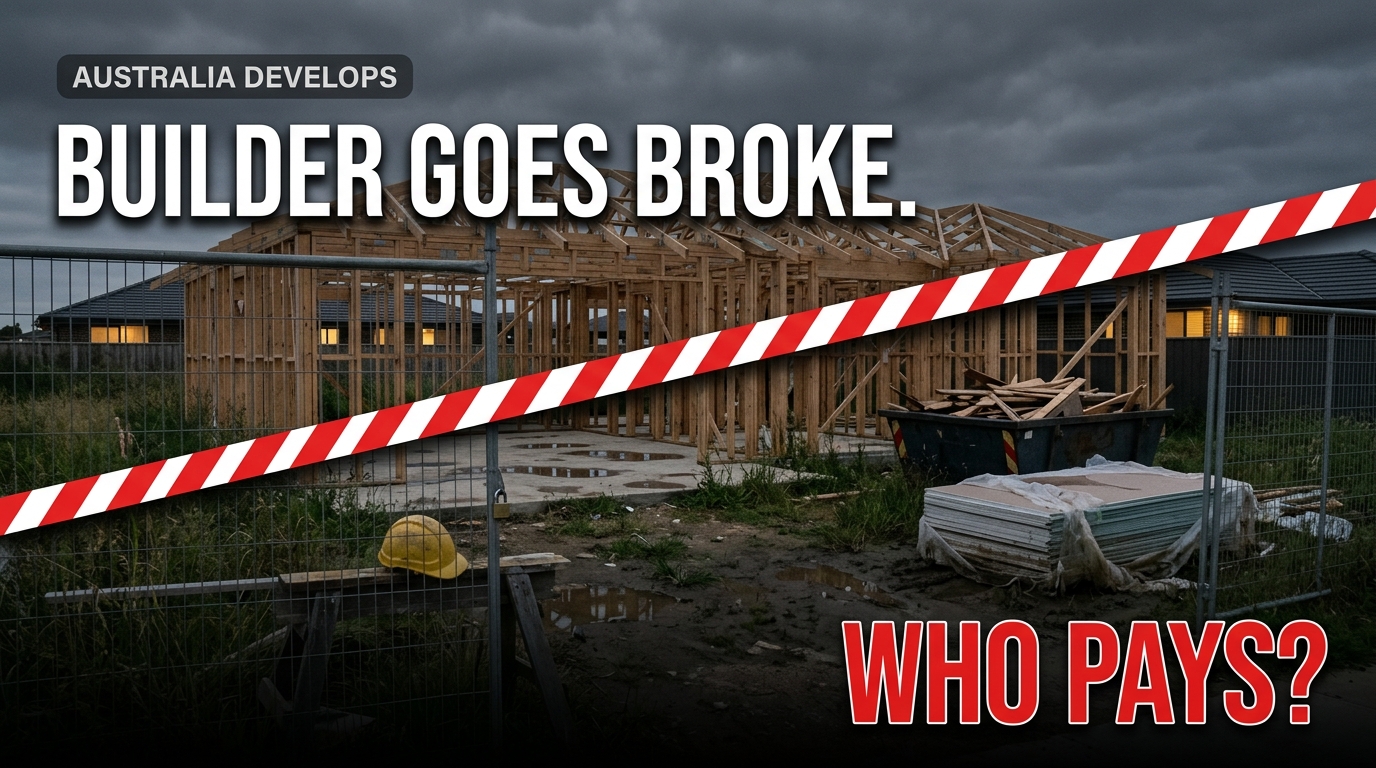
Home building warranty insurance is the safety net most buyers never read until something breaks. Every state runs its own scheme, with its own trigger, cap and time limit. And in 2026 the map shifted. Victoria switched to a first-resort scheme on 1 July, and South Australia lifted its cap. So here is how each scheme works, what it pays, and how to check a certificate first.
This article was produced and reviewed by the Australia Develops editorial team. See our Editorial Policy for sourcing standards and methodology.
How home building warranty insurance works
Your builder buys the policy, but you are the one it protects. The builder pays the premium and passes the cost through in your contract. In return, the policy covers you for lost deposits, unfinished work and defects. It also stays with the house if you sell it during the cover period.
The big difference between states is when you can claim. Most schemes are “last resort”. That means you can only claim if the builder dies, disappears or goes broke. Some states add a licence suspension. By contrast, a first-resort scheme lets you claim when the builder simply won’t finish or won’t fix defects. Until this year, Queensland stood alone here. The QBCC has made the same point itself: in most other states you have to wait until the builder has died, gone broke or can’t be contacted. Victoria has now joined it.

NSW: Home Building Compensation (HBC) via icare
In NSW the scheme is called home building compensation, and icare runs the Home Building Compensation Fund. Builders and trades must buy cover for work over $20,000 (including GST). That covers new homes, apartment buildings up to three storeys, renovations and swimming pools. The certificate must reach you before the builder asks for any payment, including the deposit.
- Cap: up to $340,000, with limits on some items.
- Defects: 6 years for major defects and 2 years for other losses.
- Deposit and unfinished work: 12 months after the builder fails to start or stops work.
- Trigger: last resort. The builder must have died, gone broke or disappeared. A licence suspension for ignoring a money order in your favour also counts.
Check every certificate on the SIRA HBC Check register. It shows whether the certificate is genuine and whether the insurer has paid any claims on it.

VIC: the new first-resort Home Warranty scheme
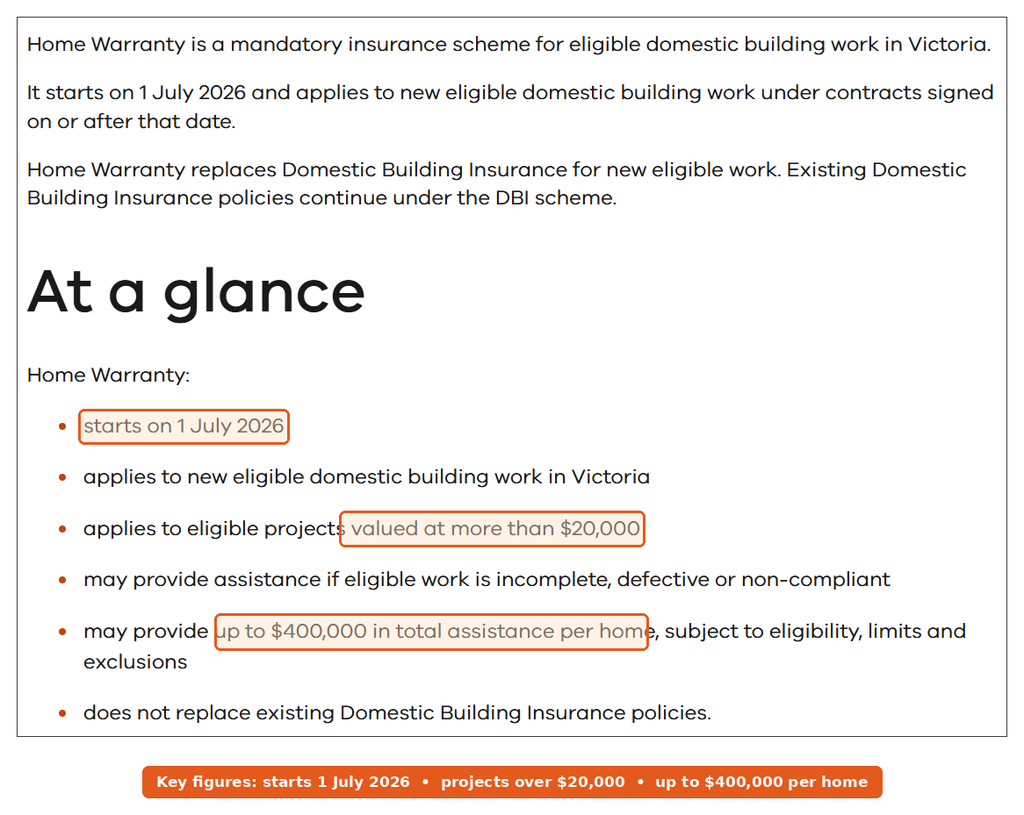
Victoria changed the most this year. First, Domestic Building Insurance moved from the VMIA to the Building and Plumbing Commission (BPC) on 1 July 2025. Then a new scheme called Home Warranty started on 1 July 2026. It applies to contracts signed on or after that date. Older DBI policies still run under the old rules.
- Threshold: eligible projects valued at more than $20,000, three storeys or less. The old DBI threshold was $16,000.
- Cap: up to $400,000 in total assistance per home. Within that, incomplete work has a cap of 30% of the contract price.
- Defects: up to 6 years for major defects (structural, waterproofing, weatherproofing) and 2 years for other defects.
- Trigger: first resort. You still need to try to sort it out with your builder first, unless that step isn’t required.
For older DBI policies, the rules haven’t changed. Cover is up to $300,000, with 6 years for structural faults and 2 years for non-structural faults. But you can only claim if the builder dies, goes broke, disappears or ignores a final VCAT or court order. On new contracts, look for the Notice of Cover. You can also search a property on the BPC Home Warranty page.
QLD: home building warranty insurance as first resort
Queensland has the lowest threshold in the country. The QBCC itself insures the work, and cover is compulsory for residential construction work valued at more than $3,300. That figure includes materials, labour and GST. So the scheme usually covers even a modest bathroom job.
- Cap: up to a maximum of $200,000 on claims.
- Structural defects: 6 years and 6 months, from the earliest of the contract date, premium payment or start of work.
- Non-structural defects: you must lodge a complaint within 7 months of noticing the defect to keep your claim alive.
- Trigger: first resort. You can claim if the contractor won’t or can’t finish, doesn’t fix defects, or the home suffers subsidence.
There’s one catch for cost-plus contracts. The QBCC explains that they only cover defective work, not non-completion. That’s because the QBCC needs a fixed price to settle a non-completion claim. You can also search whether a property already has cover attached.

WA, SA and the smaller jurisdictions
Western Australia calls it Home Indemnity Insurance (HII). It’s mandatory for residential building work of $20,000 or more. Cover runs during construction and for six years after practical completion. Then again, it only pays if the builder dies, disappears or goes broke. In October 2022 the WA Government announced caps of $200,000 for incomplete or defective work and $40,000 for lost deposits. QBE is the main insurer, and it keeps a certificate register you can check.
South Australia has Building Indemnity Insurance. From 10 November 2025 the threshold rose from $12,000 to $20,000 for work that needs council approval. Also, new QBE policies from 1 October 2025 carry a $250,000 limit, up from $150,000. Defect claims run up to 5 years after completion. But the builder must have died, disappeared or gone broke. QBE runs a certificate register covering the last 10 years.
- ACT: residential building insurance or a fidelity certificate. Cover runs 6 years for structural work and 2 years for other work. The maximum is $85,000 of insurable work plus $10,000 for a deposit.
- NT: a fidelity fund certificate. The threshold rose from $12,000 to $25,000 on 30 March 2026. Structural defects get 6 years and non-structural defects one year. It pays if the builder goes bankrupt, dies, disappears or has their registration cancelled.
- TAS: no mandatory scheme for now. In August 2024 the government said it would bring one back for contracts over $20,000, aiming for mid-2025.
What home building warranty insurance won’t cover
Every home building warranty insurance scheme has gaps, and they catch people out.
- Owner-builder work. In NSW you don’t need cover for work you do yourself, so that work stays uninsured. If you sell within 7 years and 6 months, the contract must carry a consumer warning. Queensland requires a written notice for owner-builder work done in the last 6 years.
- Plans and preparation fees. NSW says upfront payments for plans are generally not covered. WA says a Preparation of Plans Agreement falls outside HII and is often non-refundable.
- Work below the threshold. A $15,000 renovation in NSW has no cover at all.
- Wear and tear, upkeep and unregistered builders. Victoria’s scheme excludes cosmetic differences, fair wear and tear, vandalism or theft, neglected maintenance, and work by unregistered builders.
- Late claims. Miss a deadline, such as South Australia’s five years or Queensland’s 7-month window for non-structural defects, and the claim fails.
Checklist before you pay a deposit
- Get the certificate or Notice of Cover before you pay anything.
- Search the number on the state register. That’s HBC Check in NSW, the BPC search in Victoria, QBCC in Queensland, or QBE in WA and SA.
- Then match the builder’s name, ABN and site address to your contract.
- Also check the insured contract value against your contract price.
- Confirm the builder’s licence is current. Our builder licence check guide shows how.
- Keep the deposit within the legal limit, such as 10% in NSW.
- Finally, store a copy of the certificate with your contract. You’ll need it if you sell.

What’s still missing or not confirmed
A few points don’t line up across official pages. In South Australia, the SA Government page now quotes $20,000, but another SAFA page still says $12,000 and $150,000. Go by the newer figures, but check your certificate. In WA, the October 2022 statement set the new caps “as soon as possible” without a start date. I also couldn’t find a confirmed start date for Tasmania’s new scheme, so check with CBOS before you sign there. And Victoria’s new scheme is only three months old, so claim handling still has no track record.
My take: the cap matters less than the trigger. A $340,000 last-resort policy in NSW won’t help you while a solvent builder simply drags out repairs. Queensland and now Victoria let you act early, and that is worth more than any headline number. So in a last-resort state, pick a builder that looks solid and keep progress payments tight. Treat the policy as a backup for the worst case only.
Before you sign, read up on fixed-price contract exclusions, and budget for sloping block site costs and stamp duty by state.
This article is general information based on SIRA, icare, Building and Plumbing Commission, QBCC, WA Government, SAFA and other state government pages available at publication. It isn’t legal or insurance advice. Thresholds, caps and claim rules change, so check your own policy and the current scheme rules before you sign or pay a deposit.