Property Easements NSW 2026 is a core due diligence issue for residential land buyers. An easement can reduce usable land, restrict new buildings, and trigger costly legal disputes.
Importantly, an easement does not transfer ownership. Instead, it gives another party a legal right to use part of the land for a defined purpose.

Quick Answer: What Is an Easement in NSW?
An easement is a registered land-title right allowing limited use of another person’s land.
| Metric | Data |
|---|---|
| Main legal effect | Right to use part of land without ownership |
| Common purposes | Access, drainage, sewer, electricity, support |
| Typical buyer risk | Reduced buildable area and higher construction cost |
| Potential value impact | 15% to 20% reduction during active disputes |
In NSW, easements usually appear on the land title, Deposited Plan, or Section 88B Instrument. However, some utility assets may also appear in Sydney Water or Before You Dig Australia records.
Therefore, a clear title review alone may not be enough. A buyer also needs utility searches, survey checks, and legal advice before exchange.
Legal Foundation of Easements in New South Wales
NSW easements operate mainly under the Conveyancing Act 1919 and Real Property Act 1900.
| Legal concept | Meaning |
|---|---|
| Dominant tenement | Land that benefits from the easement |
| Servient tenement | Land burdened by the easement |
| Easement in gross | Easement benefiting an authority, not another parcel |
| Runs with the land | Easement binds future owners after registration |
A standard private easement usually requires two separate parcels. The benefited land is the dominant tenement. The burdened land is the servient tenement.
However, public authorities can hold easements in gross. Sydney Water, Ausgrid, and councils commonly use these rights for essential infrastructure.
Additionally, modern subdivisions often create easements through a Section 88B Instrument. This document states the terms, affected lots, and maintenance obligations.
An easement differs from a covenant. A covenant usually restricts land use, building form, or design. By contrast, an easement gives another party a specific access, drainage, utility, or support right.
Main Easement Types Found on NSW Residential Land
Most residential easements fall into access, drainage, sewer, utility, support, or environmental categories.
| Easement type | Common effect |
|---|---|
| Right of carriageway | Vehicle access across a defined strip |
| Stormwater easement | Drainage pipes, pits, or overland flow paths |
| Sewer easement | Sydney Water or council wastewater assets |
| Utility easement | Electricity, gas, fibre, or telecom corridors |
| Support easement | Protection for retaining walls, party walls, or excavations |
| Conservation easement | Environmental or heritage restrictions |
1. Right of Carriageway and Right of Way
A right of carriageway allows vehicle access across a defined strip of another property. It often supports rear lots, battle-axe lots, or landlocked parcels.
The regulation is practical and strict. The burdened owner cannot block, narrow, fence, gate, park over, landscape over, or store materials on the access strip if that prevents reasonable use.
Additionally, the owner usually cannot change the surface level or drainage pattern if that makes access harder. Any new driveway, retaining wall, landscaping edge, bin enclosure, or garage entry should be checked against the registered easement plan.
Maintenance is another risk point. The Section 88B Instrument or easement terms may allocate repair costs. If the terms are unclear, disputes often arise over resurfacing, potholes, stormwater runoff, lighting, gates, and shared driveway wear.
For buyers, the key test is simple. The land may be owned, but the access corridor must remain usable by the benefited land.

2. Easement to Drain Water (Stormwater Easement)
A stormwater easement allows water to pass through private land toward lawful drainage infrastructure.
Notably, stormwater easements matter in sloping Sydney suburbs. Water often needs to travel downhill through a lower property to reach a lawful discharge point.
The regulated area can include pipes, pits, grated drains, open channels, and overland flow paths. The burdened owner usually cannot build permanent structures over this corridor. They also cannot place fill, retaining walls, garden beds, or paving that blocks water flow.
Council drainage approval can also become relevant. If a redevelopment needs to connect to a downstream easement, the owner may need engineering plans, hydraulic design, and Section 68 approval under the Local Government Act pathway.
The NSW Supreme Court decision in McLennan v Ng [2025] NSWSC 1429 confirmed strong drainage rights. The dominant owner may have ancillary rights to enter, excavate, upgrade pipes, and install drainage pits.
Therefore, a lower owner may not be able to refuse necessary drainage works. This can affect landscaping, privacy, levels, future pools, granny flats, and backyard structures.
The buyer risk is not only the pipe location. The real issue is access for future maintenance. Even a neat backyard may need to be opened if the asset fails or needs upgrading.
3. Easement to Drain Sewage (Sewer Easement)
A sewer easement protects wastewater assets and maintenance access.
Sydney Water, Hunter Water, and councils can require clear access to sewer mains, maintenance shafts, junctions, and inspection points. Under utility rules, owners must protect the asset and allow access for maintenance crews.
The restrictions are usually tighter than buyers expect. Permanent structures, concrete slabs, pools, retaining walls, deep-root trees, large decks, and heavy landscaping are commonly prohibited over the sewer zone.
In addition, nearby building work can trigger Building Over Sewer approval. The approval may require engineering drawings, piering, concrete encasement, access openings, or asset relocation.
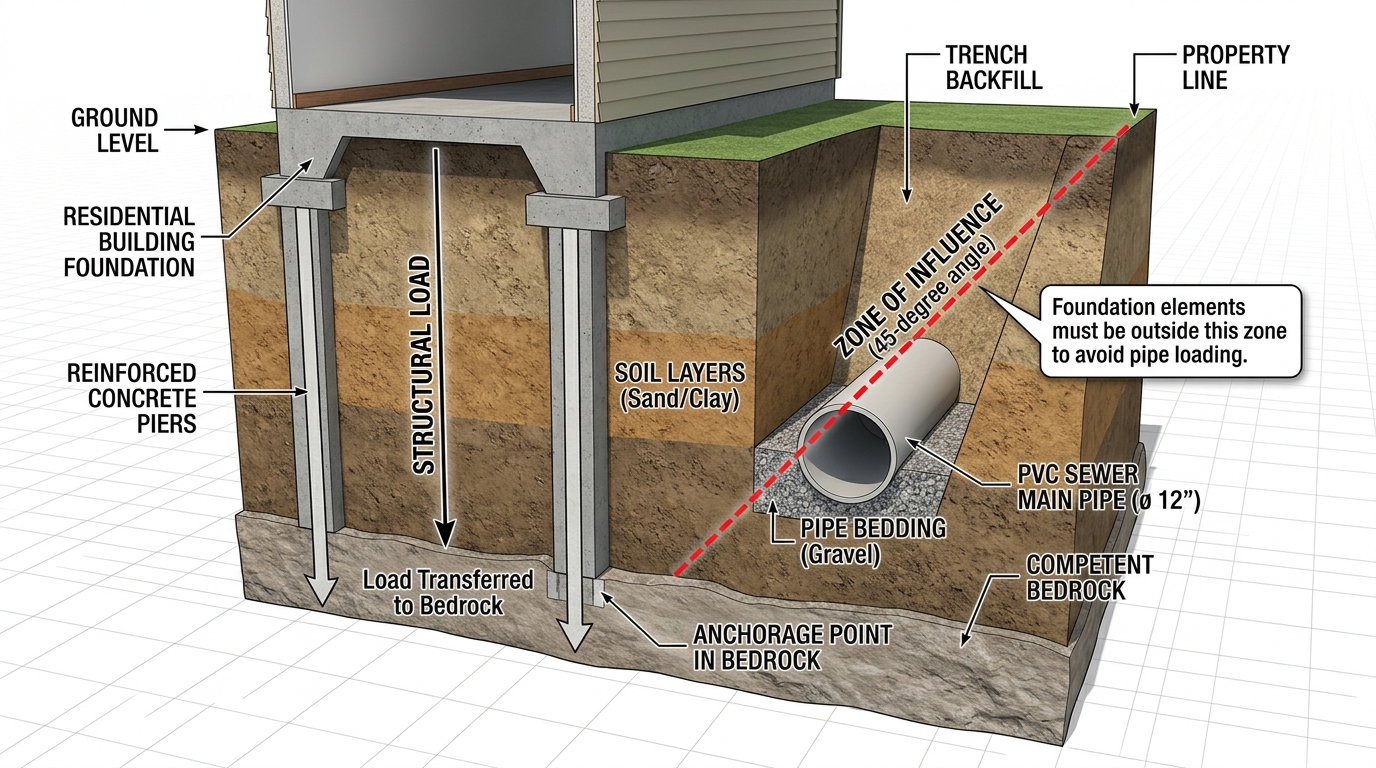
The zone of influence is the most expensive detail. If a proposed footing loads the sewer pipe, Sydney Water may require deep piers below the pipe depth. This can turn a standard slab into a much more expensive engineered footing system.
Consequently, a sewer easement can affect more than the strip shown on the plan. The asset depth, pipe diameter, maintenance access, and foundation loading path all matter.
4. Services and Utility Easements
Utility easements protect electricity, gas, telecommunications, and fibre infrastructure.
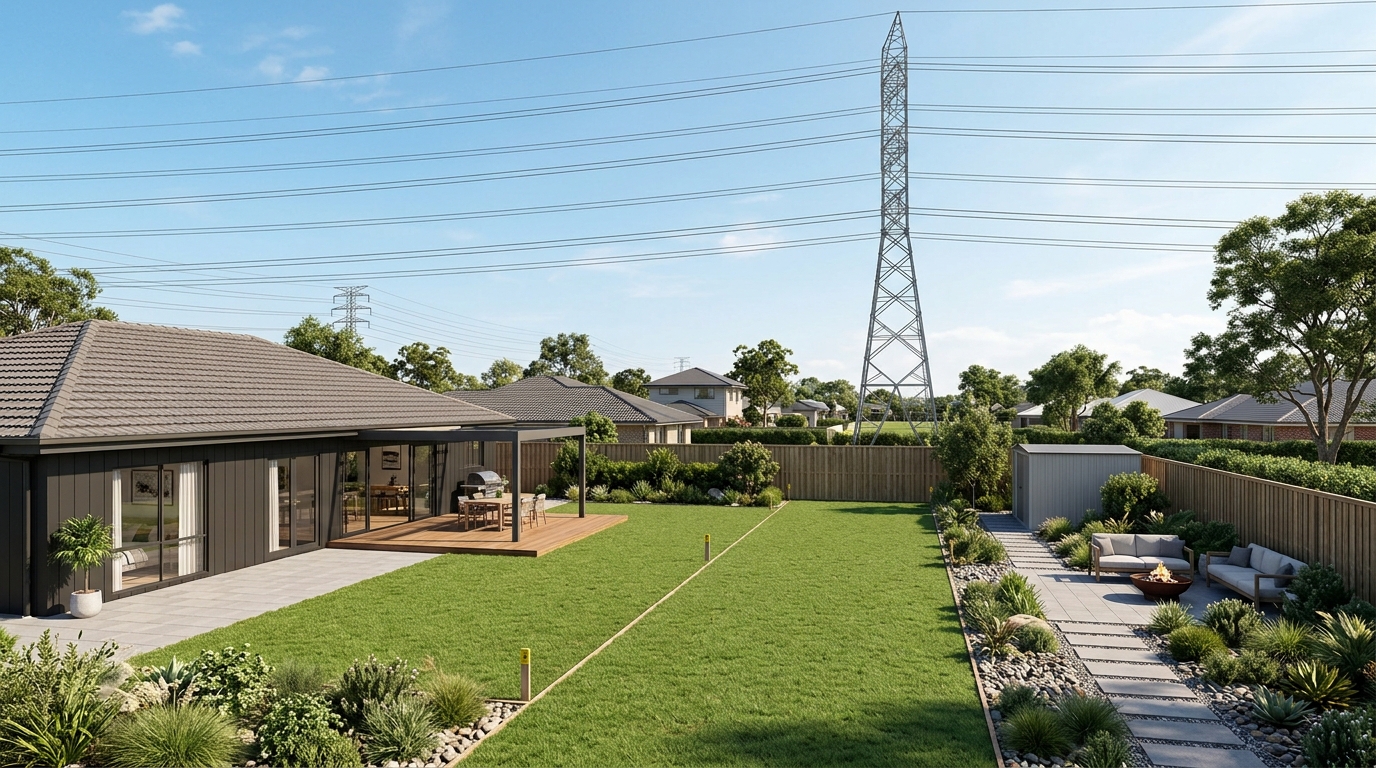
Ausgrid and other network operators often require strict clearance zones. For example, overhead powerline corridors can prevent sheds, pools, carports, pergolas, trees, and overhanging structures.
Electricity easements can regulate both horizontal and vertical clearance. This means a structure may be unacceptable even if it does not touch the line. Safe working distance, future maintenance access, and emergency access also matter.
Gas and telecommunications easements create different risks. Excavation, fencing posts, driveways, retaining walls, and tree planting may require asset owner approval. Damage to these services can create repair liability and safety risk.
For buyers, the key question is whether the easement crosses the future building envelope. A utility easement at the front boundary may be manageable. A diagonal corridor across the middle of the lot can materially reduce development potential.
5. Easement for Support and Encroachment
Support easements protect adjoining land, party walls, retaining structures, or excavations.
The restriction is mainly about structural stability. A landowner cannot excavate, cut, surcharge, or alter ground support in a way that undermines the benefited land or structure.
This is common around retaining walls, attached dwellings, terraces, basements, and subdivided buildings. It can also appear where eaves, gutters, footings, services, or walls encroach across a boundary.
Development work may need structural engineering certification. In practice, this can affect basement excavation, boundary walls, pool excavation, retaining walls, and knockdown-rebuild projects.
Further Reading and Official Resources
Use these related Australia Develops guides and official resources to check approvals, title constraints and infrastructure risks before committing to a site.
Related Australia Develops Guides
- How to Build a Granny Flat in NSW 2026
- Dual Occupancy Australia 2026
- Austral Precinct Development 2026
- Leppington Development Pipeline 2026
Official Easement and Utility Resources
- NSW Land Registry Services
- NSW Registrar General easements guidance
- Conveyancing Act 1919 NSW
- Sydney Water building over or next to assets
- Before You Dig Australia
6. Specialized and Modern Easements
Specialized easements regulate airspace, underground levels, environmental land, light, access, or hidden structures.
Easements limited in stratum apply to a defined height or depth. They can protect tunnels, underground services, basements, air rights, or infrastructure corridors.
Light and air easements can restrict nearby building mass. Conservation easements can limit clearing, earthworks, fencing, subdivision, or development across sensitive land.
Additionally, easements over physical structures can preserve access to hidden or underground assets. These rights may look minor on a plan, but they can still block pools, granny flats, extensions, or multi-dwelling designs.
Overall, each easement should be read as a live development control. The label matters, but the registered terms, plan dimensions, asset owner rules, and physical location matter more.
Buyer Risks: Buildable Area, Cost, and Resale Value
An easement can reduce the practical building envelope before design work begins.
| Risk category | Typical effect |
|---|---|
| Buildable area | Easement strip may become unusable for structures |
| Design flexibility | Standard project-home layouts may not fit |
| Engineering cost | Deep piers may replace standard slabs |
| Resale value | Active disputes can reduce buyer demand |
For instance, a 1,000 sqm residential lot may contain a four-metre-wide drainage easement along a 50-metre boundary. That single easement removes 200 sqm from the practical building area.
Consequently, site coverage and setbacks can change quickly. A planned duplex, granny flat, pool, or larger detached home may become difficult.
The issue also connects with broader NSW housing supply. For related development rules, Australia Develops has also covered dual occupancy approvals and subdivision costs in Australia.
Zone of Influence: Why Easements Increase Construction Costs
The zone of influence can force deeper foundations near underground pipes.
| Asset | Common constraint |
|---|---|
| Sewer pipe | Foundation loads must avoid pipe impact |
| Stormwater pipe | Excavation and ground levels may be restricted |
| Electricity corridor | Horizontal and vertical clearances may apply |
| Gas or fibre asset | Utility operator consent may be required |
Utility providers often apply a 45-degree zone of influence from the pipe invert. If a proposed footing sits inside that zone, normal foundation design may not be accepted.
Instead, engineers may require deep concrete piers below the pipe depth. Importantly, this can add $20,000 to $100,000+ to residential construction budgets.
| Asset class | Minimum horizontal clearance | Prohibited activities |
|---|---|---|
| Sewer pipes | Often 600 mm to 1,000 mm, depending on asset | Slabs, pools, retaining walls, permanent structures |
| Stormwater drainage | Often around 1.0 m from pipe or channel | Ground-level changes and blocked flow paths |
| Electricity lines | Operator-specific clearance corridor | Sheds, pools, buildings, storage, overhangs |
Overall, this is where commercial real estate yields and residential feasibility can move sharply. The same legal strip can alter land value, holding cost, design risk, and exit pricing.
Easement Disputes and Section 88K Court Pathways
NSW easement disputes often involve access, utilities, stormwater, or development consent conditions.
| Dispute metric | Data value or range |
|---|---|
| Transactions with easement conflict | About 12% |
| Escalation to court | About 7% of easement conflicts |
| Average complex resolution time | 18 to 24 months |
| Legal cost range | $30,000 to $250,000+ |
| Value reduction during dispute | 15% to 20% |
Right-of-way disputes commonly involve blocked driveways or maintenance costs. Meanwhile, stormwater disputes often arise when an uphill redevelopment needs drainage through a lower lot.
Section 88K of the Conveyancing Act 1919 allows the Supreme Court of NSW to impose an easement in some cases. The applicant must show reasonable necessity, public-interest consistency, proper conduct, and fair compensation.
The court does not require absolute necessity. However, the proposed easement must make the development substantially preferable.
Notably, the court can reject excessive proposals. In Aussie Skips Recycling Pty Ltd v Strathfield Municipal Council [2020] NSWCA 292, the proposed burden affected too much of the servient land.
Institutional investment infrastructure decisions also rely on these risk controls. Easement uncertainty can affect project timing, financing assumptions, and acquisition pricing.
Council Release, Relocation, and Marriage Value Risk
Old council easements can become expensive when a developer seeks release or relocation.
| Issue | Practical effect |
|---|---|
| Easement removal | May unlock higher-density development |
| Council valuation | Often compares value before and after release |
| Marriage value | Council may seek part of the uplift |
| Extra costs | Legal, engineering, survey, and council expenses |
The marriage value issue is a common trap. If removing a redundant easement increases land value, a council may seek a share of that uplift.
Therefore, the easement release process should be costed before acquisition. Aerotropolis precinct land banking and infill development strategies both need this discipline.
For broader corridor context, Australia Develops has covered Western Sydney Aerotropolis investment drivers and infrastructure-led land demand.
Due Diligence Checklist for NSW Residential Land Buyers
Easement due diligence should combine title review, utility searches, surveys, and legal advice.
| Due diligence step | Why it matters |
|---|---|
| Title search | Identifies registered easements and restrictions |
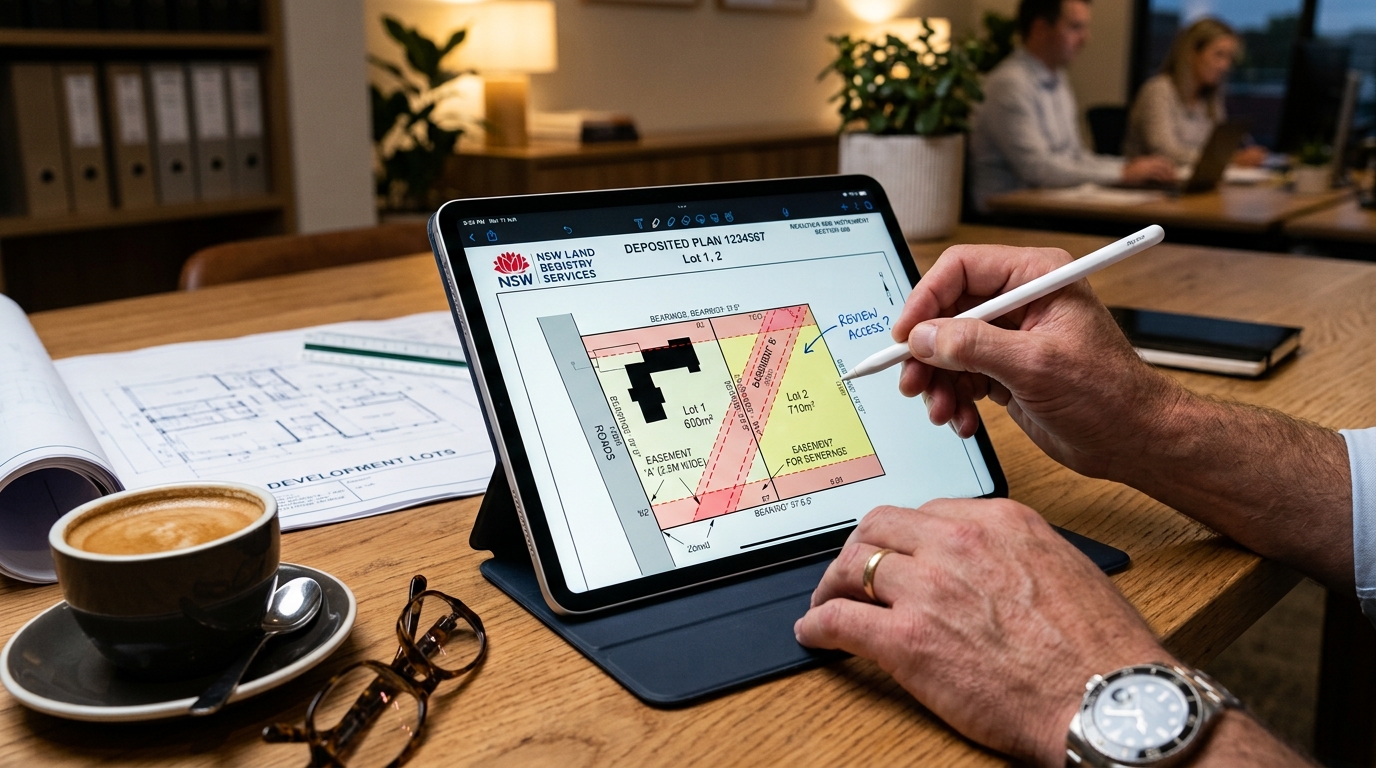
| Deposited Plan | Shows exact physical location and dimensions |
| Section 88B Instrument | Explains terms, maintenance, and prohibited works |
| Sydney Water Tap In | Finds sewer and water assets |
| BYDA search | Identifies utilities near or through the site |
| Surveyor review | Confirms the easement position on-site |
| Property lawyer review | Tests legal risk before exchange |
First, a current NSW Land Registry Services title search should be reviewed. The Second Schedule often lists easements, rights of carriageway, positive covenants, and Section 88B references.
Second, the Deposited Plan should be checked against the land shape. Importantly, the plan shows the exact easement corridor, not just its legal existence.
Third, the Section 88B Instrument should be read in full. It may allocate maintenance costs, access rights, and restrictions on building work.
Fourth, Sydney Water Tap In records should be obtained. These can reveal sewer assets that may not be obvious from the title search.
Finally, Before You Dig Australia should be checked. Before You Dig Australia provides infrastructure plans from participating asset owners.
Foreign Direct Investment (FDI) Australia analysis often focuses on major precincts. However, the same ground-level constraints can determine whether a smaller residential acquisition performs well.
Property Easements NSW 2026 Key Data at a Glance
The main easement risk is not ownership loss, but restricted use and higher development cost.
| Category | Key data |
|---|---|
| Main legislation | Conveyancing Act 1919; Real Property Act 1900 |
| Key authority searches | NSW LRS, Sydney Water Tap In, BYDA |
| Typical buildable area impact | Can exceed 20% on affected lots |
| Foundation cost impact | $20,000 to $100,000+ in complex cases |
| Common dispute areas | Access, utilities, stormwater drainage |
| Dispute value impact | 15% to 20% during unresolved litigation |
| Section 88K role | Court-ordered easement pathway |
Summary
Overall, Property Easements NSW 2026 should be treated as a core feasibility issue. A small title notation can change design, cost, timing, resale value, and legal exposure.
Importantly, the safest process starts before exchange. Title searches, Deposited Plans, Section 88B Instruments, Sydney Water records, BYDA plans, and survey advice should be reviewed together.
Consequently, buyers and developers should price the burden before committing capital. Easement risk is not only a legal detail. It is a practical land-value constraint.