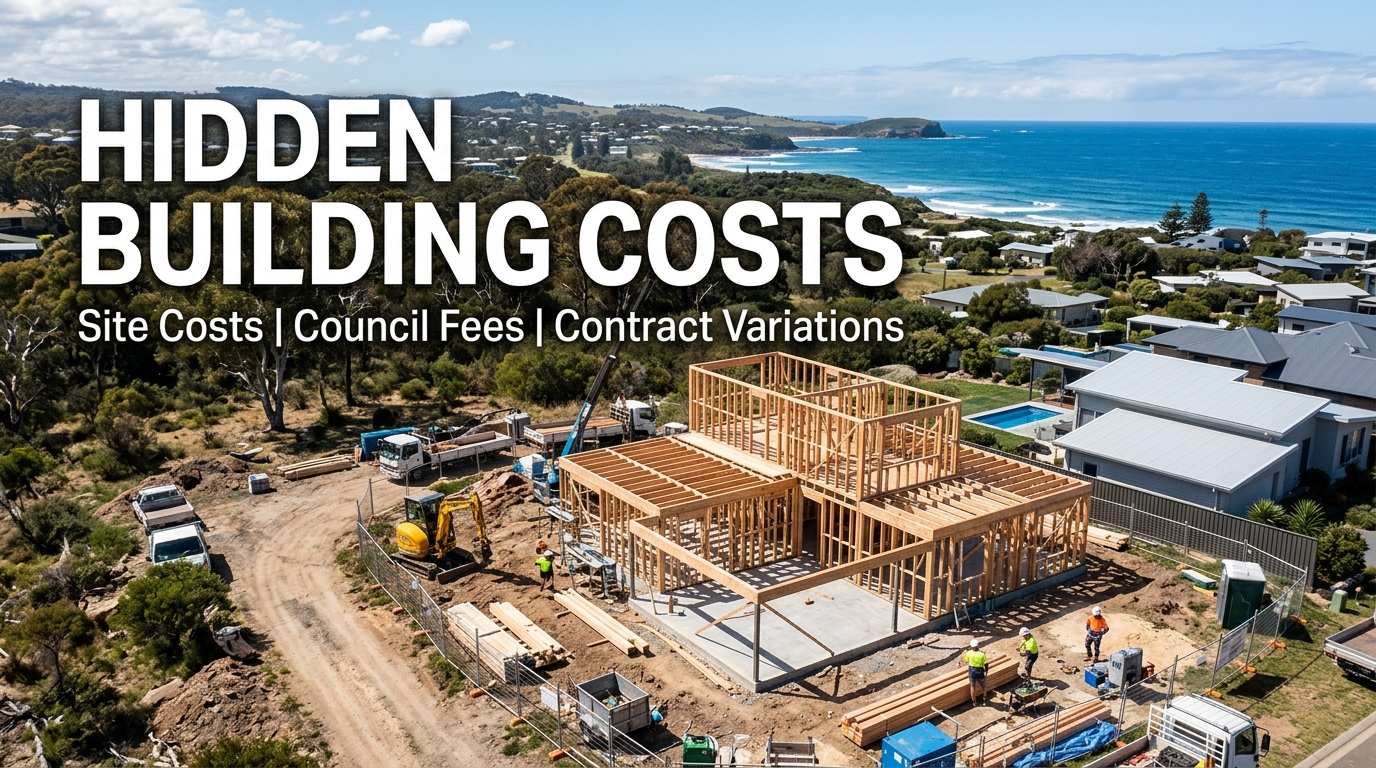
Hidden Building Costs Australia 2026 is an essential due diligence topic for anyone entering into a residential building contract. Project home builders often market a fixed price building contract as full protection. However, these agreements carry specific legal conditions. Many standard residential building contracts may include mechanisms allowing for adjustments based on real site complexities.
Although this article is Australia-wide, several examples use NSW rules. NSW buyers commonly face BASIX, Section 7.11 contributions, and infrastructure levies. Importantly, these excluded categories do not operate as optional upgrades or aesthetic luxuries. They represent mandatory structural, civil, and regulatory requirements necessary to achieve a successful handover and obtain a final Occupation Certificate.
Quick Summary: The Reality of “Fixed-Price” Residential Tenders
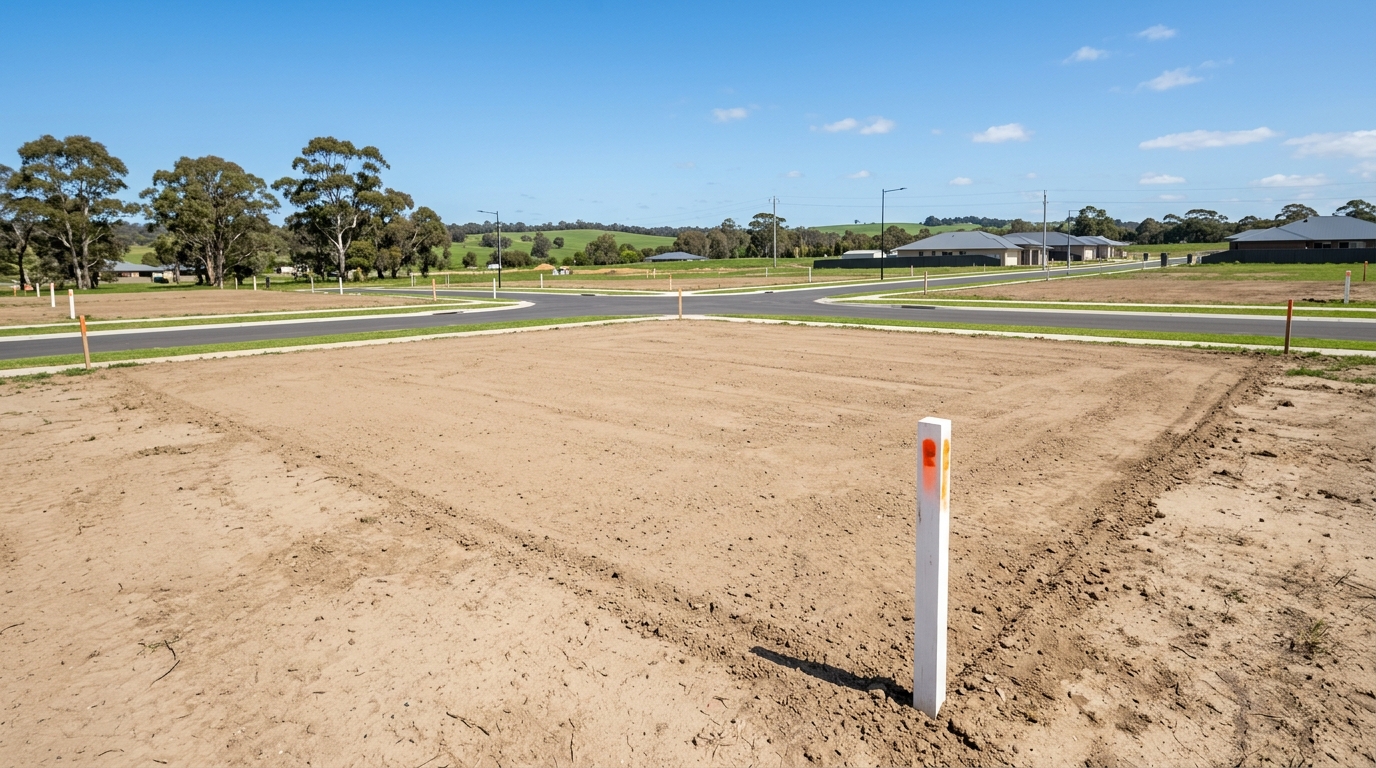
However, many fixed-price tenders include standard assumptions for site conditions, slab design, service connection distances, approvals and inclusions. Costs outside those assumptions may become contract variations. Any variation from these assumptions may trigger additional costs.
| Cost Category | Typical Range (Subject to Variation) | Primary Site or Regulatory Trigger |
|---|---|---|
| 1. Site Costs & Piering | $10,000 to $40,000+ | Rock, reactive soil, deep piers. |
| 2. Retaining Walls | $5,000 to $30,000+ | Slope, cut/fill, boundary support. |
| 3. Council Fees & Statutory Levies | $7,000 to $25,000+ | Section 7.11, levies, approvals. |
| 4. Service Connections & Stormwater | $5,000 to $20,000+ | Long runs, OSD systems. |
| 5. Energy Ratings & Finishing Items | $15,000 to $40,000+ | BASIX, driveway, flooring, fencing. |
Note: Cost ranges provided above represent a typical range across residential markets. Some items may be lower or higher. Others may not apply because contract wording, land condition, council area, and engineering reports vary.
Before executing a building tender or committing to a non-refundable administrative deposit, property buyers must carefully inspect how builders calculate provisional sums and prime cost items. Unrealistic baseline allowances in these two categories remain the leading cause of sudden post-contract budget blowouts.
1. Site Costs, Geotechnical Surveys, and Piering Variables
In particular, site costs cover civil and structural works. These works turn raw land into a stable foundation platform. Builders often insert a baseline provisional sum assuming a stable “Class A or S” soil report. However, actual sub-surface conditions are rarely uniform.
| Soil Classification Profile | General Reactivity Level | Structural Engineering Implications |
|---|---|---|
| Class A / S | Sand or Solid Rock / Stable | Standard slab. Minimal pinning. |
| Class M / MD | Moderately Reactive Clay | Minor slab and steel upgrade. |
| Class H1 / H2 | Highly Reactive Clay | Deeper beams. More concrete. |
| Class E / P | Extremely Reactive / Problematic Site | Custom slab, piling, piers. |
The Geotechnical Testing Adjustment
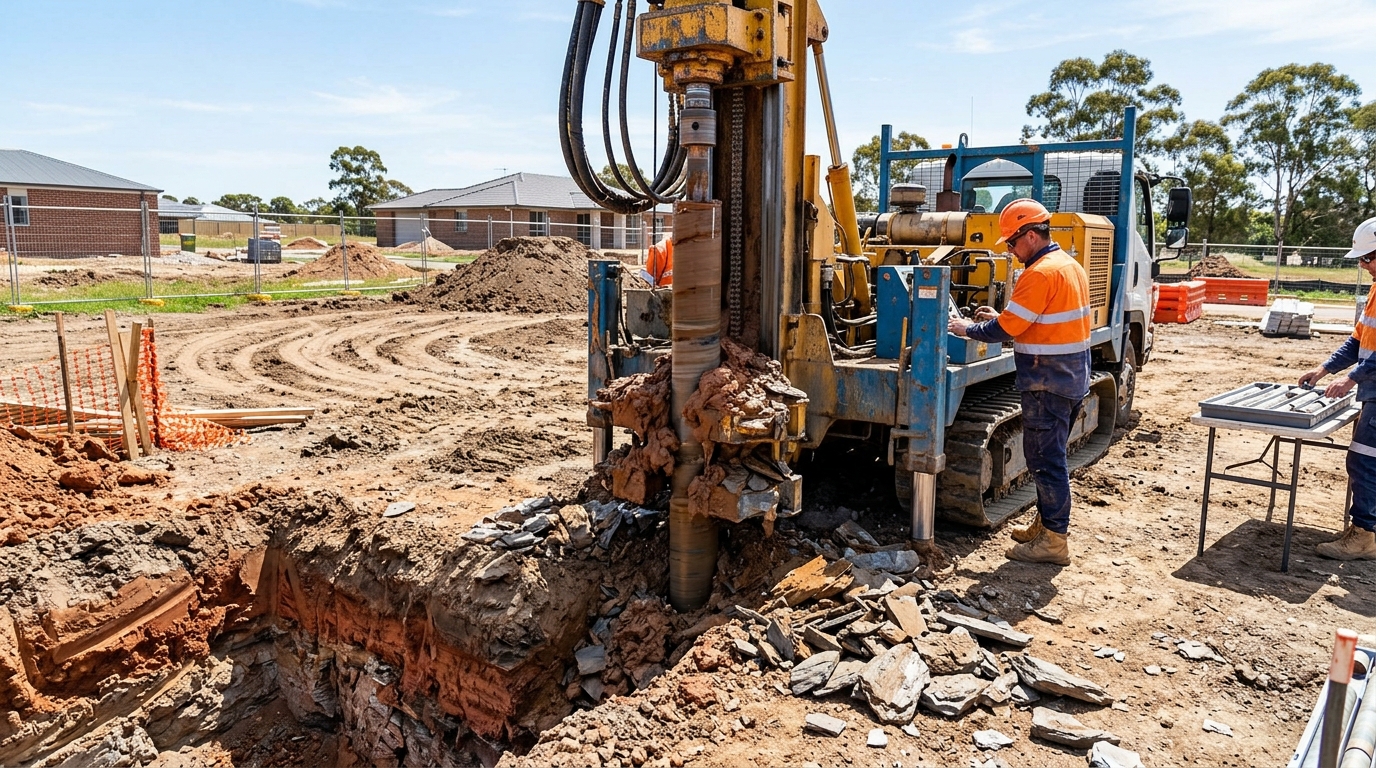
A geotechnical consultant must complete a formal soil test. Core borehole drilling verifies the true ground reactivity. If the report indicates highly reactive clay or uncertified fill dirt, the standard baseline slab design may no longer suit the site. The builder must apply contract variations to cover the costs of reinforced steel configurations and extra concrete.
Concrete Piering Extensions
Additionally, load-bearing strata may sit deep below the surface. In that case, structural concrete piers anchor the house safely. Standard tenders may only allow for a limited linear allocation of piering, such as 30 to 50 lineal metres.
A site may ultimately demand 120 metres of piering. Soft soil or a utility zone of influence can trigger that increase. The homeowner then pays per extra linear metre.
Furthermore, hard rock can appear during drilling. Builders then apply surcharges for specialised rock-breaking equipment. They also charge extra concrete for irregular cavities.
2. Retaining Walls and Civil Engineering (The Slope Risk)
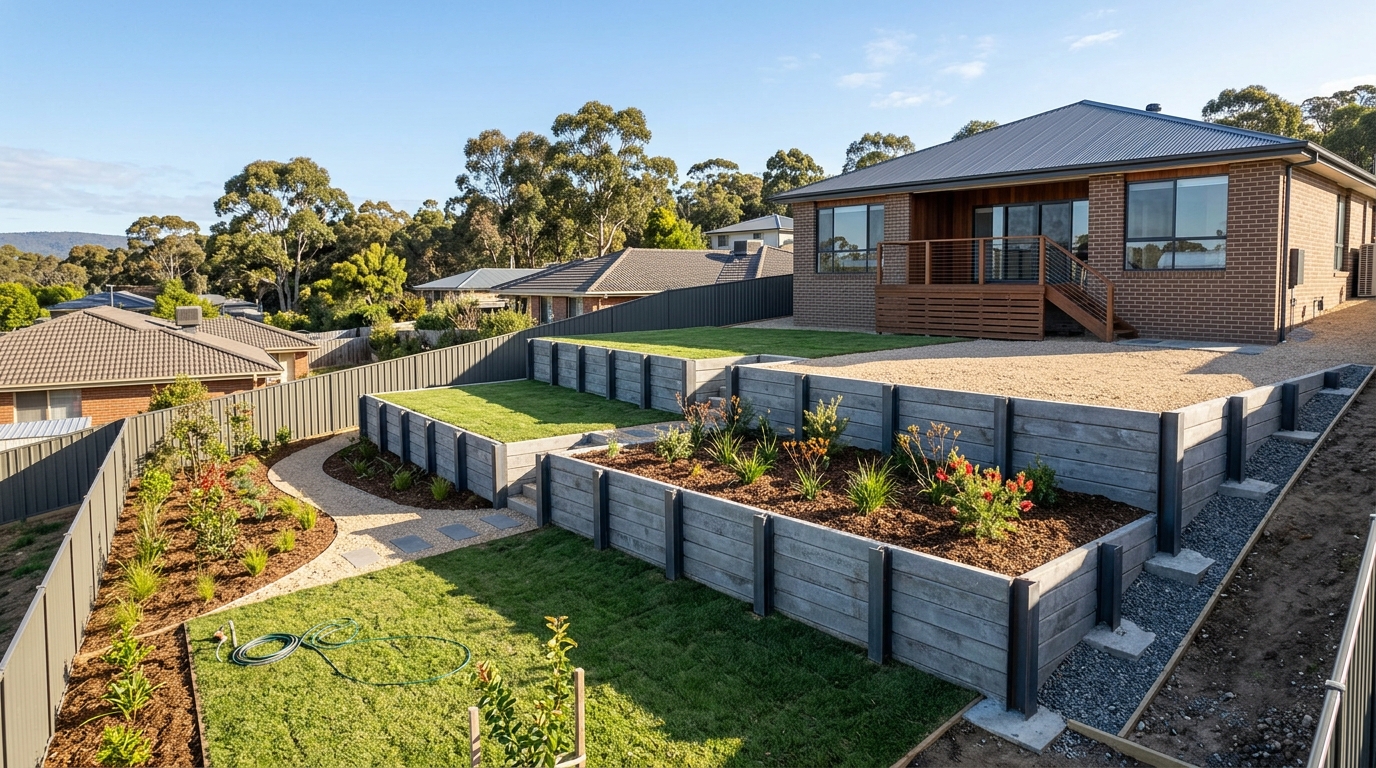
Project home designs usually assume completely flat land. If a plot presents a slope exceeding a 1 in 20 gradient, or about 5%, the land requires a structural process known as cut and fill to create a level building platform.
| Slope / Wall Element | Requirement | Cost Drivers |
|---|---|---|
| Cut and Fill | Excavate and fill. | Disposal and compaction. |
| Retaining Walls under 1m | Often under Exempt Development rules | Sleepers and drainage. |
| Retaining Walls over 1m | Mandatory Structural Engineering & DA | Concrete, steel, certification. |
Structural Independence
However, builders rarely include structural retaining walls in their initial tender. A wall near the foundation zone creates structural risk. Therefore, an engineer must design it independently.
Dropped Edge Beams
Alternatively, builders might propose a Dropped Edge Beam. This extends the slab edge downwards to retain soil. A single long dropped edge beam can easily add $10,000 to $20,000 depending on the depth of the drop.
3. Council DA, CC, and Statutory Authority Levies
Buyers often assume that “Council Fees” in a tender cover the entire approval process. In reality, builders often include only basic Complying Development Certificate processing fees, leaving the buyer liable for broader municipal levies.
| Statutory Fee Item | Responsible Authority | Average Cost Impact |
|---|---|---|
| Section 7.11 / 7.12 Levies | Local Municipal Council | $5,000 to $20,000+ |
| Long Service Levy | State Government | Percentage of works cost. |
| Section 68 Approval | Local Council | $500 to $1,500. |
| Asset Protection Bond | Local Council | $2,000 to $5,000. |
Section 7.11 Contributions
Notably, the Environmental Planning and Assessment Act 1979 supports developer contributions. Councils use these fees to fund parks, roads, and community facilities. In many growth centres, councils bill these fees directly to the landowner. Payment usually comes before the Construction Certificate. The Blacktown City Council Section 7.11 Contributions Plans show how these levies work. They provide a useful primary reference point.
State Long Service Levies
Additionally, larger building projects attract a mandatory state levy. The levy funds portable long service leave for construction workers. The official rate metrics and payment portals sit with the NSW Government Long Service Levy Corporation.
Specialised Environmental Overlays
Meanwhile, if a land parcel falls within a specialised environmental zone, the project requires independent consultant reports. Bushfire zones require a formal Bushfire Attack Level assessment. High ratings, such as BAL-29 or BAL-Flame Zone, increase material standards. Therefore, windows, cladding, and ember screens can lift costs.
For statutory guidelines, users can review the current law directly. The Environmental Planning and Assessment Act 1979 on the NSW Legislation Portal provides the source text.
4. Service Connections and On-site Stormwater Detention
Typically, a standard tender assumes utility mains sit at the front boundary. These mains include water, sewer, electricity, gas, and telecommunications. The assumed distance is usually 6 to 10 metres.
Extended Trenching and Run-Ins
However, a deep setback changes the cost. Larger regional blocks and battle-axe lots often need longer runs. The buyer then pays for trenching, conduit, and wiring.
On-Site Stormwater Detention
Importantly, modern civil engineering standards prevent new homes from overwhelming local council stormwater networks. If the local council mandates On-Site Stormwater Detention, the project needs storage. This may mean an underground tank or specialised pits. Then, the system releases it slowly.
An engineered OSD system routinely adds $10,000 to $25,000. Builders almost always exclude this item from base prices.
Electrical Supply Upgrades
Usually, standard pricing includes single-phase power. A high-load electrical design may need a three-phase power upgrade. Examples include ducted air conditioning, EV charging, and induction cooking. This upgrade adds wiring and switchboard costs.
5. BASIX Compliance and Mandatory Turnkey Exclusions
To obtain an Occupation Certificate, the completed building must meet sustainability targets. In New South Wales, BASIX is a key example. Additionally, standard contracts leave out core finishings necessary to make the house liveable.
| Category | Typical Items Excluded | Estimated Final Cost |
|---|---|---|
| BASIX / Energy Rating | Glazing, insulation, solar. | $8,000 to $20,000 |
| Civil Finishings | Driveway, paths, paving. | $7,000 to $15,000 |
| Internal Fit-out | Flooring, blinds, screens. | $10,000 to $25,000 |
| Site Handover Items | Fencing, turf, letterbox. | $5,000 to $12,000 |
The BASIX Reality
Often, a builder’s base price uses the cheapest possible materials. When the actual thermal comfort assessment is run, the home may fail statutory requirements. The online NSW Planning Portal BASIX Tool.
To pass, buyers may need contract variations for upgraded low-E or double-glazed windows, higher-rated wall/ceiling insulation bats, and larger rainwater tanks.
The “Turnkey” Mirage
However, unless explicitly signed as a full turnkey package, standard contracts often exclude the concrete driveway, boundary fencing, internal flooring, window coverings, and light fittings. Therefore, leaving these items out allows builders to display an artificially low base price to attract customers.
Hidden Building Costs Australia Key Data at a Glance
Hidden Building Costs Australia usually arise from site, engineering, council, service, and compliance assumptions. Hidden Building Costs Australia 2026 remains the current buyer due diligence frame.
| Risk Area | Typical Exposure | Primary Evidence to Check |
|---|---|---|
| Site costs and piering | $10,000 to $40,000+ | Soil report, slab design. |
| Retaining walls | $5,000 to $30,000+ | Contour and civil design. |
| Council and statutory levies | $7,000 to $25,000+ | Contribution plans, levies. |
| Service connections and stormwater | $5,000 to $20,000+ | Service plan, OSD design. |
| Energy and turnkey exclusions | $15,000 to $40,000+ | BASIX and inclusions. |
Comprehensive Buyer Due Diligence Checklist
To reduce variation risk, buyers should complete the following steps before contract signing:
- Request a Full Inclusions and Exclusions Schedule: Demand an exhaustive, itemised list detailing exactly what is covered in the base price and what constitutes an extra charge.
- Secure Fixed Site Costs in Writing: Attempt to negotiate a “Guaranteed Fixed Site Cost” clause with your builder to shift the subterranean soil and piering risks back to them.
- Thoroughly Review Provisional Sums and Prime Cost Items: Additionally, ensure the budget allowances allocated for items like site excavation or piering represent realistic market values rather than artificially deflated figures.
- Confirm Local Council Infrastructure Contributions Directly: Contact your local planning authority to verify if developer infrastructure levies apply to your specific lot.
- Confirm BASIX / NCC Energy Compliance Requirements: Furthermore, confirm the builder has conducted a preliminary thermal comfort assessment so that any required window upgrades are integrated into the initial contract price.
- Obtain an Independent Legal Contract Review: Submit your documentation to a specialised construction lawyer to protect your interests. Refer to the NSW Government Fair Trading Home Building Contract Guidance for official regulatory overviews.

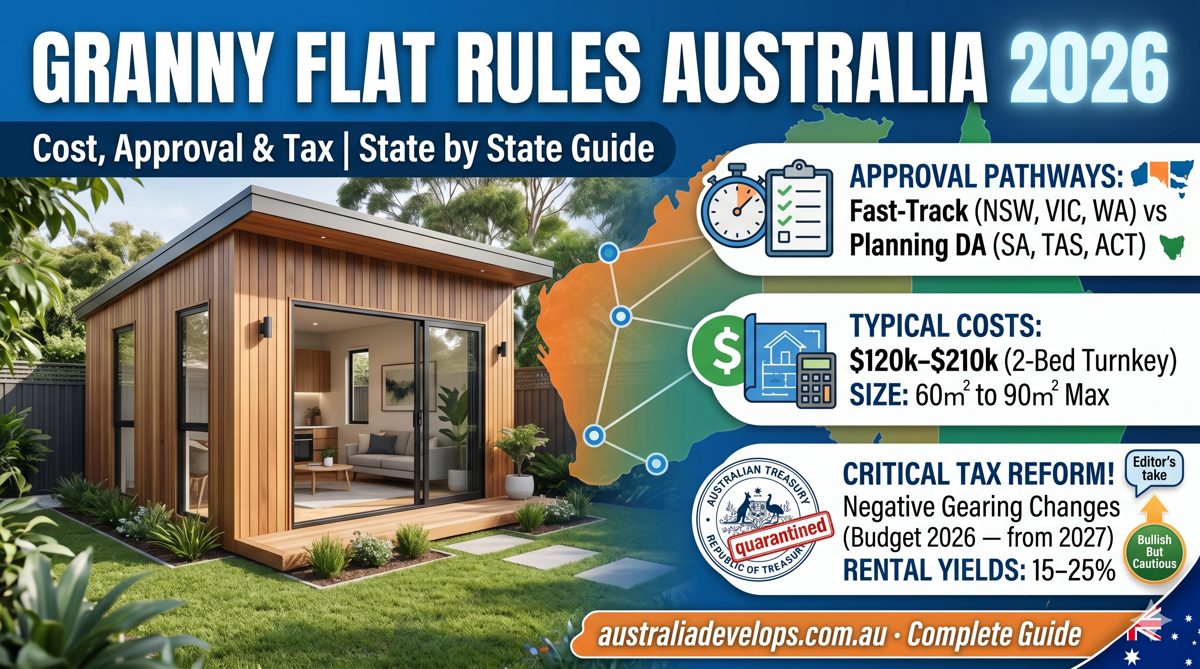
Additionally, for broader due diligence context, Australia Develops also covers property easements in NSW, dual occupancy feasibility in Australia, granny flat approval costs in NSW, Leppington development pipeline risks,
Additionally, Australia Develops tracks Western Sydney Aerotropolis infrastructure trends.
Legal Disclaimer: The information provided in this article is intended for general informational and educational purposes only. It does not constitute legal, financial, or professional building advice. Building regulations, planning acts, and construction costs vary significantly across different states, councils, and property types. Therefore, readers must obtain independent professional legal advice, financial counsel, and formal site inspections from qualified experts before entering into any residential building contract.