Written by Daniel Whitfield, founder of Australia Develops, who has personally bought, subdivided, and built property across Australia.
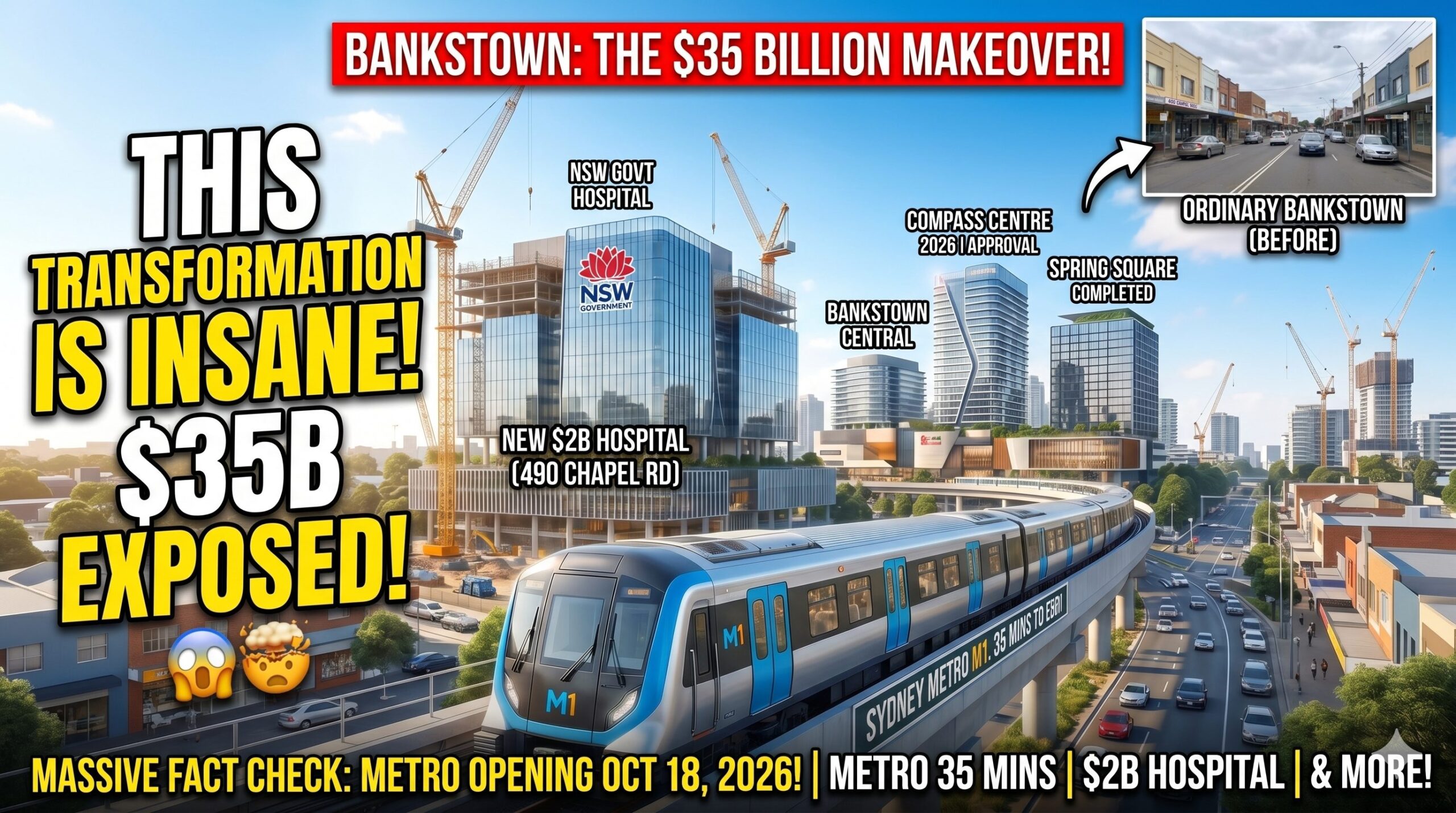
In 2026, Bankstown CBD development has reached an inflection point unprecedented in the suburb’s modern history. Three milestones are converging in a single calendar year: delivery of the Sydney Metro M1 Southwest rail infrastructure, groundwork for a $2 billion public hospital, and Development Application (DA) approval for $327 million in new commercial towers.
These have placed Canterbury-Bankstown on a trajectory that few Western Sydney corridors have matched. Across five flagship projects, total committed capital in the Bankstown CBD now exceeds $3.9 billion.
This figure is underpinned by state government infrastructure spending, institutional property capital, and a formal rezoning that has unlocked capacity for 14,000 new homes and 14,300 jobs within walking distance of the metro station.
| Project | Value (AUD) | Lead Parties | Status mid-2026 | Reference |
|---|---|---|---|---|
| Sydney Metro M1 Southwest | $30B programme | Sydney Metro / Transport for NSW | Opening H2 2026; 360 platform screen doors installed; transit plaza open 22 Mar 2026 | NSW Transport Infrastructure Testing Report (2026) |
| New Bankstown Public Hospital | $2.0 billion | NSW Health Infrastructure / Architectus & BLP | SSDA exhibited Apr–7 May 2026; TAFE demolition underway; main construction 2027 | NSW DPHI SSDA Notice |
| Bankstown Central Masterplan | $1.3 billion (to 2050) | Vicinity Centres / CIP Asset Management | Stage 1 (Bankstown Exchange) DA approved; Eat Street & bus interchange relocation underway | Council Mixed-Use Masterplan Approval |
| Compass Centre | $327 million | Barings Real Estate Australia & Aware Super | DA approved 13 Feb 2026; target completion late 2028 | Sydney South Planning Panel DA Decision |
| Spring Square | $364 million | Poly Global (Australia) | Completed late 2023 — 516 units + 6,500 sqm commercial | Canterbury-Bankstown Development Register |
PROJECT 1 — Sydney Metro M1 Southwest: H2 2026 Opening
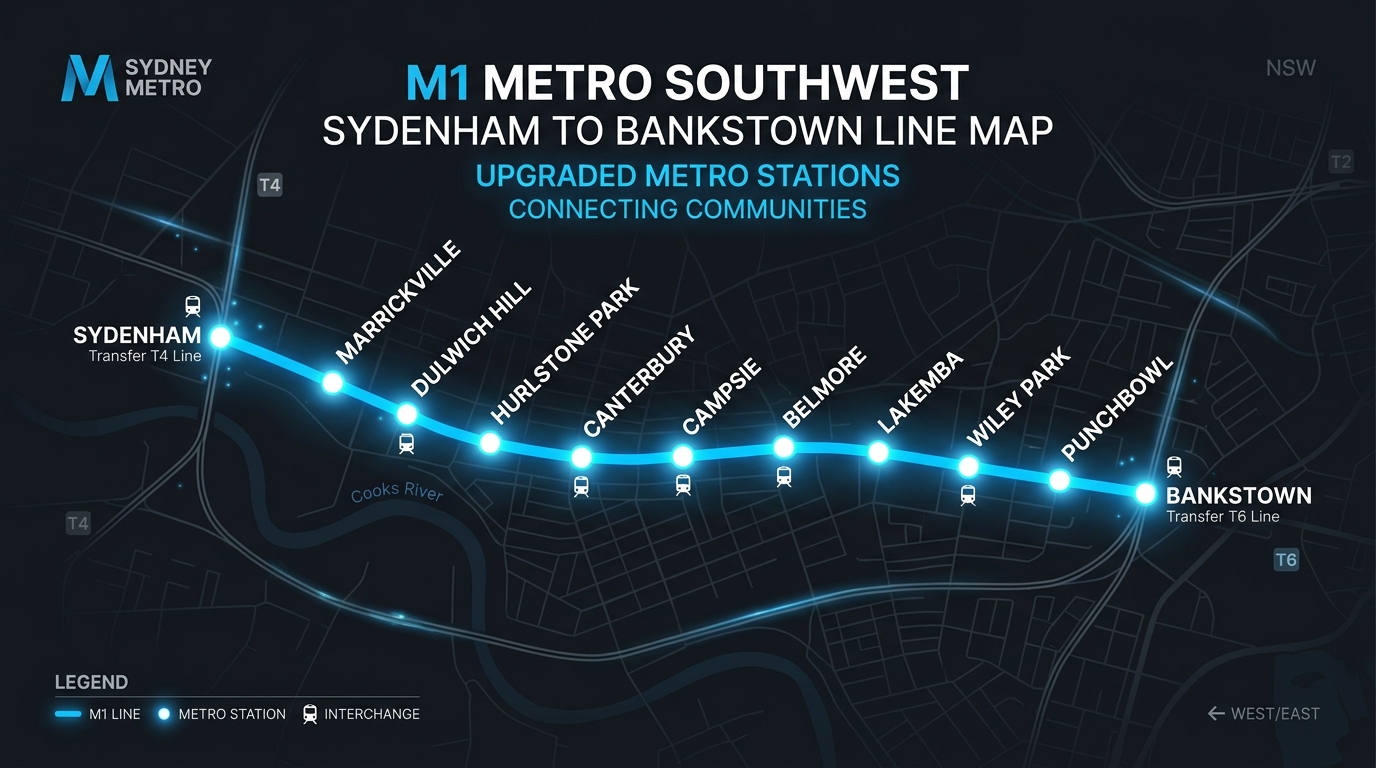
The conversion of the T3 Bankstown Line to Metro standards between Sydenham and Bankstown — a 13.5 km stretch spanning 10 stations — was originally scheduled to open in 2025.
Sydney Metro formally revised the target to the second half of 2026 following industrial action and the logistical complexity of commissioning autonomous, single-deck trains with platform screen doors on a previously heavy-rail corridor.
Transport for NSW and Sydney Metro have since published granular milestone data that establishes the project’s technical readiness trajectory.
Platform Screen Doors and Testing Milestones
As of mid-2026, Sydney Metro has installed all 360 platform screen doors across the 10 converted stations, and crews have upgraded 13 of 15 overbridges to metro standard.
The testing programme has accumulated more than 2,500 of the required 9,000 hours of high-speed passenger simulation at up to 100 km/h. Engineers have also completed 17,000 of the target 30,000 km of track testing.
A notable milestone came when engineers loaded a test consist with 106 water containers, carrying 115,500 litres in total to simulate the weight of 1,540 passengers.
The consist then successfully ran the full end-to-end route from Tallawong to Bankstown, stopping at all 31 stations across the 66 km network.
The operator handover to Metro Trains Sydney targets 13 July 2026, with public opening scheduled for 18 October 2026.
| Milestone | Date / Status |
|---|---|
| T3 heavy rail closure & metro conversion commences | September 2024 |
| 360 platform screen doors installed (10 stations, 13.5 km) | Complete — mid-2026 |
| 13 of 15 overbridges upgraded to metro standard | Complete — mid-2026 |
| High-speed testing: 2,500+ hrs completed of 9,000 hrs target (100 km/h) | In progress |
| Track testing: 17,000 km completed of 30,000 km target | In progress |
| Passenger load test (106 containers, 115,500 L, all 31 stations, 66 km) | Completed |
| Bankstown Transit Interchange Plaza opens | 22 March 2026 |
| Operator handover (Metro Trains Sydney) | 13 July 2026 |
| Target public passenger opening | 18 October 2026 |
Bankstown Transit Interchange Plaza Opens March 2026
Ahead of full metro operations, the new Bankstown Transit Interchange Plaza opened to the public on Sunday, 22 March 2026. The 90-metre tree-lined walkway features a heritage-respecting timber deck constructed around a 150-year-old fig tree.
It provides a continuous pedestrian link between Bankstown’s northern and southern residential precincts. Furthermore, a second station entrance building simultaneously activated for Sydney Trains T6 Lidcombe–Bankstown services, equipped with nine new Opal gates and 18 secure bicycle parking spaces.
The interchange anchors the pedestrian spine around which the Bankstown City Centre’s Night-Time Economy Action Plan and Eat Street casual dining precinct are being staged. This work falls under the Complete Streets CBD Transport and Place Plan.
PROJECT 2 — New Bankstown Hospital: $2 Billion at 500 Chapel Road
The NSW Government’s $2 billion investment in a new public hospital at 500 Chapel Road. This is the largest single public health infrastructure commitment in NSW history.
It is advancing through its pre-construction phase throughout 2026. The 3.8-hectare site is the former TAFE NSW Bankstown campus, which officially closed in 2026 with all training operations relocated to the new TAFE city campus within the 18-storey Western Sydney University (WSU) vertical campus tower developed in partnership with Walker Corp — itself generating an estimated $50 million in annual economic activity within the Bankstown city centre.
| Detail | Specification |
|---|---|
| Address | 500 Chapel Road, Bankstown NSW 2200 (former TAFE NSW Bankstown campus) |
| Investment | $2 billion (largest public hospital investment in NSW history) |
| Building configuration | 14-storey acute care tower with 3 inpatient wings + 10-storey car park |
| Site area | 3.8 hectares (former TAFE NSW + Raw Avenue corridor) |
| Designers | Architectus & Billard Leece Partnership (BLP) |
| SSDA public exhibition | April 2026 — closed 7 May 2026 |
| Current status mid-2026 | TAFE demolition and site remediation underway |
| Main construction start | 2027 (post builder selection) |
Architectus and Billard Leece Partnership (BLP) designed the hospital, drawing its facade on local geology, natural tree canopy, and the colours of the Bankstown sky.
The building programme comprises a 14-storey acute care tower with three dedicated inpatient wings and a separate 10-storey car park structure.
The State Significant Development Application (SSDA) exhibited publicly from April 2026, closing on 7 May 2026. Main construction on the primary towers is expected to commence in 2027, following the State Significant Development (SSD) pathway contractor procurement process.
Two-Site Healthcare Model and Employment Anchor
NSW Health Infrastructure has confirmed a two-site healthcare model. The existing Bankstown-Lidcombe Hospital on Eldridge Road will operate as a day surgery and community health centre, while the new Chapel Road facility will serve as the acute inpatient and emergency care hub with overnight ward capacity.
This model preserves local community access points while concentrating high-acuity care on the larger, metro-adjacent site. Moreover, the hospital is projected to generate thousands of permanent healthcare positions.
This creates sustained demand from high-income renters and owner-occupiers within 800 metres of the metro station.
PROJECT 3 — Bankstown Central: $1.3 Billion Mixed-Use Masterplan
The Bankstown Central precinct is the subject of a $1.3 billion staged masterplan, with long-term projections exceeding $3 billion across all phases to 2050. Vicinity Centres and CIP Asset Management are jointly developing the 11.4-hectare precinct around the existing shopping centre.
The masterplan transforms one of Canterbury-Bankstown’s largest commercial land holdings into a high-density, mixed-use urban quarter positioned directly above the incoming metro interchange.
| Component | Specification |
|---|---|
| A-grade commercial office space | 106,000 sqm (3 office towers — Bankstown Exchange) |
| Retail and creative / cultural space | 14,800 sqm |
| Public open space | 11,100 sqm (more than twice the size of Paul Keating Park) |
| Student accommodation | 1,664 beds |
| Hotel | 656 rooms |
| Serviced apartments | 84 units |
| Residential apartments | 929 units |
| Childcare centre | 900 sqm |
| Masterplan horizon | 2050 |
| Architect | FJMT Studio |
Stage One, branded Bankstown Exchange, has received council approval. It delivers three commercial office buildings fronting Jacobs Street and Rickard Road: two eight-level mixed-use buildings and one five-level building with a private rooftop terrace.
The stage includes a 320-space underground car park, a 240-space secure bicycle facility, a new Eat Street casual dining strip, and the relocation of the bus interchange to a position closer to the incoming metro station entrance.
The masterplan DA received approval in 2021. By 2022, council had repositioned the Grand Market and original bus interchange to clear the development footprint. FJMT Studio leads design across the precinct.
Analysts project more than 3,500 new residents and workers entering the Bankstown CBD at full buildout.
PROJECT 4 — Compass Centre: $327 Million at 83–99 North Terrace
On 13 February 2026, the Sydney South Planning Panel approved the Compass Centre DA at 83–99 North Terrace — directly opposite Bankstown Station.
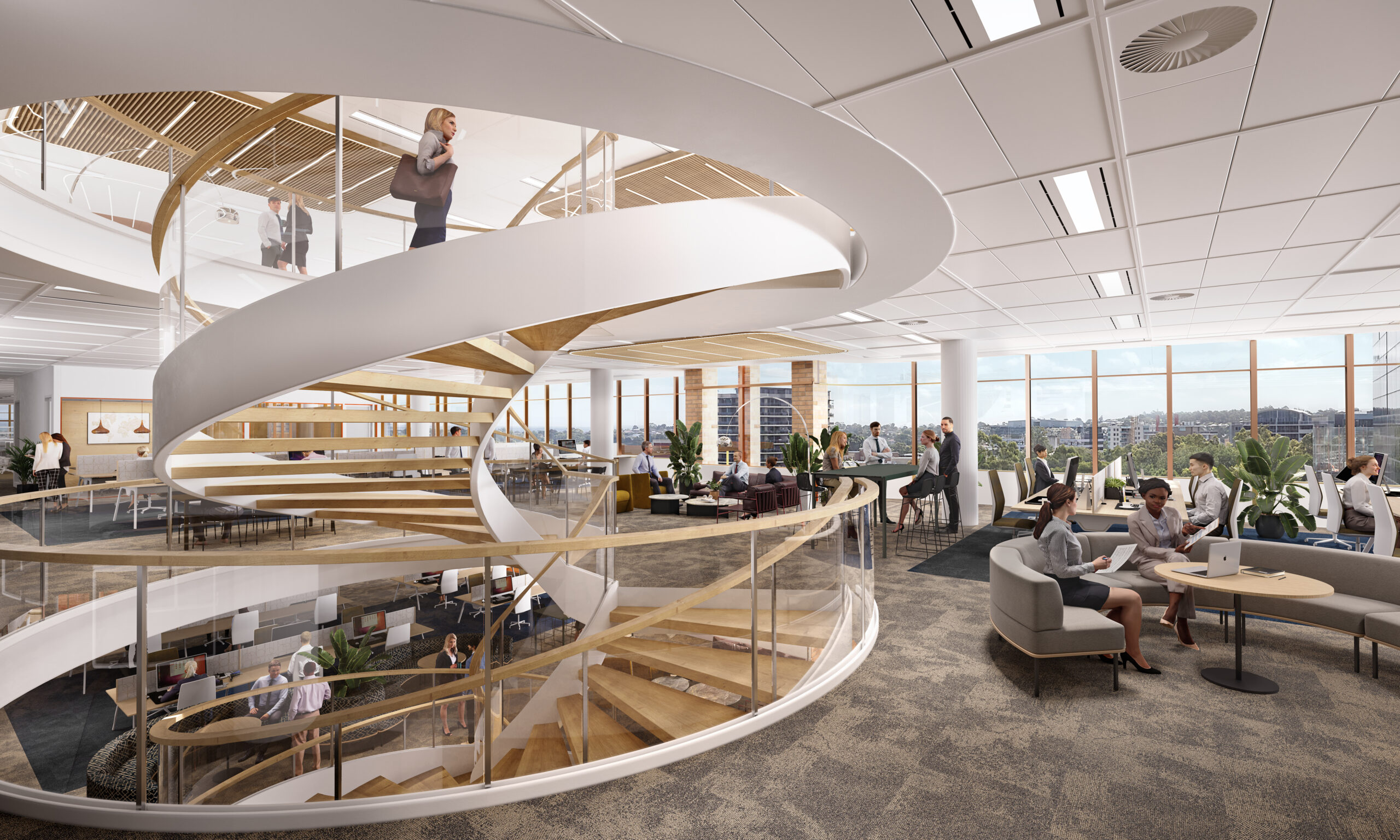
The $327 million scheme delivers a 19-storey hotel with 169 rooms and two 24-storey build-to-rent residential towers containing 339 units, with completion targeted for late 2028.
Barings Real Estate Australia (formerly Altis Property) and Aware Super are co-funding the project, with Essence Project Management as project manager and PTW Architects leading the design.
The build-to-rent component — 339 institutionally managed rental apartments under single ownership — aligns with NSW Government policy to increase purpose-built rental supply within TOD precincts.
PROJECT 5 — TOD Rezoning: 14,000 New Homes & 14,300 Jobs Unlocked
The Canterbury-Bankstown Local Environmental Plan (LEP) was formally gazetted on 27 November 2024 under the NSW Government’s Transport Oriented Development (TOD) Accelerated Precinct programme.
It applies higher-density controls within 400 metres of Bankstown Station and medium-density controls within 800 metres.
The rezoning unlocks capacity for 14,000 new homes and 14,300 new jobs. A mandatory affordable housing contribution of 3–4% of gross floor area applies to all new residential buildings within the precinct, whether delivered in-kind or via financial contribution.
| Planning Metric | Pre-TOD Controls (DCP) | TOD Accelerated Precinct (gazetted 27 Nov 2024) | Benefit |
|---|---|---|---|
| Housing capacity | Site-by-site assessment; development limits | High-density uplift within metro radius | 14,000 new dwellings unlocked |
| Employment capacity | Limited commercial zoning | Mixed-use commercial uplift | 14,300 new business jobs |
| DA fast-track pathway | Standard council DA process (long timeframes) | Temporary SSD pathway for residential DAs over $60M (until Nov 2027) | Bypass council assessment; significantly reduced timeframes |
| Design assessment | Design competition required | Design excellence pathway replaces competition | Reduced design procurement costs; faster approvals |
| Affordable housing | Voluntary or minimal contribution | Mandatory 3–4% affordable housing (in-kind or contribution) | Increased housing diversity; development social licence |
Comparing TOD Typologies: Bankstown vs Greenfield Growth
The TOD rezoning framework affecting Bankstown mirrors density uplift mechanisms also active across the Leppington Development Pipeline 2026. However, the two models represent fundamentally different growth typologies.
Leppington is characterised by greenfield land subdivision and large-format apartment supply on former rural land. The Bankstown TOD leverages mature metropolitan infrastructure — metro rail, public hospitals, and university campuses — to justify transit-integrated urban consolidation.
Spring Square at Kitchener Parade, delivered by Poly Global (Australia) with Westbourne Constructions on a $364 million total value, provides a completed at-scale example: 516 apartments and 6,500 sqm of commercial space, completed late 2023.
INFRASTRUCTURE — Council Reform & Municipal Investment
As part of Bankstown CBD development 2026, Canterbury-Bankstown Council has delivered a programme of enabling infrastructure that directly complements the state-led development pipeline.
Completed public works include the Paul Keating Park playground upgrade and major stormwater capacity improvements beneath North Terrace, The Appian Way, and The Mall to address CBD flood risk.
A further completed project is the 18-storey Western Sydney University (WSU) vertical campus, developed in partnership with Walker Corp.
This campus generates an estimated $50 million in annual economic activity within the city centre and now accommodates the relocated TAFE NSW city campus, transferred from the Chapel Road site following the formal 2026 closure.
Two municipal reform measures carry direct implications for development applicants. Since 1 July 2025, Canterbury-Bankstown Council has mandated the submission of 3D digital model files for all new Development Applications within the Bankstown City Centre and Canterbury town centre.
This improves the assessment panel’s ability to evaluate visual impact, massing, and shadow effects at the pre-determination stage.
Separately, the council is rolling out 22 kWh AC and 55 kWh DC fast electric vehicle (EV) chargers across 12 municipal car park sites as part of its Complete Streets framework.
This aligns public parking infrastructure with the NSW Government’s transition to zero-emission vehicles.
INVESTMENT — Western Sydney Growth Axis & Bankstown’s Strategic Position
The metro-adjacent urban consolidation model in Bankstown connects into the broader South West Sydney growth axis extending to the Western Sydney Aerotropolis and the newly opened Western Sydney International Airport.
The future Southwest Link replacement bus services will give way to autonomous metro operations. Bankstown Station is positioned to function as a pivotal interchange node on the macro passenger flow corridor connecting Sydney’s three emerging business districts.
In this context, institutional investment infrastructure commitments at both Compass Centre and Bankstown Exchange signal that sophisticated capital views the corridor as a credible long-term commercial proposition.
MARKET DATA — Bankstown Property Market Mid-2026
As part of Bankstown CBD development 2026, the two-bedroom unit market has recorded 10.1% annual price growth as of mid-2026, with a median unit price of $600,000 and a gross rental yield of 5.2% — outperforming Parramatta’s gross yield of 4.8% at a lower entry price point.
Bankstown represents one of the more compelling commercial real estate yields in the Western Sydney corridor for investors comparing transit-adjacent precincts.
| Metric | Bankstown | Parramatta |
|---|---|---|
| Median house price | $1,605,000 | — |
| House price growth | +3.5% | — |
| Median unit price (2-bed) | $600,000 | $680,000 |
| Unit price growth | +10.1% | — |
| Median rent (unit) | $600/week | — |
| Gross yield | 5.2% | 4.8% |
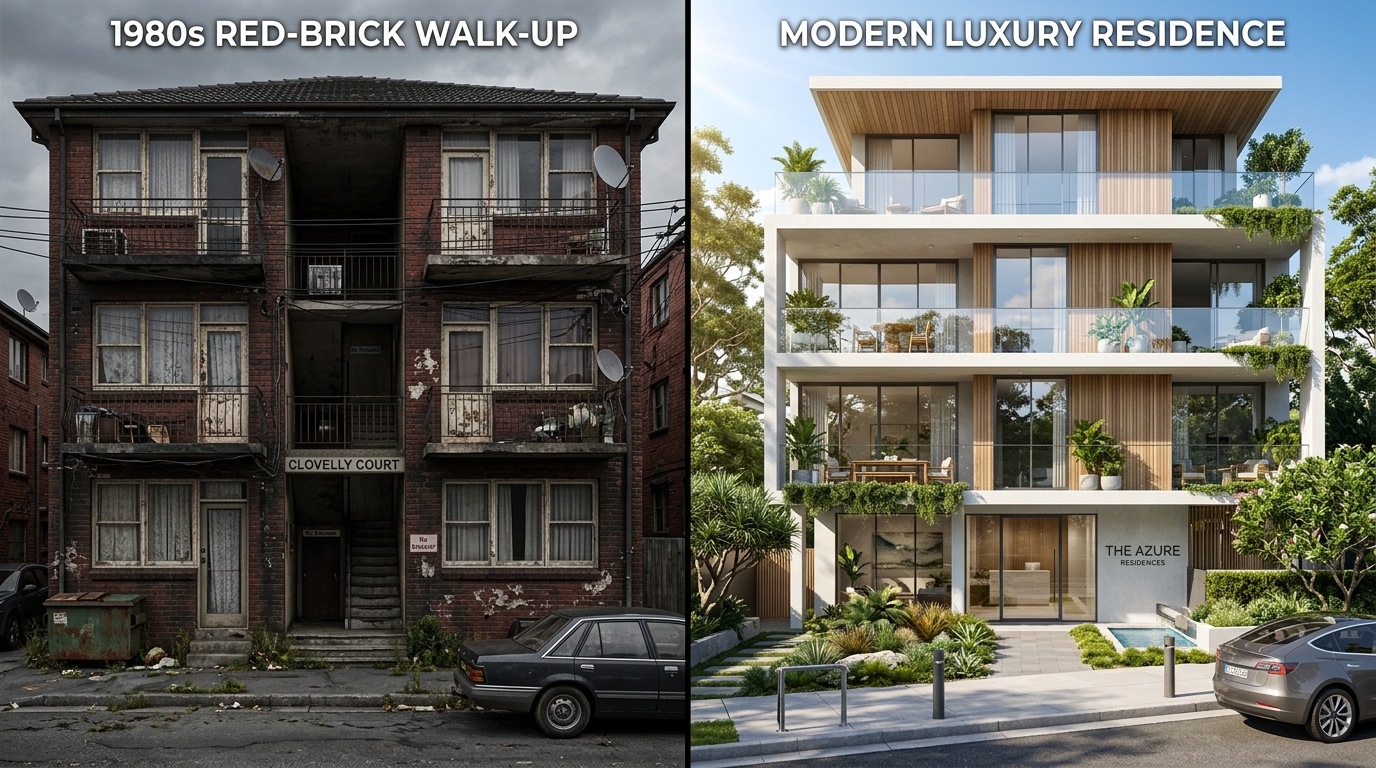
Post-2015 built two-bedroom units within 800 metres of the Metro station represent the highest-demand segment in mid-2026. By contrast, 1980s and 1990s low-rise walk-up blocks carry higher maintenance liabilities and slower capital growth.
See our Austral Precinct analysis for comparable TOD dynamics in the outer South West corridor. Redevelopment sites near the station should also be checked against the NSW property easements guide, as sewer and utility easements can restrict basement or podium footings on higher-density sites.
Bankstown CBD Development 2026 — Key Data at a Glance
| Project | Value | Address | Status mid-2026 |
|---|---|---|---|
| New Bankstown Hospital | $2.0 billion | 500 Chapel Rd | Demolition active; SSDA closed 7 May 2026 |
| Sydney Metro M1 | $30B programme | Bankstown Station | Opening H2 2026; plaza open 22 Mar 2026 |
| Bankstown Central | $1.3 billion | Bankstown Central | Stage 1 (Bankstown Exchange) DA approved |
| Compass Centre | $327 million | 83–99 North Terrace | DA approved 13 Feb 2026 |
| Spring Square | $364 million | Kitchener Parade | Completed 2023 |
Investment Window: Metro Opening to Hospital Construction Ramp-Up
Bankstown CBD development activity in 2026 reflects the simultaneous arrival of metro infrastructure and record public health investment. Institutional capital is also committing to build-to-rent and A-grade office supply in the same precinct.
The combined pipeline exceeds $3.9 billion across five verified developments, anchored by the Canterbury-Bankstown LEP rezoning and the temporary State Significant Development (SSD) pathway active until November 2027.
This represents a structural shift in Bankstown’s position within Greater Sydney. For buyers, investors, and developers assessing the Canterbury-Bankstown corridor, the window between the Metro’s October 2026 opening and the hospital’s full construction ramp-up in 2027 represents a critical decision period.
Foreign Direct Investment (FDI) Australia benchmarks increasingly identify transit-oriented precincts with confirmed hospital anchors as a distinct asset class — a description that now applies squarely to Bankstown.
This article is general information only and is not financial, legal or planning advice. See the Disclaimer for details.
Suburbs further from the CBD but closer to the airport corridor, benchmarked in Australia Develops’ Western Sydney Airport property hotspots guide, show a different growth trajectory.
Bankstown’s logistics sector stands to benefit from the airport’s 24-hour freight model, examined in Australia Develops’ WSI 24-Hour Operations analysis.
Bankstown’s Metro upgrade sits within a broader western Sydney transit network, detailed further in the WSI transport guide to Metro, M12 and commute times.
Bankstown’s connectivity to the new airport precinct is strengthened by confirmed carrier routes, covered in the WSI airlines and airfares analysis.
Bankstown’s connectivity to the new airport precinct is strengthened by regional employment growth, covered in the WSI jobs and careers employment pathways guide.
For readers weighing air travel options in the region, the Sydney Airport vs Western Sydney Airport traveller comparison breaks down curfew rules, terminal design and ground transport differences between the two facilities.
For a closer look at the architectural design behind the new terminal, the Inside WSI: Nancy-Bird Walton legacy and future airport design feature covers the building’s sustainability engineering and long-term expansion plans.