
A HECS or HELP debt doesn’t stop a lender from approving your home loan application — that’s one of the most persistent myths in Australian property forums. What it does do is quietly shrink the number a lender is willing to put next to your name, because every dollar you’re required to repay each year is treated as a dollar you don’t have free for a mortgage.
Two changes since mid-2025 make this worth checking even if you looked at the numbers a year or two ago: the way compulsory repayments are calculated changed completely, and the government cut every outstanding HELP balance by 20% in one hit. Here’s what’s actually true now, with the current thresholds and a worked example.
| What | Where It Stands Now |
|---|---|
| 2026–27 minimum repayment threshold | $69,528 |
| HELP indexation applied 1 June 2026 | 2.8% |
| 20% debt reduction | Applied to balances as at 1 June 2025, no action needed |
| How lenders treat it | A fixed monthly commitment, not a ban on lending |
| APRA serviceability buffer | Your rate plus at least 3 percentage points |
No, a HECS Home Loan Isn’t Off the Table
Having an outstanding HECS or HELP debt has never been grounds for a lender to refuse a home loan application outright. It shows up on your income tax return, not your credit file, and it doesn’t affect your credit score. What it affects is serviceability — the lender’s calculation of how much of your income is actually free to service a new loan once your existing commitments are accounted for.
Lenders already build some flexibility around this. NAB, for example, doesn’t count a HECS balance in its debt calculations once it’s $20,000 or under, treating it as immaterial to serviceability. A change to APRA’s guidance also lets lenders leave a compulsory repayment out of serviceability altogether if the debt will be fully repaid within 12 months. Neither exception helps someone with a large balance and years of repayments ahead, which is where the real impact sits.
How Much You Actually Repay Each Year
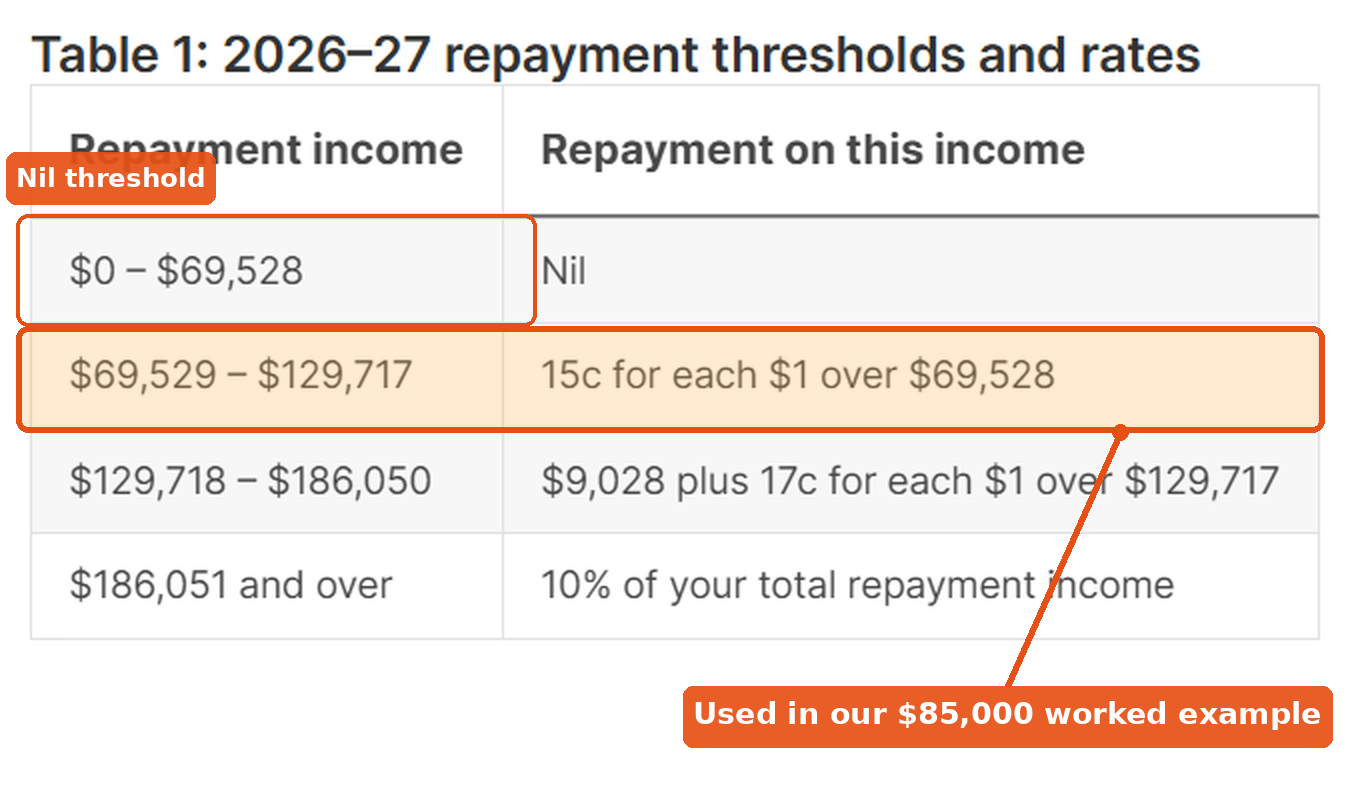
From the 2025–26 income year, the ATO changed how compulsory repayments are calculated. Repayments used to be a single flat rate applied to your entire income once you crossed the threshold, so a jump of even a few dollars in income could tip you into a materially higher repayment. From 2025–26 onward, it’s a marginal system instead: you only pay the relevant rate on the income above each threshold, the same logic as income tax brackets.
| Repayment Income (2026–27) | Repayment Rate |
|---|---|
| $0 – $69,528 | Nil |
| $69,529 – $129,717 | 15c for each $1 over $69,528 |
| $129,718 – $186,050 | $9,028 plus 17c for each $1 over $129,717 |
| $186,051 and over | 10% of total repayment income |
2026–27 Repayment Thresholds
If a repayment figure you’ve seen quoted elsewhere for your income doesn’t match what you calculate now, it’s most likely using an older threshold. Thresholds are indexed and reset every financial year, and the calculation method itself changed for 2025–26.
Worked Example: What HECS Actually Costs an $85,000 Earner
Take someone earning $85,000 in the 2026–27 financial year, working from the current ATO table above. Their income above the $69,528 threshold is $15,472. At 15c for every dollar over that threshold, their compulsory repayment for the year comes to $2,320.80 — about $193 a month.

That’s noticeably lower than it would have been even one financial year earlier. Under the 2025–26 thresholds, the same $85,000 income sat $18,000 above that year’s $67,000 threshold, producing an annual repayment of $2,700 — about $225 a month. The gap comes entirely from the threshold rising faster than the person’s income did between the two years.
How Lenders Turn That Into a Smaller Loan Amount
A $193 monthly repayment doesn’t sound like it should matter much against a six-figure home loan, but lenders don’t just subtract it once. They run it through a serviceability calculator that assesses your ability to repay at a stress-tested rate, not your actual one. APRA requires every lender to test your capacity to repay at your interest rate plus a buffer of at least 3 percentage points, and the calculator discounts a recurring monthly commitment through that same inflated rate — turning what looks like a small deduction into a meaningfully smaller loan amount.
Aussie Home Loans has published a worked example that shows the scale: on an $80,000 income with a HECS repayment of roughly $267 a month, they estimate the debt could reduce borrowing power by $50,000 or more compared with having no HECS debt at all. The exact figure depends heavily on the lender’s own calculator, your other debts and your income — it isn’t a fixed multiplier — but it shows the effect compounds well beyond the repayment amount itself.
This is also where a large HECS balance combined with other debt can trigger extra scrutiny. Some lenders, including NAB, apply stricter conditions once your total debt-to-income ratio reaches 6 times your income — a threshold a HECS debt can help push you toward if you’re also carrying a car loan or credit card debt.
The 2025 Debt Cut: Did Your Balance Actually Drop 20%?
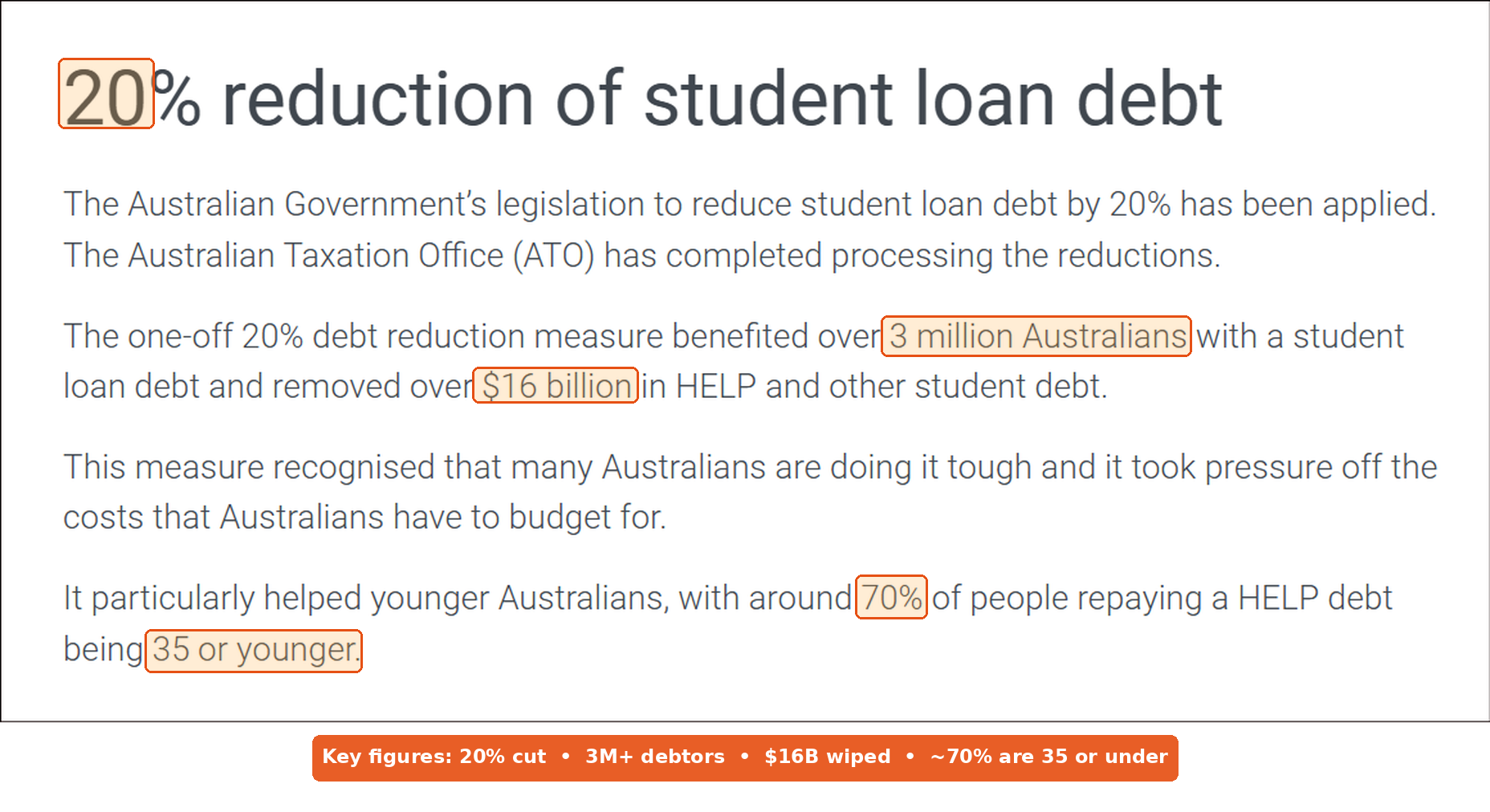
Yes, if you had a HELP debt as at 1 June 2025. The government legislated a one-off 20% reduction to every outstanding balance under HECS-HELP, FEE-HELP, STARTUP-HELP, SA-HELP, OS-HELP, VET Student Loans, Australian Apprenticeship Support Loans, the Student Start-up Loan and the Student Financial Supplement Scheme. It applied automatically — nobody needed to apply, and it isn’t optional.
The order of operations matters if you’re checking your own numbers: standard indexation for 2025 (3.2%) was applied on 1 June 2025 first, and the government then applied the 20% reduction retrospectively, adjusting both the underlying debt and the indexation just charged on it. The government’s own figures put around 70% of people repaying a HELP debt at 35 or younger, so the reduction landed heavily on the age bracket most likely to be applying for a first home loan in the next few years.
Indexation: Why Your Balance Still Grows Even While You’re Repaying It
Separately from your compulsory repayments, whatever HECS or HELP balance you’re still carrying gets indexed once a year, on 1 June, to keep its real value in line with inflation. A change legislated in 2024 caps this at whichever is lower — the Consumer Price Index or the Wage Price Index — which is why recent years look far more moderate than the highs some borrowers paid before the reform.
HELP Indexation Rate, By Year
Should You Pay HECS Off Faster to Borrow More?
There’s no discount for paying a HECS debt off ahead of schedule — the government removed the bonus for voluntary lump-sum repayments in 2024, so this is purely an opportunity-cost decision, not a guaranteed saving. Putting extra money toward your HECS balance instead of your deposit only helps your borrowing power if it drops your balance under $20,000, where some lenders stop counting it altogether, or gets you within about 12 months of paying it off completely, where APRA’s guidance allows a lender to leave the repayment out of serviceability.

For most people carrying a mid-sized balance well above either of those thresholds, a bigger deposit or a lower rate is the more direct lever — HECS repayments only become a serviceability problem worth actively managing once you’re close to one of those two cut-off points. A mortgage broker can run the actual numbers through a specific lender’s calculator, since the treatment of HECS debt varies more between lenders than almost any other line item in a loan application.
What This Means If You’re Planning to Buy
A HECS or HELP debt is a real but manageable drag on borrowing power, not a wall between you and a home loan. If you’re weighing it up against a scheme like Help to Buy or the 5% Deposit Scheme, the mechanics work independently of each other — your compulsory repayment reduces the size of loan you can service, while the deposit scheme changes how much deposit you need to get there in the first place. Getting an accurate read of your real borrowing capacity, alongside a smaller required deposit, is worth doing before you start looking.
FAQ: HECS/HELP Debt and Your Home Loan
Does a HECS or HELP debt stop me from getting a home loan?
No. It doesn’t appear on your credit file and isn’t grounds for a lender to refuse your application outright. The lender’s serviceability assessment factors it into how much you can borrow, not whether you can borrow at all.
How much will my HECS debt actually reduce my borrowing power?
It depends on your income, your lender and your other debts, but published examples suggest a moderate income with a HECS debt can see borrowing power reduced by tens of thousands of dollars compared with having no HECS debt. A mortgage broker can run the exact figure through a specific lender’s calculator.
Did my HECS balance actually get cut by 20%?
Yes, automatically, if you had a HELP debt as at 1 June 2025. You didn’t need to apply, and it covered HECS-HELP, FEE-HELP and several other government study and training loan types.
Should I pay off my HECS debt faster to borrow more for a house?
There’s no early-repayment bonus, so it’s an opportunity-cost decision rather than a guaranteed saving. It mainly helps your borrowing power if it gets your balance under $20,000 or within about 12 months of being fully repaid, since those are the two points where some lenders reduce or remove it from their serviceability calculation.
This article is general information only and doesn’t take into account your personal financial situation. It isn’t financial, tax or lending advice. Figures are based on official ATO and government sources current as of publication and may change. Speak with a licensed mortgage broker or financial adviser before making borrowing decisions.