Mount Barker development has run ahead of its infrastructure for 15 years. In 2010 the state rezoned 1,300 hectares of farmland around the town. Since then the population has blown past every forecast. So 2026 is the year the money finally started landing. A rebuilt hospital is rising on Wellington Road, and two freeway interchanges are under construction. On top of that, a new primary school now has a site. But some of the biggest asks, like rail and a second high school, still have no funding. Here is what’s real and what isn’t.
This article was produced and reviewed by the Australia Develops editorial team. See our Editorial Policy for sourcing standards and methodology.
How big Mount Barker development has become
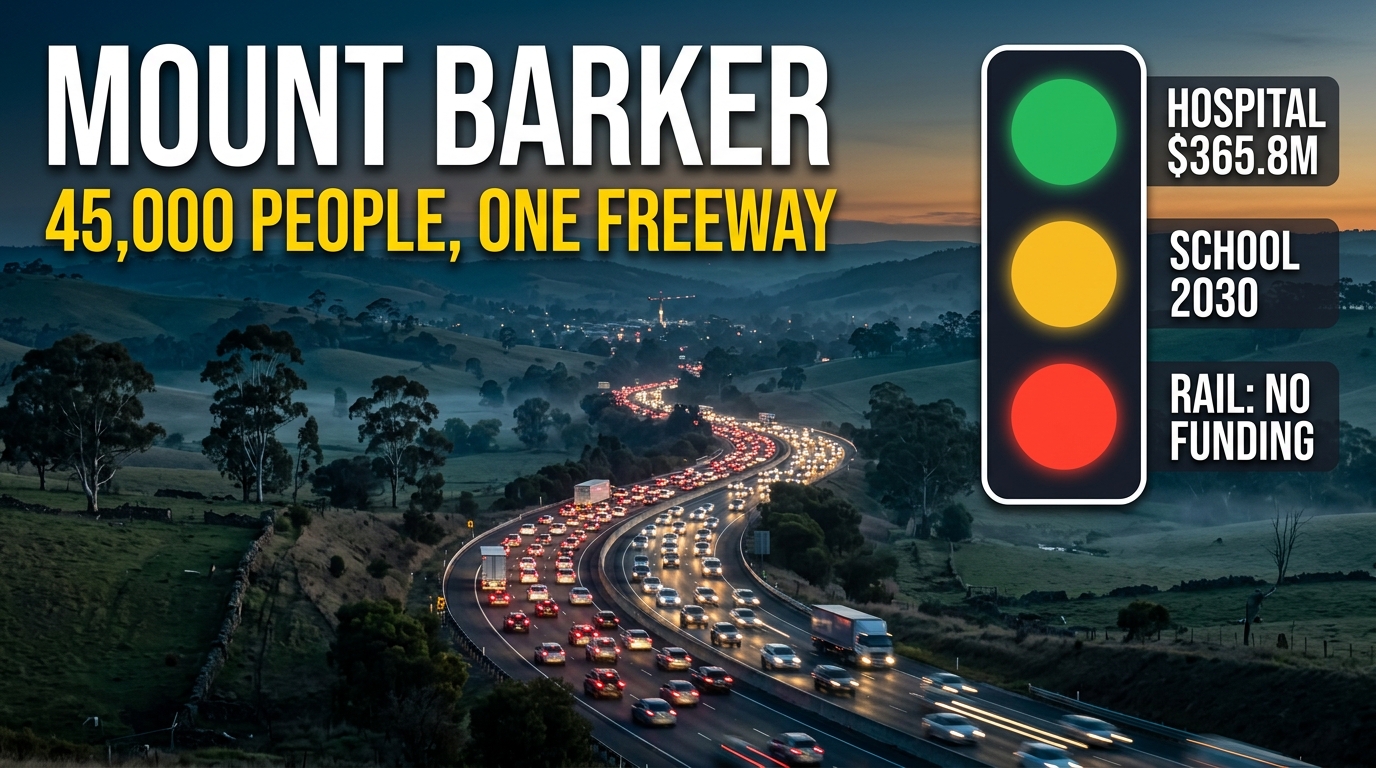
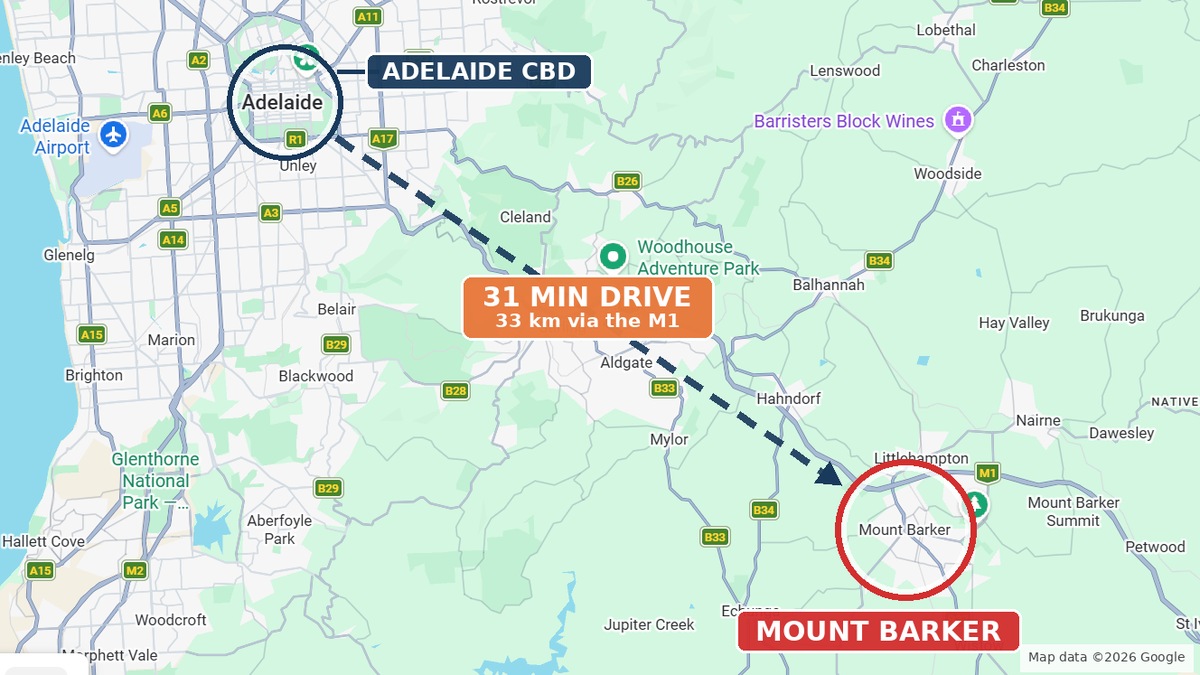
Mount Barker sits in the Adelaide Hills, on the South Eastern Freeway east of Adelaide. The 2010 rezoning targeted the first 15 years of Greater Adelaide’s 30-year plan. Back in 2003, planners expected the district to double from 15,000 to 30,000 people over 20 years. Instead, it reached about 45,000 residents by 2024, according to figures reported by InDaily.
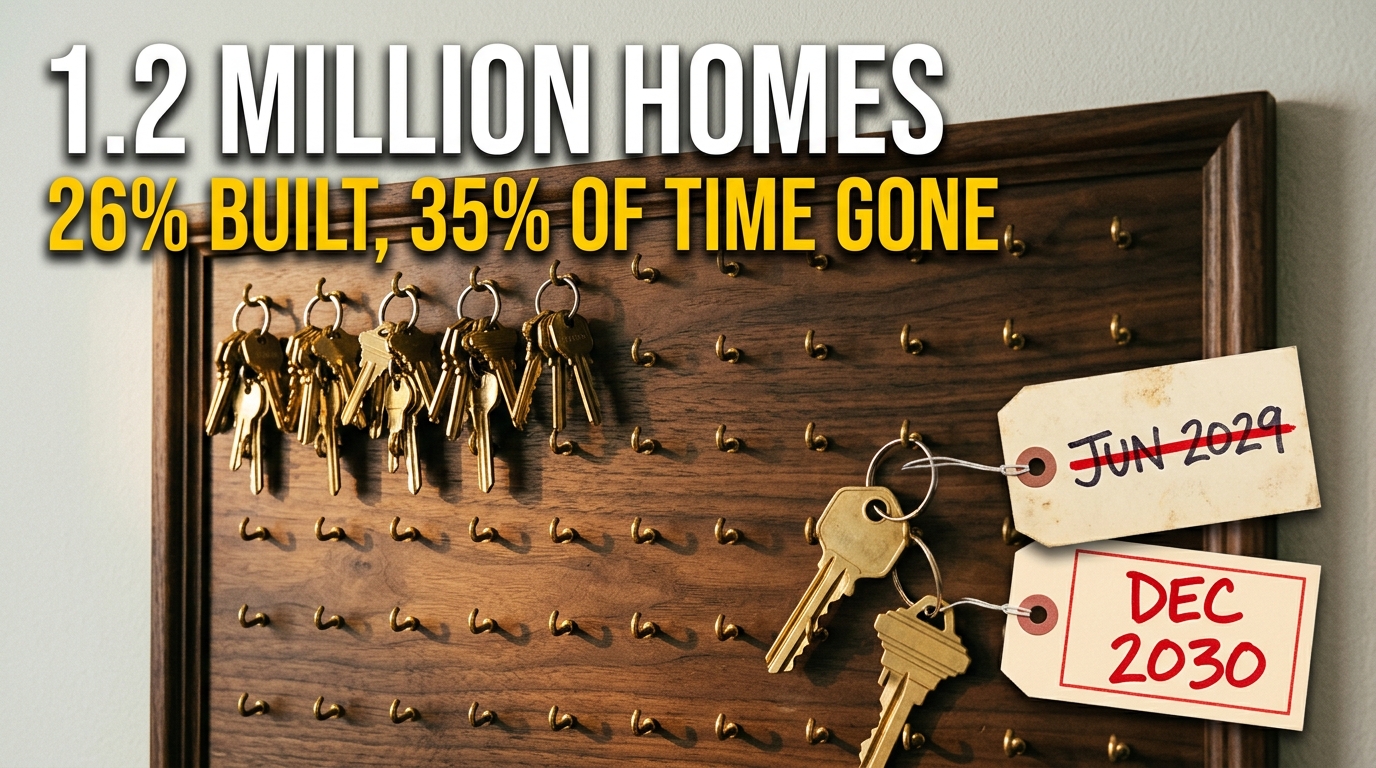
Yet most land earmarked for Mount Barker development is still paddock. In November 2022, the District Council of Mount Barker said developers had built on just over 17% of the rezoned area. By late 2025, InDaily put that at about 25%, or roughly 325 hectares. That means around three quarters of the growth area is still to come. The council also says there is “no indication that a slowdown in development and allotment creation is coming”. Developers released 571 allotments in 2021/22 alone.
Who is building the new estates
Mount Barker development is spread across several estates, and new players keep arriving.
- Cedar Woods. The ASX-listed developer bought 64 hectares in Mount Barker for more than 860 residential lots. It plans to launch in the 2027 financial year, with staged releases over several years.
- Civecon (Woodcrest). This is a $90 million project with 300 lots on 18 hectares, near the Heysen Boulevard extension.
- Newenham. It has more than 1,000 residents across about half its lots since 2015. The developer expects another five to eight years to finish.
- Springlake Communities and Lanser’s Clover Wood. Both sit next to the newer releases.
The catch is the connector road. Heysen Boulevard is the spine of the growth area, but developers build it in pieces under their own agreements. In 2022 the council said only 53% was complete after 12 years. Then the $5 million rail level crossing finally joined two broken sections, and it reopened on 3 November 2024.
The new Mount Barker hospital: $365.8 million
This is the biggest single project in town. It isn’t on a greenfield site. Instead, the state is rebuilding Mount Barker and District Soldiers’ Memorial Hospital on its existing Wellington Road land. Builder Built finished a new emergency department there in 2023. Now it is working on the Clinical Services Building, which is the heart of the project.
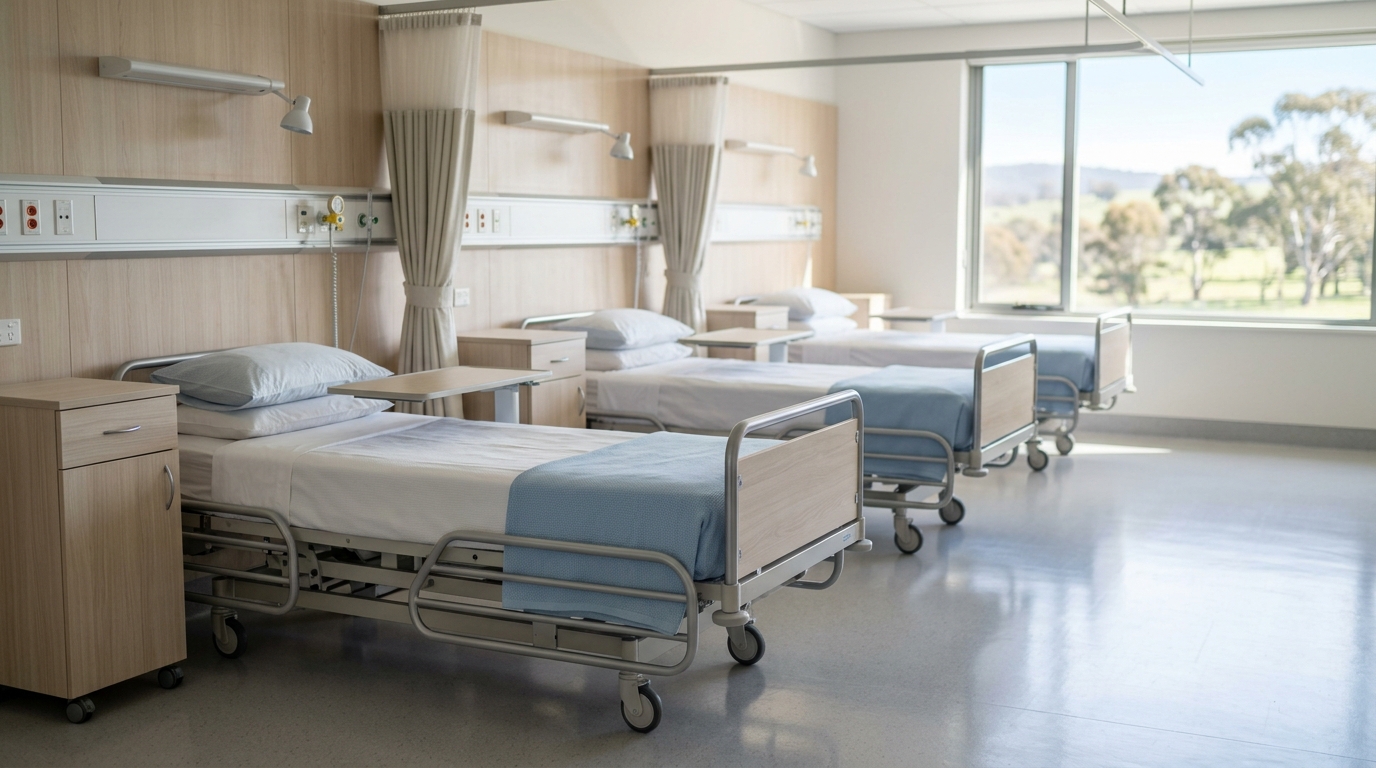
According to the Premier’s release on major works, the hospital will triple inpatient capacity from 34 to 102 beds. It adds specialist beds for maternity, paediatrics, mental health, palliative care and rehabilitation, plus new operating theatres. A 654-space multi-deck car park replaces the old 431-space lot. The government says it will open by the end of 2027.
Watch the price tag, though. When the government picked the site in January 2023, local paper The Courier reported a $220 million project. By the time construction started, the figure was $320.8 million. Now it is $365.8 million. The bed count also varies by source. Built’s own update says 32 to 104 beds, while the government says 34 to 102. Built marked the building’s topping out on 12 May 2026.

Freeway interchanges and the Bald Hills link
The Bald Hills Road interchange is old news. It opened in August 2016 as a $27 million job. Canberra paid $16 million, the state $8 million and the council $3 million. DIT lists no new Bald Hills upgrade today.
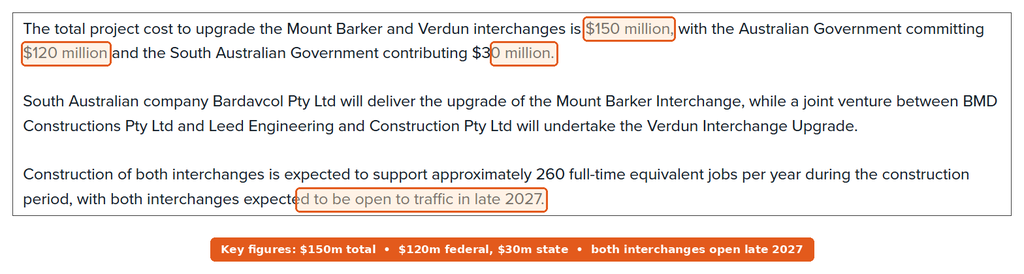
The live work is further west. The Department for Infrastructure and Transport is spending $150 million on the Mount Barker and Verdun interchanges. The Australian Government pays $120 million and the state pays $30 million. About 31,200 vehicles cross the Mount Barker interchange daily, and it logged 43 crashes from 2019 to 2023. So the upgrade adds a new three-lane northbound bridge, signals, a shared path and a priority bus lane. Verdun becomes a full interchange, which finally links Hahndorf and Mount Barker by freeway in both directions. Both should open to traffic in late 2027.
In town, the state is also fully funding a $40 million dual-lane roundabout where Adelaide, Alexandrina, Wellington and Flaxley roads meet. The government first said 2026 for completion. However, DIT’s project page now says the first quarter of 2027.
Schools for Mount Barker development
Schools are the sore point. A 2013 cabinet paper recommended a new R-12 school in Mount Barker South by 2018. It never happened. Today the council says a new classroom’s worth of children arrives every two months.

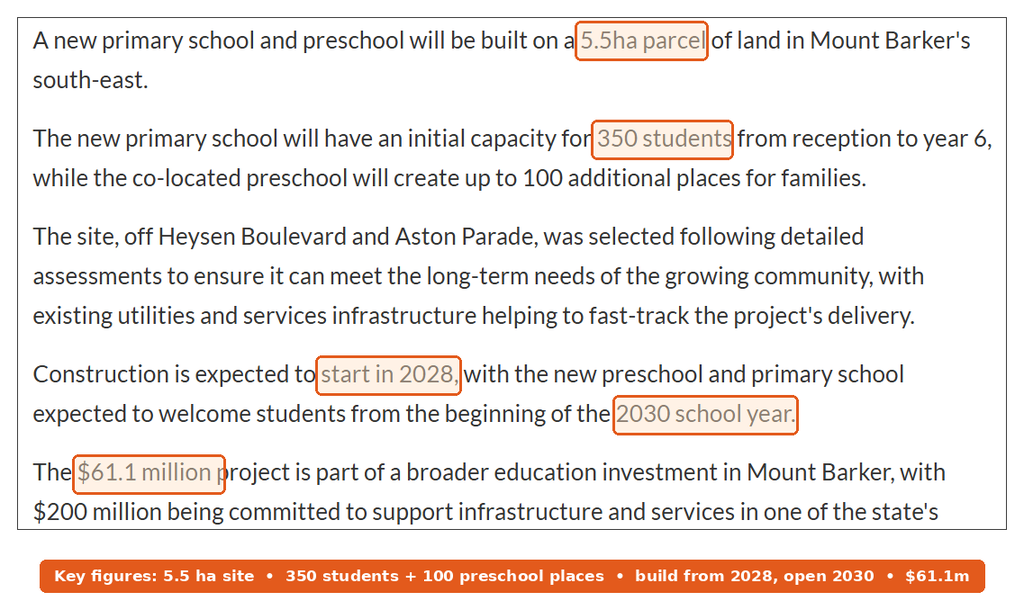
On 17 July 2026, the state named a site for a new preschool and primary school. It is a 5.5-hectare parcel off Heysen Boulevard and Aston Parade. The $61.1 million school will take 350 students from reception to Year 6, plus up to 100 preschool places. Construction starts in 2028, and students arrive from the 2030 school year.
Then there is the high school. Labor promised a $96 million Mount Barker High School redevelopment before the March 2026 election, adding 200 places. DIT’s September 2026 tender program also lists $96 million, still in planning with no tender date. But InDaily’s coverage of the June budget quoted $87 million. Separately, a $25.5 million TAFE trades workshop is already out to tender.
Rail and buses: the gap in Mount Barker development
Mount Barker has no passenger train. The Mount Barker and Adelaide Hills Transport Study ran from 2022, and DIT now lists it as “Planning complete”. Its ideas include an express bus service with its own fleet and depot. It also floats a bigger Crafers Park ‘n’ Ride and a Bridgewater Park ‘n’ Ride. For funding, the page says “To be determined”.

In 2024, InDaily reported the costed options. Running trains on the existing freight line would cost about $250 million but take 71 minutes to the city. A new heavy rail corridor would cut that to 37.5 minutes, yet cost $5.8 billion. By contrast, a bus rapid transit system came in at about $300 million. None has a construction budget, so Mount Barker development still leans on one freeway.
What does work today is the Mount Barker On-Demand bus. It has carried more than 502,000 trips since January 2020. Also, the 2025-26 budget locked in $2 million a year to keep it running.
What the 2026 budget funded for Mount Barker development
In January 2026, Premier Peter Malinauskas and Mayor David Leach, then a Labor candidate, announced a $200 million plus plan for the town. After the election, the June budget picked up several items.
- Adelaide and Hawthorn Road intersection. It gets $80 million over five years, with $17.5 million in 2026-27.
- Police station. The budget gives $5 million over two years for planning only. That covers two stations, at Mount Barker and Murray Bridge.
- Buses. It adds more services between Murray Bridge and Mount Barker.
What’s still missing or not confirmed
- No funding exists for any passenger rail, and no route or station is chosen.
- The express bus service and depot from the transport study have no budget.
- A second high school was promised as a land purchase only. No amount, site or date was found.
- The police station has planning money, but nothing to build it.
- The high school figure differs between sources ($96 million or $87 million).
- In June 2025 the council asked the state and federal governments for $48 million, for wastewater, public transport, education and roads. How much it received could not be confirmed.
Editorial take: Mount Barker development is finally getting the catch-up spending it should have had a decade ago. The hospital and the interchanges are real, funded and both due by the end of 2027. That will change daily life more than any new estate. But the commute is still a car on one freeway. Without a funded bus rapid transit line, every new lot adds to the same queue at Crafers. So the case for buying here rests on space, schools from 2030 and the hospital, not on a train that may never come.
If you’re comparing South Australian growth areas, see how Riverlea Park and Angle Vale stack up, and check the 5% deposit scheme caps before you sign.
This article is general information based on South Australian Government, Department for Infrastructure and Transport, District Council of Mount Barker and developer material available at publication. It isn’t financial advice. Budgets, timelines and project scopes can change, so check current details with the agency or developer before you buy.