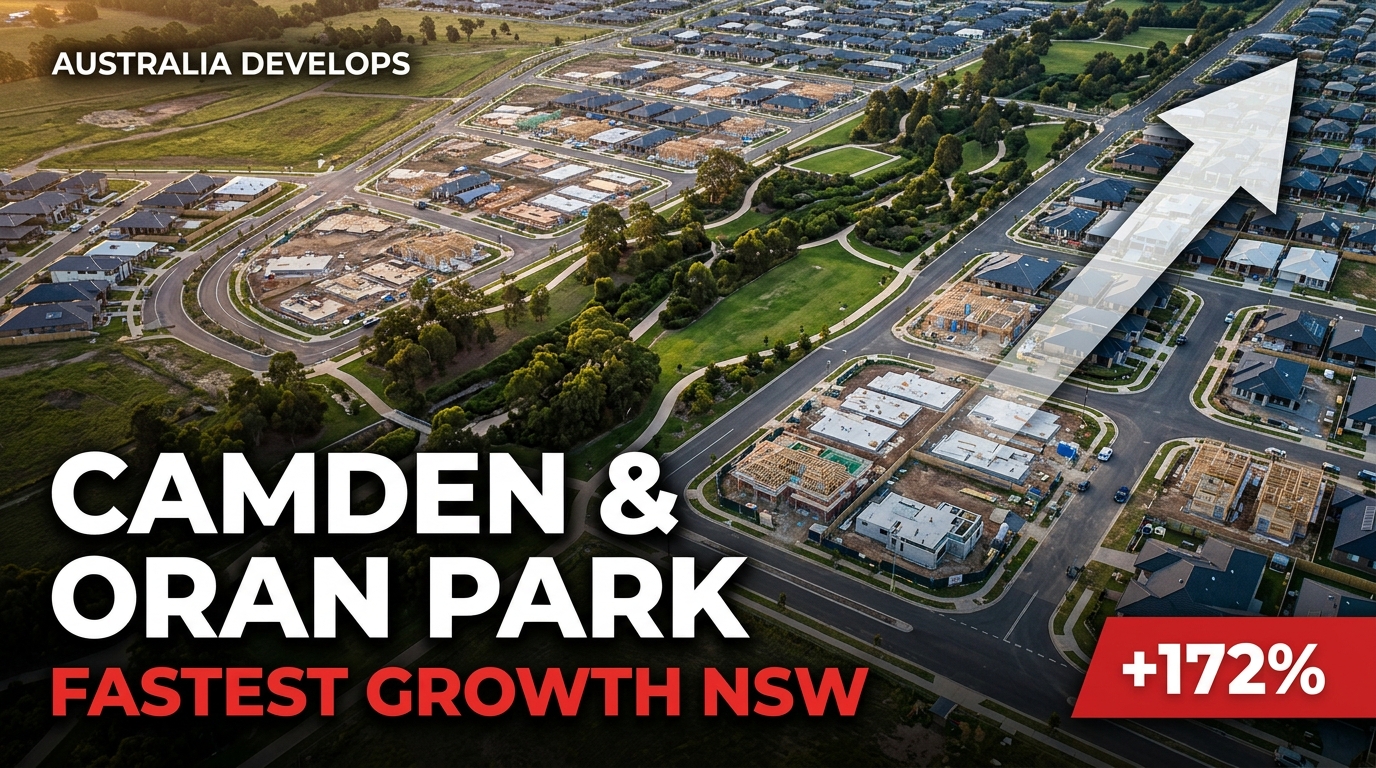
Camden Oran Park development 2026 confirms Camden as the fastest-growing local government area in New South Wales. Furthermore, by some measures it ranks among the fastest-growing in all of Australia.
The Camden LGA covers the south-western fringe of Greater Sydney. It encompasses a string of rapidly urbanising precincts — Oran Park, Leppington, Gregory Hills, Gledswood Hills, and newer growth corridors.
Together, these represent the leading edge of Sydney’s residential expansion. In 2026, the cumulative weight of infrastructure delivery, rezoning decisions, and population milestones is reshaping the LGA.
Consequently, it is moving from a dormitory fringe into a self-contained urban region, with its own hospitals, schools, commercial centres, and transport links.
This guide provides a comprehensive, data-verified overview of the most significant development themes across Camden LGA and Oran Park in 2026.
Written by Daniel Whitfield, founder of Australia Develops, who has personally bought, subdivided, and built property across Australia. Updated July 2026.
The scale of what is happening in Camden is best understood through the numbers. The LGA is forecast to grow by 172.9% by 2040. Indeed, this represents an addition of approximately 137,700 people.
This makes it the second-largest volume population growth LGA in Greater Sydney, after the Liverpool–Campbelltown corridor. Furthermore, this growth is attracting sustained Foreign Direct Investment (FDI) Australia interest into south-western Sydney infrastructure.
Development application activity tells a similar story. Leppington recorded 524 DAs and Oran Park 466 DAs in the 12 months to mid-2026. Consequently, these are the two most active DA suburbs in the entire Camden Council area.
Understanding what is driving this activity is essential context for anyone tracking Sydney’s south-western growth corridor. For related coverage of the broader Western Sydney development context, see Australia Develops’.
Guides to the Liverpool City Centre rezoning and the Campbelltown–Macarthur development corridor.
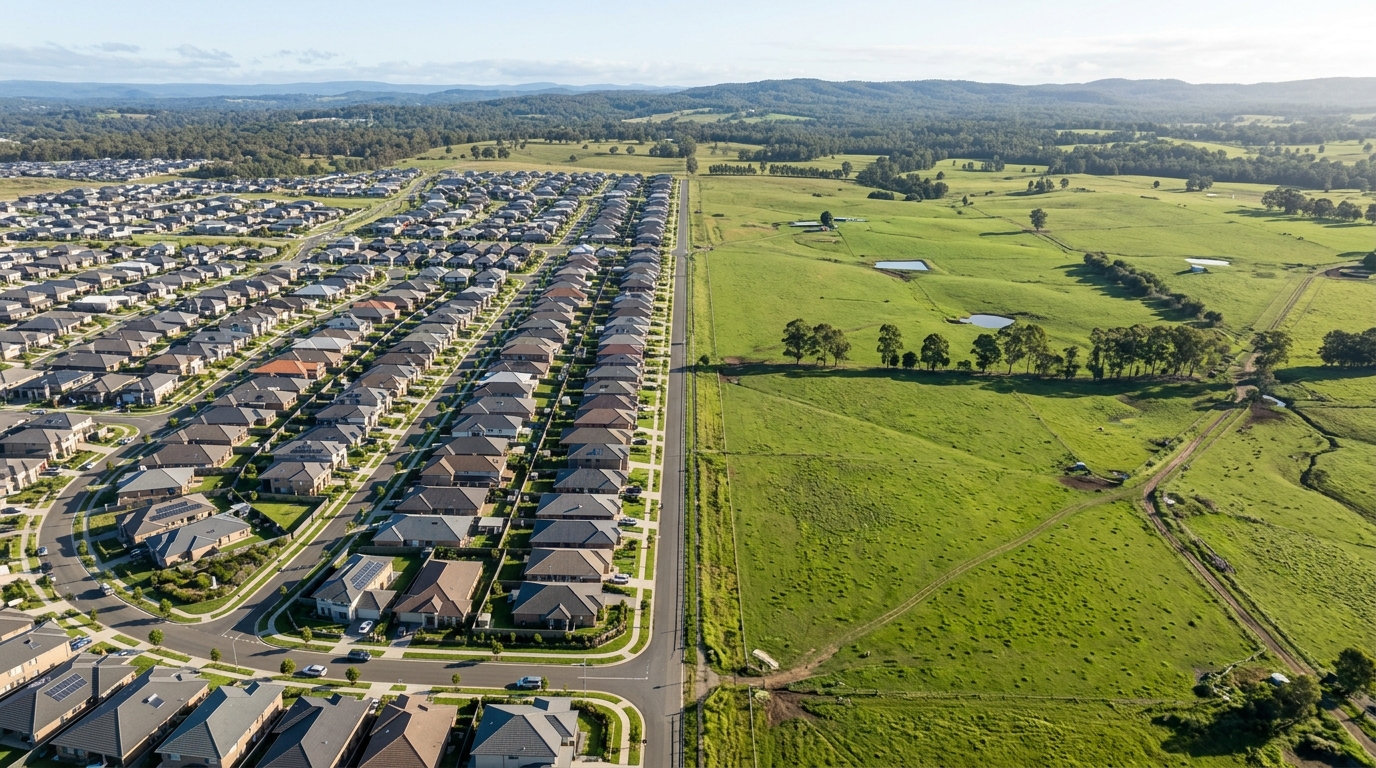
Camden and Oran Park Overview: Why This Growth Area Matters
Camden Council covers approximately 654 square kilometres of south-western Sydney. This spans from the established urban areas around historic Camden township in the south to the rapidly urbanising growth precincts along The Northern Road corridor in the north.
The LGA’s population was approximately 107,620 at the 2021 Census. It is estimated to have grown to around 145,000 by mid-2026, a gain of nearly 40,000 people in five years.
This reflects the concentrated effect of greenfield land release, infrastructure investment, and demand from young families seeking affordable housing within commuting distance of Western Sydney and Sydney CBD jobs. Demographic Solutions’ analysis of Camden migration patterns identifies interstate and overseas migration, alongside established-suburb-to-fringe movement, as the dominant growth drivers.
Young families with children remain the primary demographic cohort choosing Camden.
Camden’s Economic Development Strategy
The economic development profile of Camden has been set by the Camden Economic Development Strategy 2022–2026, which identifies four strategic priorities: delivering new commercial and employment land to reduce the LGA’s reliance on out-commuting.
Building the health, education, and retail services necessary to serve a rapidly growing population. Ensuring that infrastructure delivery keeps pace with residential growth; and leveraging the proximity of the Western Sydney International (Nancy-Bird Walton) Airport to catalyse freight, logistics, and advanced manufacturing investment in the northern parts of the LGA.
The opening of the airport to cargo in July 2026 and passengers in October 2026 is expected to have a significant secondary effect on Camden’s northern precincts, particularly Leppington, which sits within the airport’s influence zone.
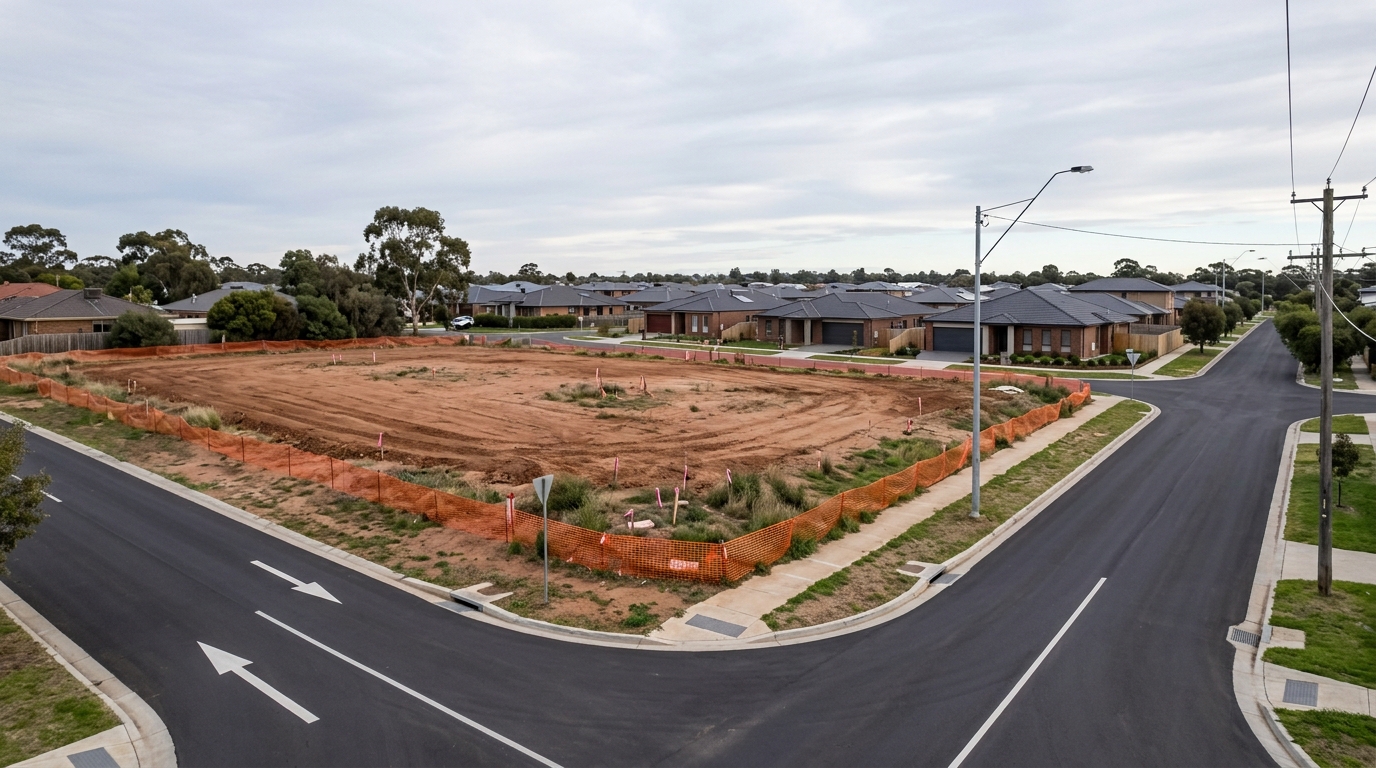
Indeed, this transition is visible along the corridor, as pictured below.
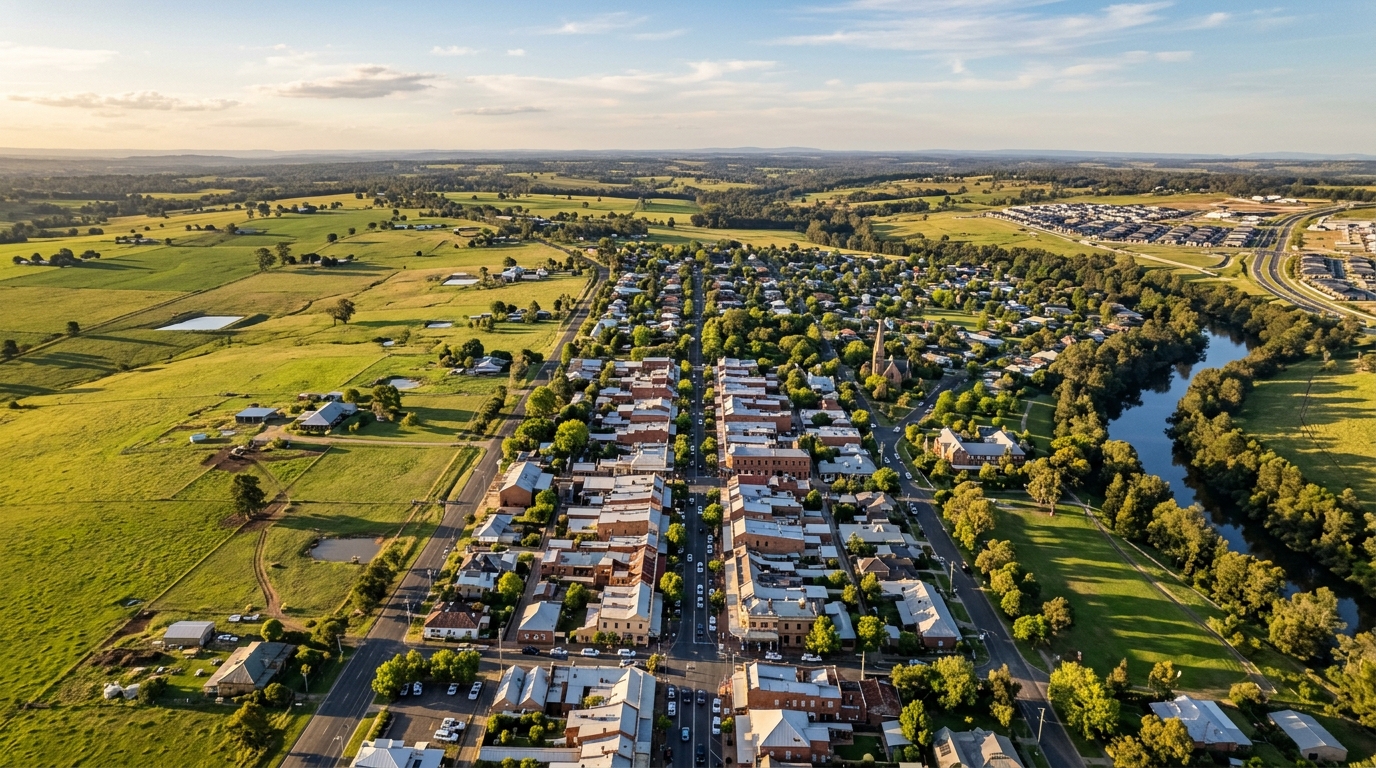
Moreover, the figures below quantify the pace of this growth corridor.
Indeed, the figures below summarise Camden LGA’s scale and economic profile.
This population growth is a direct driver of the development activity tracked across the corridor.
Oran Park Precinct 2026: Population, Retail, and the Airport Connection
Oran Park is the most advanced of Camden’s major greenfield precincts and has reached a stage of development where it functions as a genuine town centre rather than simply a residential estate.
The precinct’s population reached approximately 27,447 as of February 2026, representing a 55.7% increase since the 2021 Census when 17,639 people lived there — one of the highest five-year growth rates of any suburb in New South Wales.
The Landcom Oran Park Town development masterplan envisages a 380-hectare community of approximately 10,000 dwellings housing 35,000 people at full build-out, meaning the precinct is now past its midpoint in residential delivery and entering the phase where commercial and civic infrastructure investment is intensifying to serve the established population base.
Commercial Milestones in Oran Park
The major commercial milestones in Oran Park during 2026 include the opening of the 184-room Atura Hotel. This full-service hotel signals the precinct’s transition to a visitor destination as well as a residential suburb.
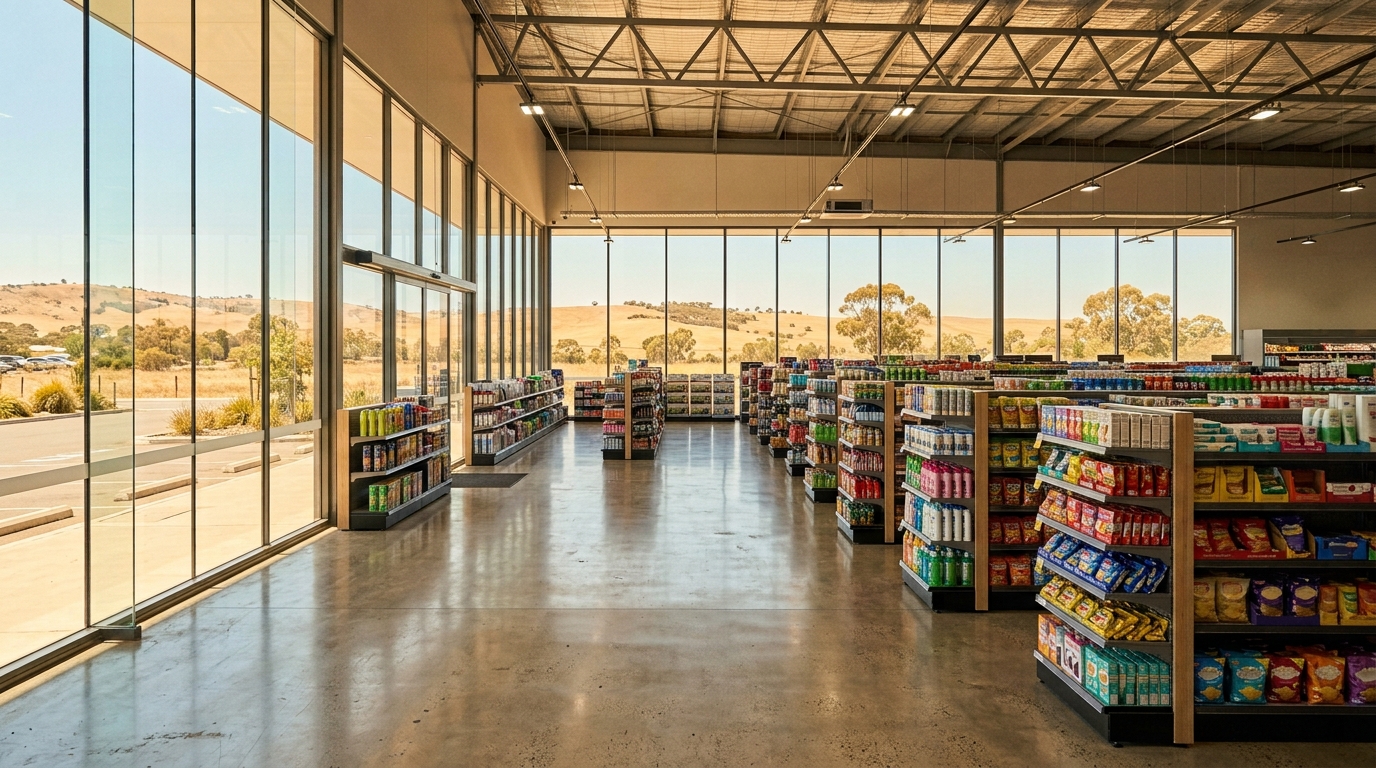
Additionally, The Podium retail and entertainment precinct has expanded to 28,800 sqm, adding dining, entertainment, and service retail capacity to an already well-patronised centre. Rapid bus services now connect Oran Park to the Western Sydney International Airport at Badgerys Creek.
This represents a significant accessibility improvement. The direct service cuts travel times for residents commuting to airport-adjacent employment centres, positioning the suburb as a logical address for airport workers.
Macroplan’s commercial space demand analysis for Oran Park Town Centre projects substantial growth in office and service retail demand through to 2031, as the residential population approaches its planned ceiling and spending capacity increases.
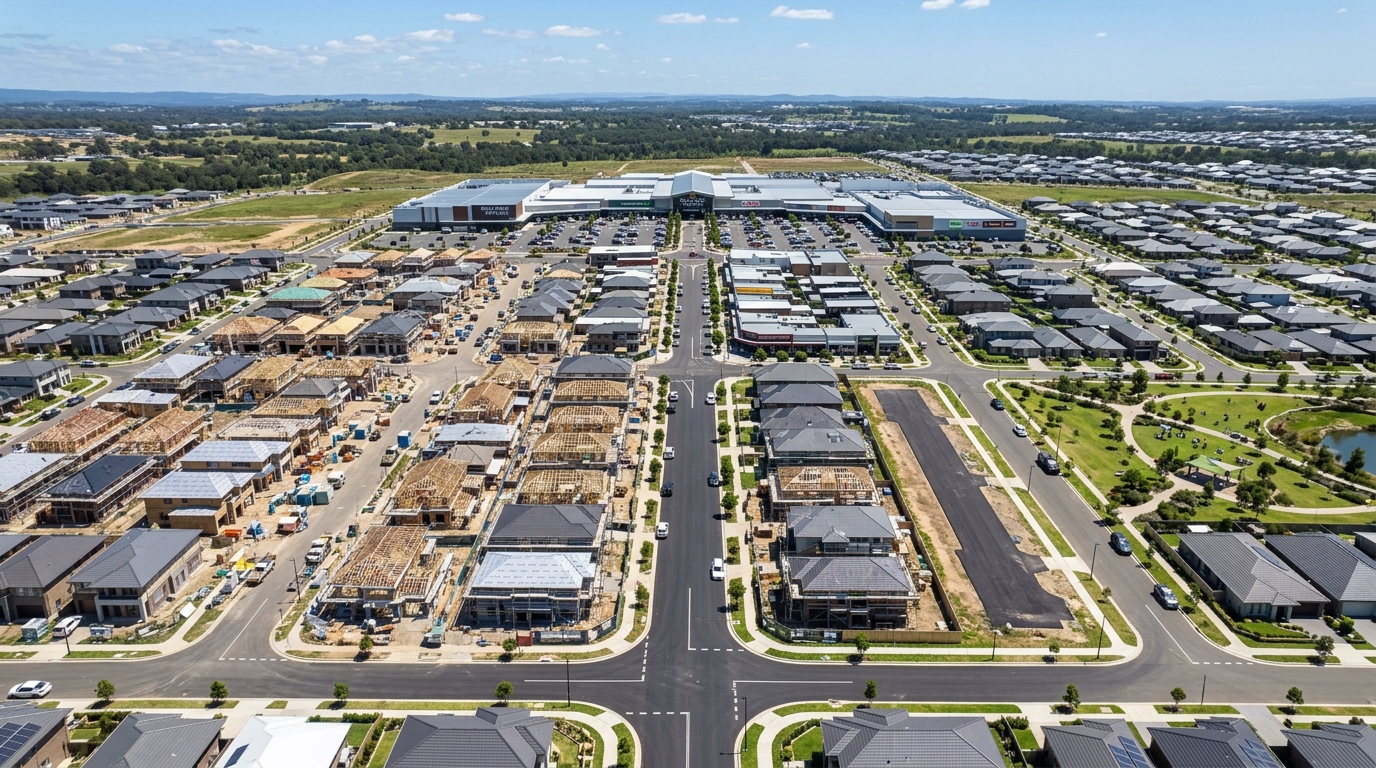
Development application activity in Oran Park reflects this maturation. The 466 DAs lodged in the 12 months to mid-2026 include a mix of residential completions in the outer stages of the estate, commercial and retail fitouts in the town centre, and childcare, medical, and educational facilities serving the established community.
The DA pipeline indicates that the precinct is moving from its primary residential construction phase into a secondary phase of community infrastructure intensification.
This represents a pattern typically associated with above-average rental demand and stable owner-occupier market conditions as amenity matures.
Furthermore, the milestones below mark Oran Park’s transition to a mature town centre.
Leppington Town Centre: The Rezoning That Changes Everything
The most significant single planning event in the Camden LGA in 2026 is the finalisation of the Leppington Town Centre state-assessed rezoning.
The NSW Department of Planning, Housing and Infrastructure (DPHI) identified it as a State-Assessed Rezoning Precinct (SARP) in December 2024.
It was finalised in the first quarter of 2026. The Minns Labor Government’s decision to take the rezoning to state level, bypassing the local council process, reflects both the strategic importance of the precinct and the NSW Government’s commitment to accelerating housing delivery in the south-western growth area.
Consequently, the rezoning unlocks approximately 11,500 new homes over 20 years across a 440-hectare precinct that spans the Camden and Liverpool Local Government Areas, anchored around Leppington Station on the T8 Airport & South Line.
Furthermore, this scale of delivery mirrors the momentum already tracked in Australia Develops’ Leppington development pipeline coverage. Full details are available on the NSW Planning Portal’s Leppington Town Centre page.
Oran Park Corridor Planning Controls and Rezoning
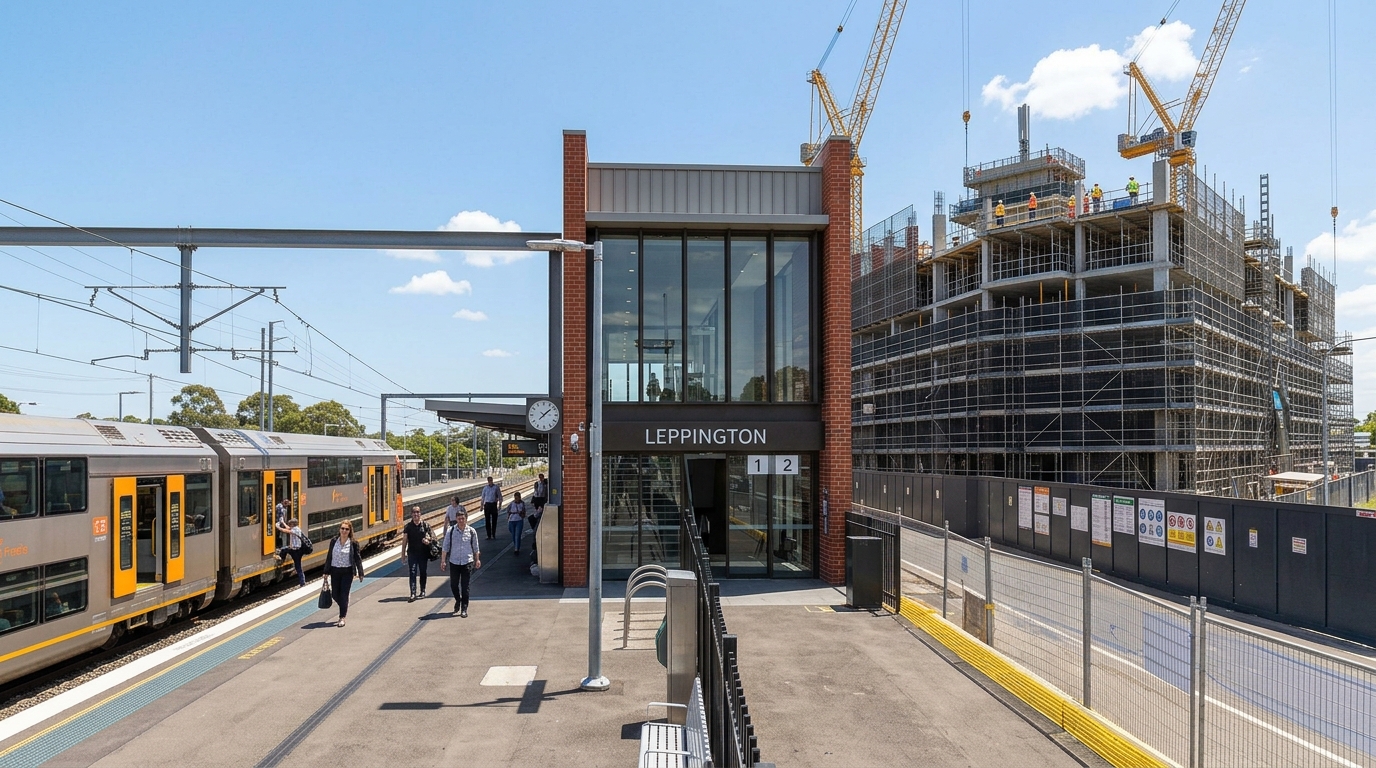
The planning controls established by the rezoning are notable for their ambition relative to the LGA’s existing development character. Maximum building heights of between three and 30 storeys — up from a previous maximum of 20 storeys in key locations.
Signal that DPHI intends Leppington to evolve as a genuinely urban mixed-use centre rather than a low-rise suburban node. The rezoning mandates a minimum three per cent affordable housing requirement for residential development in perpetuity.
This represents a provision that will apply across the precinct throughout its 20-year delivery horizon. The precinct is designed to generate up to 11,000 jobs over the longer term through commercial, retail, health, education, and light industrial uses, reducing the structural employment deficit that has historically characterised Camden LGA and forced residents to out-commute for work.
The proximity to the Western Sydney International Airport — approximately 15 kilometres via the improved road network. Is a material advantage for Leppington’s commercial and industrial development prospects. The NSW Government’s ministerial release on the finalised rezoning details the full suite of planning controls and infrastructure commitments.
Oran Park Corridor Budget and Infrastructure Funding
The 2026–27 NSW Budget includes $4.1 billion for new and upgraded schools in Western Sydney, with Leppington among the key beneficiaries.
Commitments include a new primary school for Austral South with co-located public early learning, an upgrade at Leppington Public School with co-located early learning facilities, and a new high school for Leppington.
Infrastructure that is critical to the precinct’s ability to attract and retain young families at the scale the rezoning envisions.
The education investment is being delivered in parallel with the rezoning to avoid the infrastructure lag that has affected earlier greenfield precincts in Western Sydney, where residential development preceded school and health service delivery by years.
Additionally, this construction activity directly supports the rezoning outlined below.
Gregory Hills and Gledswood Hills: Health, Commercial, and Education Investment
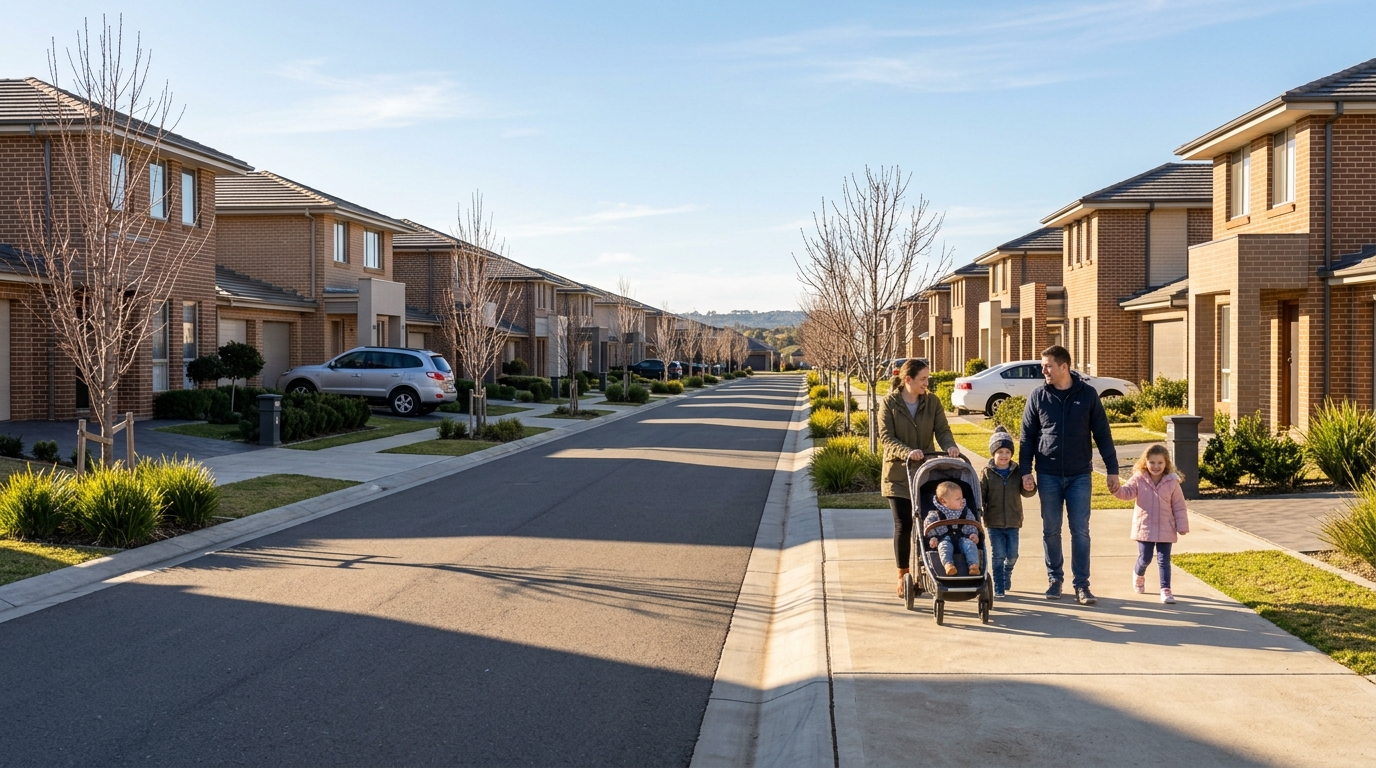
The Gregory Hills and Gledswood Hills precincts — which share an SA2 statistical area for demographic tracking. Have grown to a combined population of approximately 20,556 as of May 2026, a 43.8% increase since the 2021 Census.
This growth rate substantially exceeds both the NSW state average (7.1%) and the Greater Sydney average, cementing the precinct as one of the most dynamic residential growth areas in the country.
The AreaSearch demographic profile for the combined suburb identifies a population dominated by young families with children, with high rates of owner-occupation and a median household income above the Western Sydney average.
This represents a demographic profile that underpins strong demand for quality health, education, and lifestyle infrastructure.
Camden Medical Campus and Health Investment
The most significant infrastructure development in Gregory Hills for 2026 is the Camden Medical Campus, a $330 million private hospital development that has received NSW State Government planning approval and is currently under construction.
The six-storey facility will deliver 473 surgical beds and represents the first purpose-built private hospital to serve the Camden LGA.
This represents a population that has historically been forced to travel to Liverpool, Campbelltown, or Sydney CBD for specialist hospital services.
The project is being developed as phase one of a broader $500 million health and innovation precinct, with HealthCo as the developer.
The delivery of a major private hospital in Gregory Hills is a structural amenity improvement that materially enhances the precinct’s long-term liveability and strengthens the case for continued residential and commercial development in the area.
The George Centre, a paediatric and maternity private hospital, is part of the same precinct and has been operating since 2023.
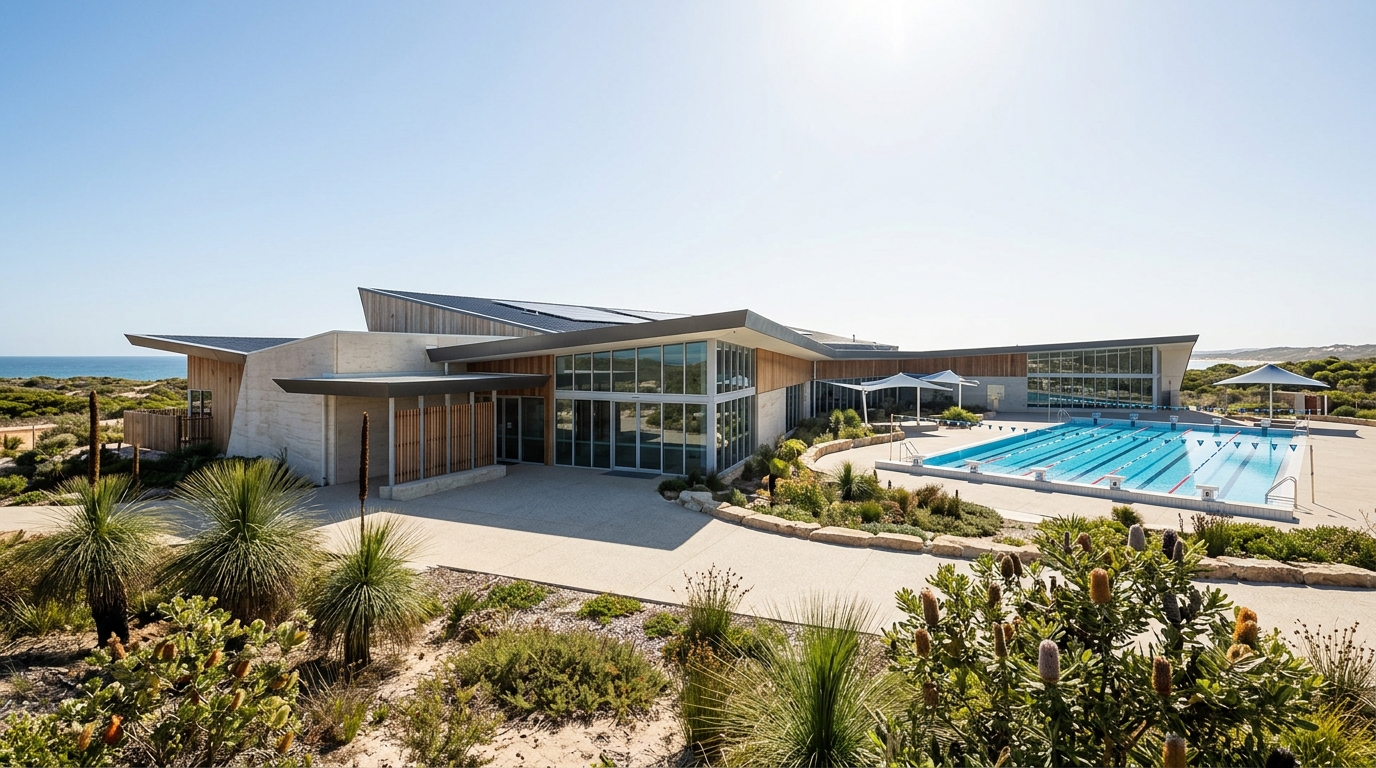
This investment builds on the broader commercial momentum in the precinct, pictured below.
Commercial and Retail Investment
Commercial development in Gregory Hills is also progressing in 2026. HQ Gregory Hills and Central Hills Plaza are among the office and retail developments scheduled for completion during the year.
Indeed, this pattern of institutional investment infrastructure spreading into second-tier growth precincts is reshaping commercial real estate yields across the broader Macarthur sub-region —. This represents a trend explored further in Australia Develops’ NSW Commercial Real Estate 2026 guide.
A heritage-inspired mixed-use village precinct has planning approval and is in delivery. It features boutique shopping, cafes, restaurants, a supermarket, cinema, gymnasium, childcare, specialty retail, and 358 residential apartments.
This adds a high-amenity mixed-use destination that will serve the combined Gregory Hills–Gledswood Hills catchment. Additionally, it complements the existing Narellan Town Centre, which remains the primary sub-regional retail centre for the broader Macarthur area.
The Gregory Hills high school, operating from a temporary campus since Term 1 2025, is scheduled for its permanent building to open for the 2027 school year, subject to approvals.
Oran Park and Camden Road Infrastructure Delivery
One of the most consistent criticisms of greenfield growth areas in Western Sydney has been the gap between residential development and the delivery of road infrastructure necessary to make those communities functional.
Camden LGA has been particularly vocal in its advocacy for road investment, with Camden Council’s road infrastructure advocacy identifying the Hume Motorway access network, Camden Valley Way, and The Northern Road as priority corridors.
The 2026 infrastructure picture is meaningfully better than it was in 2023–24, with three major projects either completed or in under construction and a further two in planning.
Oran Park Road Links: Northern Road and Spring Farm Parkway
The Northern Road widening is a $1.6 billion, 35-kilometre project. It upgrades the corridor from The Old Northern Road at Narellan to Jamison Road at South Penrith to a minimum of four lanes.
The project reached substantial completion in March 2026, ahead of the opening of the Western Sydney International Airport. Delivered under the Commonwealth’s Western Sydney Infrastructure Plan, it is transformative for Camden LGA’s northern precincts.
Furthermore, it cuts travel times to Penrith, Parramatta, and the airport corridor. This increases the practical catchment of employment accessible to residents within a reasonable commute —.
This represents a dynamic examined in more detail in Australia Develops’ Ultimate WSI Transport Guide.
Spring Farm Parkway Stage 1, which opened in August 2024, delivers a new connection between Spring Farm and the Hume Motorway.
It saves local drivers up to 15 minutes compared to previous route options, reducing pressure on the Camden Valley Way corridor through Narellan.
Camden Valley Way and Local Road Upgrades
Construction commenced in January 2026 on a $32.7 million upgrade to Camden Valley Way and Liz Kernohan Drive, widening the corridor between Kirkham Lane and Hilder Street to two lanes in each direction and raising the road level to reduce flood risk.
This represents a chronic issue for this route that has caused disruption during weather events. Planning is now underway on the Camden Bypass extension, which will provide an alternative route for freight and through-traffic bypassing the Camden Township, and Transport for NSW is advancing planning for Spring Farm Parkway Stage 2.
The Camden Council road infrastructure advocacy page details the full suite of projects that the Council is pursuing with state and federal governments, including a strategic options study for improving access to and egress from the Hume Motorway between Narellan Road and Picton Road, which carries more than 52,000 vehicles daily.
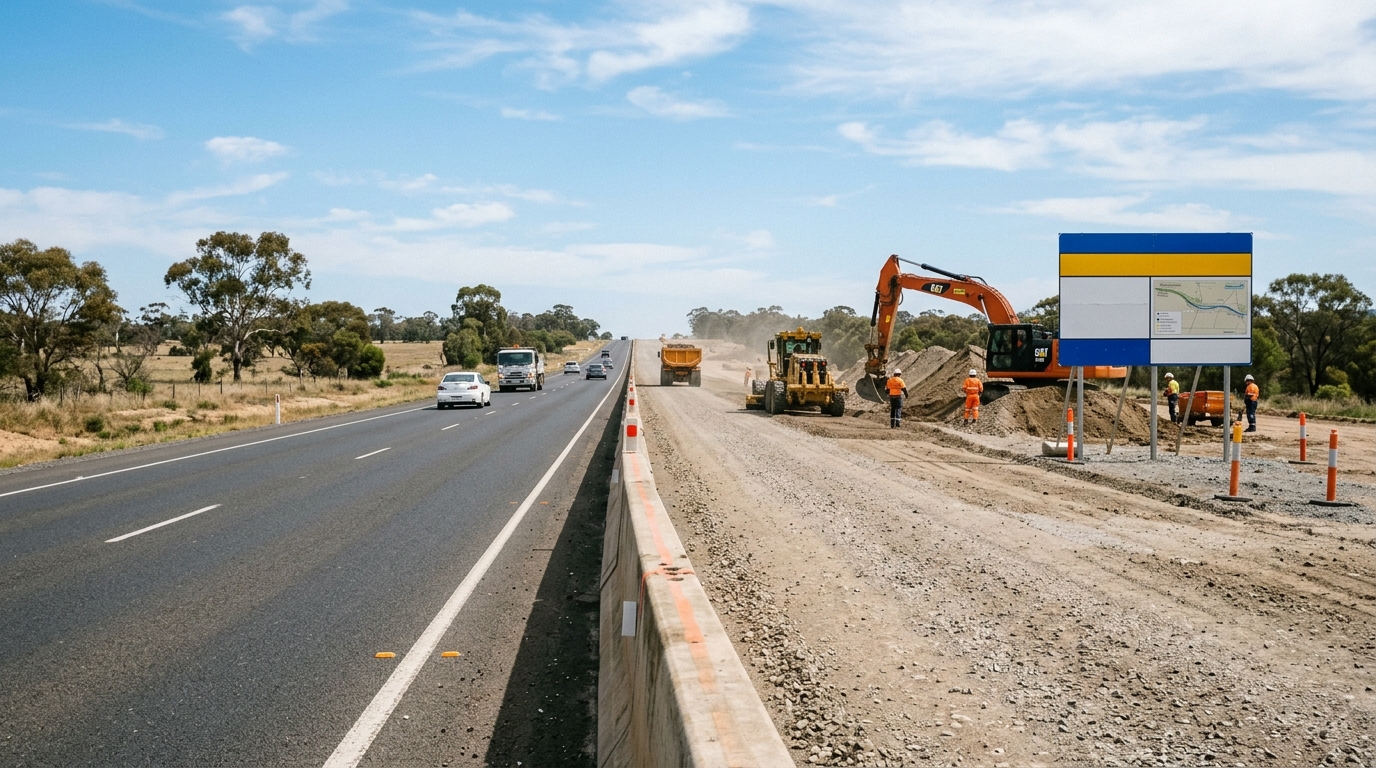
Indeed, this upgrade illustrates the scale of works underway across the road network.
Indeed, several major road projects have progressed on a tight sequence through 2024–2026.
Camden Oran Park Development 2026: Key Data at a Glance
| Metric | Figure |
|---|---|
| Camden LGA Population (est. mid-2026) | ~145,000 |
| Camden LGA Growth Forecast to 2040 | +172.9% (+137,700 people) |
| Oran Park Population (Feb 2026) | 27,447 (+55.7% since 2021) |
| Oran Park Planned Dwellings (full build-out) | 10,000 homes / 35,000 people |
| Leppington Town Centre Rezoning Area | 440 ha (Camden + Liverpool LGAs) |
| Leppington New Homes (20-year plan) | ~11,500 |
| Leppington Jobs (long-term) | Up to 11,000 |
| Leppington Max Building Height | 30 storeys |
| Gregory Hills Medical Campus | $330M, 473 beds (under construction) |
| Northern Road Widening (completed Mar 2026) | $1.6B, 35km, 4 lanes |
| Camden Valley Way Upgrade (started Jan 2026) | $32.7M |
| Top DA Suburbs in Camden Council (12 months) | Leppington (524), Oran Park (466) |
| NSW Budget Schools Investment (Western Sydney) | $4.1B (incl. new Leppington schools) |
Furthermore, this delivery sequence directly supports the development activity outlined below.
Summary — What Camden and Oran Park Development in 2026 Means for the South West
Camden LGA in 2026 is at an inflection point. The first generation of its growth precincts — Oran Park, Gregory Hills, Gledswood Hills — are transitioning from construction sites into functioning urban communities with a full suite of amenities, while the second generation — Leppington, Austral South, Catherine Field.
Is being unlocked by the rezoning and infrastructure decisions being finalised this year. The Leppington Town Centre rezoning is the most consequential single planning event, establishing the framework for a genuinely mixed-use urban centre of 11,500 homes and 11,000 jobs anchored around an existing rail station and positioned within 15 kilometres of the new Western Sydney International Airport.
The concurrent delivery of the Northern Road widening, Spring Farm Parkway, and Camden Valley Way upgrade is closing the infrastructure gap that has historically constrained the area’s development potential.
Overall, the summary below distills the key 2026 takeaway for each Camden and Oran Park precinct.
What This Means for the South West
For planners, developers, infrastructure agencies, and community members tracking Western Sydney’s evolution, Camden’s trajectory in 2026 offers a worked example.
It shows what structured growth area delivery can achieve when land release, planning controls, infrastructure investment, and community services are sequenced effectively.
The challenges that remain — out-commuting rates, commercial employment density, health service capacity, and traffic congestion on residual secondary roads —. Are real. They will require sustained investment beyond the current cycle.
However, the foundation being laid in 2026 is materially stronger than it was three years ago. The opening of the Western Sydney Airport this year adds a long-term economic catalyst.
Consequently, it is likely to amplify the commercial development trajectory of Camden’s northern precincts for a decade or more, a theme also covered in Australia Develops’ Western Sydney Airport Property Hotspots guide.
Additionally, sustained population growth of this scale is reshaping housing demand across the wider corridor, as tracked in Australia Develops’ Sydney Rental Market 2026 report. For more context on the broader south-western growth corridor, see Australia Develops’.
Coverage of the NSW TOD rezoning program and its implications for transport-oriented density across Sydney.
Frequently Asked Questions
How fast is Camden LGA growing in 2026?
Camden LGA is forecast to grow by 172.9% by 2040, an addition of approximately 137,700 people, making it the second-largest volume population growth LGA in Greater Sydney after the Liverpool–Campbelltown corridor.
What does the Leppington Town Centre rezoning include?
The rezoning unlocks approximately 11,500 new homes and up to 11,000 jobs across a 440-hectare precinct, with maximum building heights of up to 30 storeys, anchored around Leppington Station on the T8 Airport & South Line.
How advanced is development in Oran Park?
Oran Park’s population reached approximately 27,447 as of February 2026, up 55.7% since the 2021 Census, with 466 development applications lodged in the 12 months to mid-2026 as the precinct matures into a genuine town centre.
What road infrastructure is being delivered in Camden LGA?
The $1.6 billion Northern Road widening reached substantial completion in March 2026, alongside the August 2024 opening of Spring Farm Parkway Stage 1 and a $32.7 million Camden Valley Way upgrade that began construction in January 2026.
This article is for general informational purposes only and does not constitute financial, investment, or legal advice. Seek independent professional advice before making property decisions. See our Disclaimer for details.