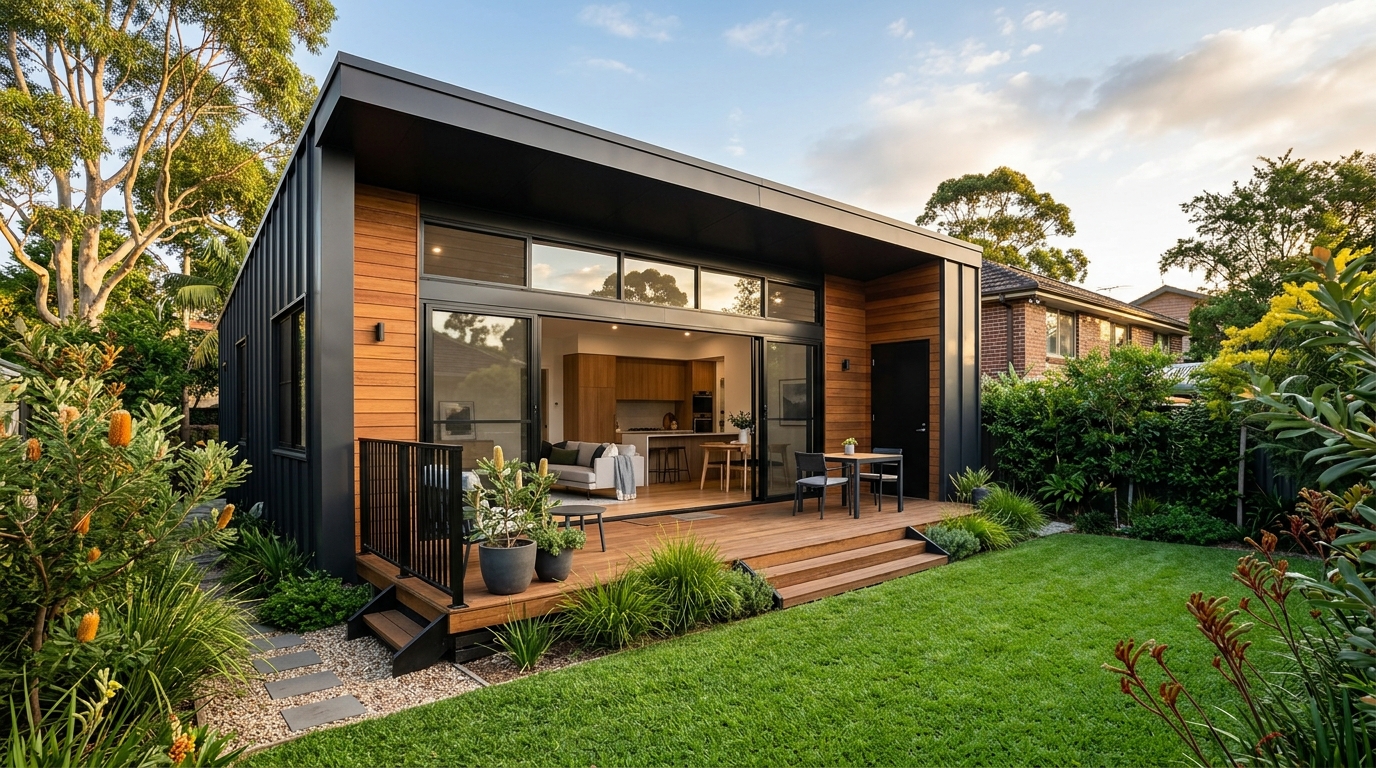
Building a granny flat in NSW 2026 is more accessible than at any point in the state’s history, and the fastest route is the granny flat CDC approval NSW 2026 pathway.
SEPP Housing 2021 replaced seven separate policies with a single instrument. However, it permits secondary dwellings on standard residential lots without council approval, provided the property meets measurable site thresholds.
In 2025, the NSW Planning Portal recorded over 14,000 secondary dwelling applications across Greater Sydney — a 22% increase from the prior year.
Written by Daniel Whitfield, founder of Australia Develops, who has personally bought, subdivided, and built property across Australia.
Two approval pathways exist for secondary dwellings in NSW. Meanwhile, complying Development (CDC) is the faster route — typically 10–20 business days — when the site meets prescriptive standards set in SEPP Housing 2021.
Development Application (DA) applies when the site falls outside CDC thresholds and requires merit assessment by the council.
Understanding which pathway applies to a specific lot determines cost, timeline, and design flexibility. A registered property easement in NSW can narrow the available building envelope before design work even begins.
SEPP Housing 2021 — What the Law Actually Allows
SEPP Housing 2021 permits secondary dwellings on lots zoned R1, R2, R3, R4, or RU5 across NSW, subject to a minimum site area of 450 m² and a minimum lot width of 12 m.
| SEPP Housing 2021 Rule | Requirement |
|---|---|
| Minimum lot area | 450 m² |
| Minimum lot width | 12 m |
| Maximum secondary dwelling GFA | 60 m² (or 10% of lot area, whichever is lesser) |
| Minimum lot frontage (single storey) | 6 m |
| Applicable zones | R1, R2, R3, R4, RU5 |
| Instrument reference | State Environmental Planning Policy (Housing) 2021, s.53 |
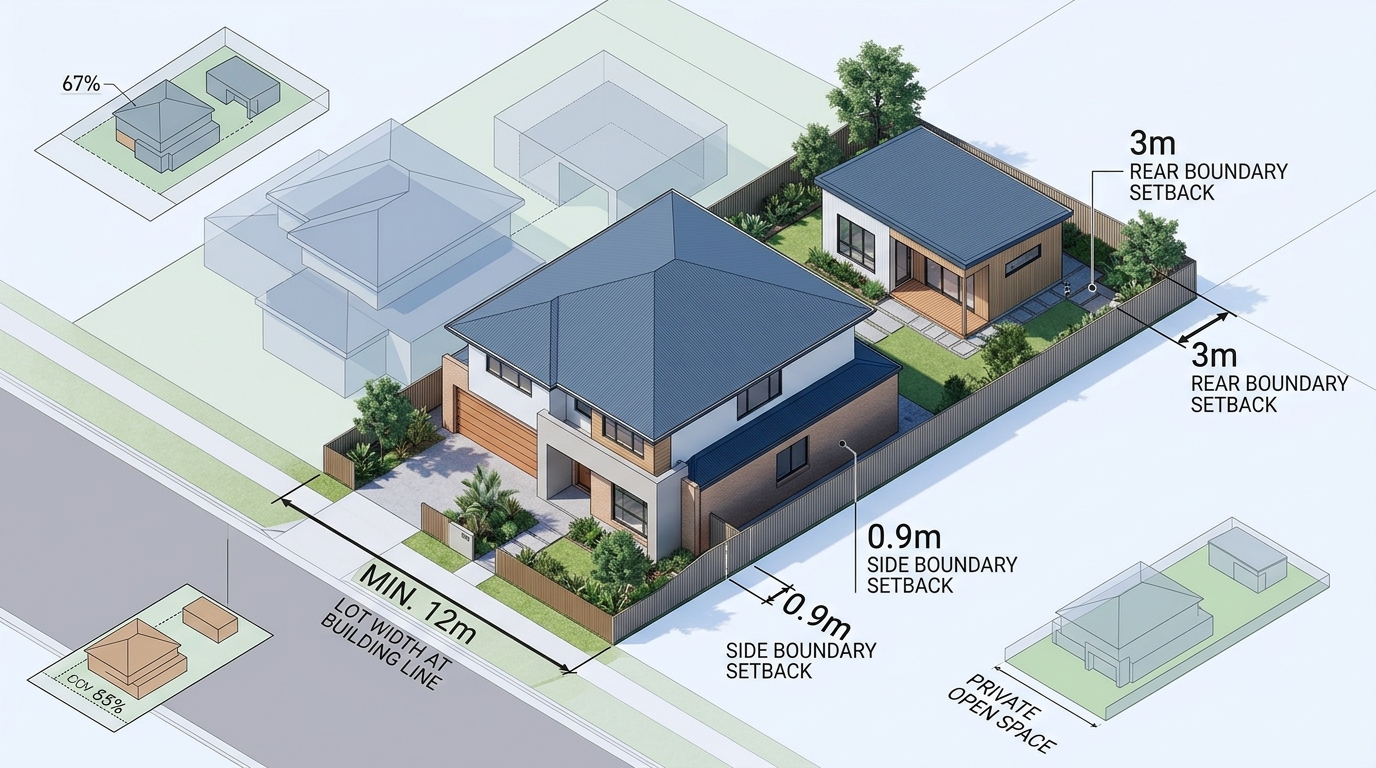
Under SEPP Housing 2021, councils cannot impose additional controls beyond the policy for CDC secondary dwellings. The 450 m² minimum lot area applies uniformly across all NSW councils — Camden, Liverpool, Blacktown, and inner-ring councils alike. The 60 m² GFA cap applies only to the secondary dwelling.
The primary dwelling on the same lot is unaffected by this limit.
Lots under 450 m² may still be eligible for a secondary dwelling via DA, subject to the relevant Local Environmental Plan (LEP).
Some inner-ring councils — notably Canterbury-Bankstown and Inner West — accommodate secondary dwellings on smaller lots under their own LEP provisions. The Bankstown CBD Development 2026 corridor is seeing increased granny flat demand as lot values rise in that area.
Granny Flat CDC Approval NSW 2026 — CDC vs DA: Which Path Applies
CDC approval applies when the lot satisfies all SEPP Housing 2021 site standards. Therefore, DA approval applies when the site falls outside those standards or when the proposed design requires merit assessment.
| Factor | CDC | DA |
|---|---|---|
| Lot area required | ≥450 m² | Any (merit-assessed) |
| Minimum lot width | 12 m | No minimum (merit-assessed) |
| Approval timeline | 10–20 business days | 3–12 months |
| Assessment authority | Private certifier | Council |
| Design flexibility | Low (prescriptive standards) | High (merit-based) |
| Typical total cost | $90,000–$160,000 | $130,000–$290,000 |
| Section 7.11 contributions | Generally exempt | May apply |
| Neighbour notification | Not required | Required |
CDC remains the preferred pathway for complying lots due to its shorter timeline and cost certainty. DA provides the flexibility to exceed the 60 m² GFA cap or vary setbacks, which can materially increase rental income for larger secondary dwellings. Lots within Western Sydney growth corridors — particularly south-west Sydney — are increasingly assessed under combined DA/infrastructure processes due to the Western Sydney City Deal contribution framework.
Owners considering subdivision after constructing a granny flat should also review the Dual Occupancy NSW 2026 guide for a full comparison of strata subdivision costs and timelines. Dual occupancy via subdivision and secondary dwelling via SEPP Housing 2021 serve different ownership and investment objectives.
Granny Flat CDC Approval — Stage-by-Stage Process
A CDC secondary dwelling approval in NSW involves seven stages, from pre-lodgement checks through to occupation certificate.
| Stage | Step | Typical Timeframe |
|---|---|---|
| 1 | Pre-lodgement site check (lot area, width, setbacks) | 1–3 days |
| 2 | Engage private certifier and obtain builder quotes | 1–2 weeks |
| 3 | Prepare architectural plans and engineer’s report | 2–4 weeks |
| 4 | Obtain BASIX certificate via NSW Planning Portal | 3–5 business days |
| 5 | Lodge CDC application on NSW Planning Portal | Same day |
| 6 | Certifier assessment and determination | 10–20 business days |
| 7 | Construction and occupation certificate issued |
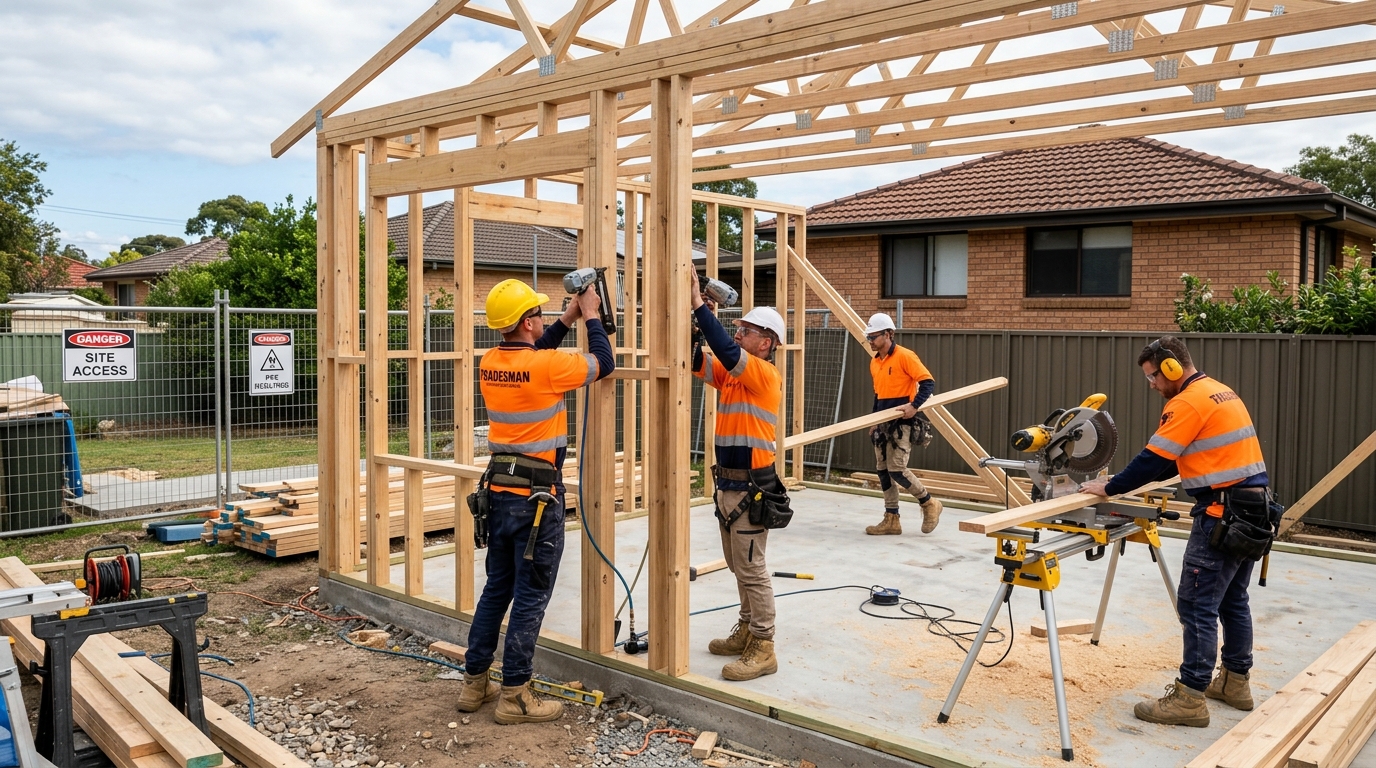
The certifier must determine a straightforward secondary dwelling CDC within 10 business days of a complete lodgement.
Most complying applications receive determination within the statutory period. Construction contracts should include a fixed-price clause and a schedule of finishes to manage material cost risk — a significant consideration given ABS Producer Price Index data showing construction sector inflation of approximately 3.8% for the 12 months to December 2025.
Stage 4 — the BASIX certificate — is a mandatory attachment to the CDC lodgement and cannot be waived. Any variation to the approved plans after the occupation certificate is issued requires a new application.
Post-completion modifications (such as adding a loft or extending the footprint) are assessed as new development, not an amendment.
BASIX and WELS Requirements for Granny Flats
Granny flat CDC approval in NSW requires BASIX compliance to be locked in before the certificate is issued, not after.
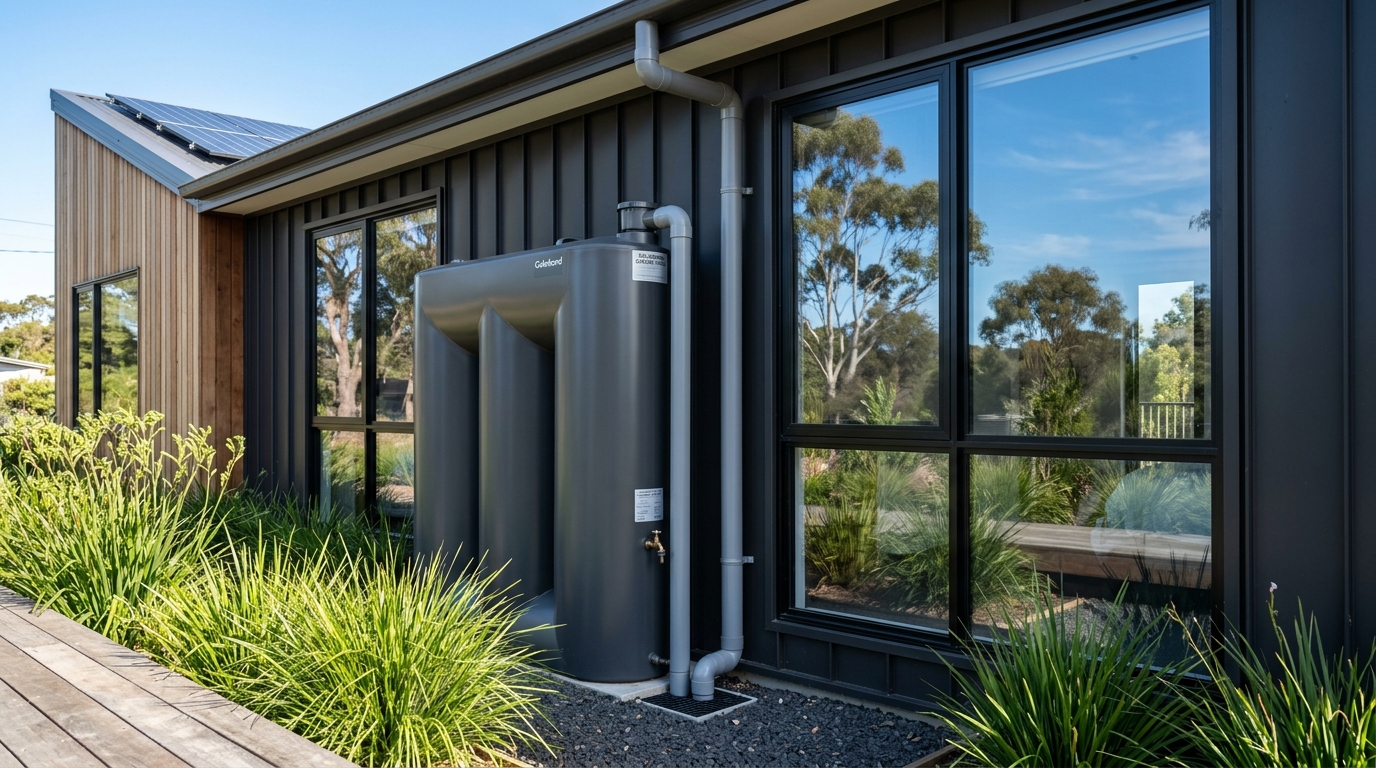
All new secondary dwellings in NSW must satisfy BASIX minimum scores for water and energy efficiency, along with WELS (Water Efficiency Labelling and Standards) minimum fixture ratings.
| Requirement | Standard |
|---|---|
| BASIX water score | ≥40 |
| BASIX energy score | ≥50 (Sydney Metro) / ≥45 (Regional NSW) |
| NatHERS thermal comfort | 7-star equivalent |
| WELS — taps | Minimum 4-star rating |
| WELS — showers | Minimum 3-star rating |
| WELS — toilets | Minimum 4-star (dual flush: 4.5 L / 3 L) |
| Certificate issuer | NSW Planning Portal (basix.planning.nsw.gov.au) |
| Legislative basis | Environmental Planning and Assessment Act 1979 s.4.17; Water Efficiency Labelling and Standards Act 2005 |
The BASIX certificate is a mandatory attachment to any CDC or DA lodgement for a secondary dwelling.
Without it, a private certifier cannot accept the application. WELS minimum ratings apply regardless of whether the approval pathway is CDC or DA — they are not optional upgrades.
The BASIX tool on the NSW Planning Portal auto-applies Sydney metropolitan thresholds for lots in the Greater Sydney Basin.
BASIX scores and NCC 2022 requirements must both be satisfied. In addition, in some cases — particularly for energy performance — the NCC 2022 standard is more stringent than BASIX. Builders experienced in secondary dwellings typically specify BASIX-compliant fixtures by default, reducing the risk of certificate rejection or non-compliant construction.
Costs and Timelines in 2026
A CDC secondary dwelling in NSW typically costs between $90,000 and $160,000 for a 60 m² single-storey design, inclusive of design, certification, and construction.
| Cost Component | CDC Estimate (60 m²) | DA Estimate (up to 80 m²) |
|---|---|---|
| Architectural plans | $3,000–$8,000 | $8,000–$20,000 |
| BASIX certificate | $200–$400 | $200–$400 |
| Private certifier / DA fee | $3,000–$6,000 | $8,000–$25,000 |
| Engineer’s report (structural) | $1,500–$3,500 | $2,000–$5,000 |
| Construction (supply and labour) | $75,000–$130,000 | $110,000–$220,000 |
| Landscaping and driveway | $5,000–$15,000 | $5,000–$20,000 |
| Total range | $87,700–$162,900 | $133,200–$290,400 |
Cost variation reflects builder margin, site access difficulty, and connection costs for water, sewer, and electrical services. Lots in south-west Sydney benefit from reduced infrastructure charges under the Western Sydney City Deal, which may lower Section 7.12 contributions for DA approvals in Liverpool, Campbelltown, and Penrith local government areas.
A granny flat is not the only way to add income potential to an existing block. For instance, for owners with a larger lot, full subdivision into two separate titles — dual occupancy — is the other major pathway, with its own approval process and cost structure.
The video below breaks down that alternative in detail, including DA versus CDC approval and real subdivision costs.
Rental Income and Investment Return
For a granny flat NSW 2026 investment, a 60 m² two-bedroom secondary dwelling in Western Sydney generates median weekly rent of $380–$480, based on Domain and REA Group Q1 2026 rental data.
| Market | Property Type | Median Weekly Rent | Gross Yield (on $130,000 build cost) |
|---|---|---|---|
| Liverpool / Fairfield LGA | 2-bed secondary dwelling | $420/week | 16.8% |
| Camden / Campbelltown LGA | 2-bed secondary dwelling | $390/week | 15.6% |
| Bankstown / Canterbury LGA | 2-bed secondary dwelling | $480/week | 19.2% |
| Greater Sydney median | 2-bed secondary dwelling | $430/week | 17.2% |
These gross yield figures do not account for property management fees (typically 8–10%), maintenance provisions, or vacancy periods. Even after deducting these costs, net rental returns from secondary dwellings frequently exceed returns from a comparable investment property acquisition, due to the lower capital cost of construction versus purchase. Secondary dwelling rental income is assessable for negative gearing purposes under current ATO rules.
The Western Sydney Aerotropolis corridor — including Leppington and the South-West Growth Area — is exhibiting above-median rental demand driven by airport construction workforce and industrial precinct employment.
For context on the broader growth drivers, the Western Sydney Aerotropolis 2026 investment case outlines the infrastructure pipeline supporting rental demand in those corridors.
Builder Verification Checklist
Selecting a registered NSW builder with proven secondary dwelling experience reduces construction risk and protects against non-compliant work that may void certification.
| Verification Item | Where to Check |
|---|---|
| Builder licence (individual or company) | NSW Fair Trading licence search (onlineregistry.fairtrading.nsw.gov.au) |
| Home Building Compensation (HBC) Fund cover | icare NSW HBC Fund lookup (icare.nsw.gov.au) |
| Completed secondary dwelling portfolio | Builder’s website or in-person inspection of completed properties |
| Public liability insurance | Request certificate of currency (minimum $5M cover) |
| Contract works insurance | Request certificate of currency |
| Fixed-price contract with schedule of finishes | Review before signing — exclude “provisional sums” where possible |
| BASIX-compliant inclusions specified | Cross-check against BASIX certificate item by item |
HBC Fund insurance is mandatory in NSW for residential building work over $20,000. Any builder who cannot provide HBC Fund evidence for a secondary dwelling contract is operating outside the Home Building Act 1989 requirements. The builder must personally hold the relevant licence — subcontracting the entire project to an unlicensed party is prohibited and voids HBC Fund cover.
Granny Flat NSW 2026 — Key Data at a Glance
| Metric | Data |
|---|---|
| Governing instrument | SEPP Housing 2021 (s.53 Secondary Dwellings) |
| Minimum lot area (CDC) | 450 m² |
| Minimum lot width (CDC) | 12 m |
| Maximum secondary dwelling GFA | 60 m² (CDC) / merit-assessed (DA) |
| Applicable zones | R1, R2, R3, R4, RU5 |
| CDC timeline | 10–20 business days |
| DA timeline | 3–12 months |
| Typical CDC build cost (60 m²) | $90,000–$160,000 |
| Typical DA build cost (up to 80 m²) | $130,000–$290,000 |
| Western Sydney median weekly rent (2-bed) | $380–$480 (Q1 2026, Domain/REA Group) |
| BASIX water score required | ≥40 |
| BASIX energy score required | ≥50 (Sydney Metro) / ≥45 (Regional) |
| NSW secondary dwelling applications (2025) | 14,000+ (22% year-on-year increase) |
Granny Flat CDC Approval — Summary
SEPP Housing 2021 establishes a clear, accessible framework for secondary dwelling construction across NSW. Overall, lots meeting the 450 m² area and 12 m width thresholds qualify for CDC granny flat NSW 2026 approval, delivering a 10–20 business day determination that significantly reduces holding costs compared to a DA process. The 60 m² GFA cap provides a standardised design target that most Sydney lots can accommodate within complying setback requirements. Registered drainage, sewer or utility easements can also override standard setback assumptions, so it is worth checking the NSW property easements guide before finalising a granny flat site plan.
For properties outside CDC thresholds, the DA pathway allows design flexibility — including GFA above 60 m² — but requires council assessment, neighbour notification, and a longer timeline of three to twelve months. The economics of secondary dwelling construction in NSW favour the CDC pathway for standard lots, with gross rental yields of 15–19% achievable across Greater Sydney markets based on Q1 2026 rental data.
For full planning guidance, NSW Planning’s secondary dwelling resources provide the current SEPP Housing 2021 instrument text, BASIX requirements, and council contact details.
Owners in Western Sydney growth areas should additionally review infrastructure contribution schedules under the Western Sydney City Deal — these affect the total cost of DA approvals for secondary dwellings on newly subdivided lots. Engaging a certifier or town planner early in the process remains the most effective way to confirm the applicable pathway and cost exposure for a specific lot.
This article is general information only and is not financial, legal or planning advice. However, see the Disclaimer for details.