Written by Daniel Whitfield, founder of Australia Develops, who has personally bought, subdivided, and built property across Australia.
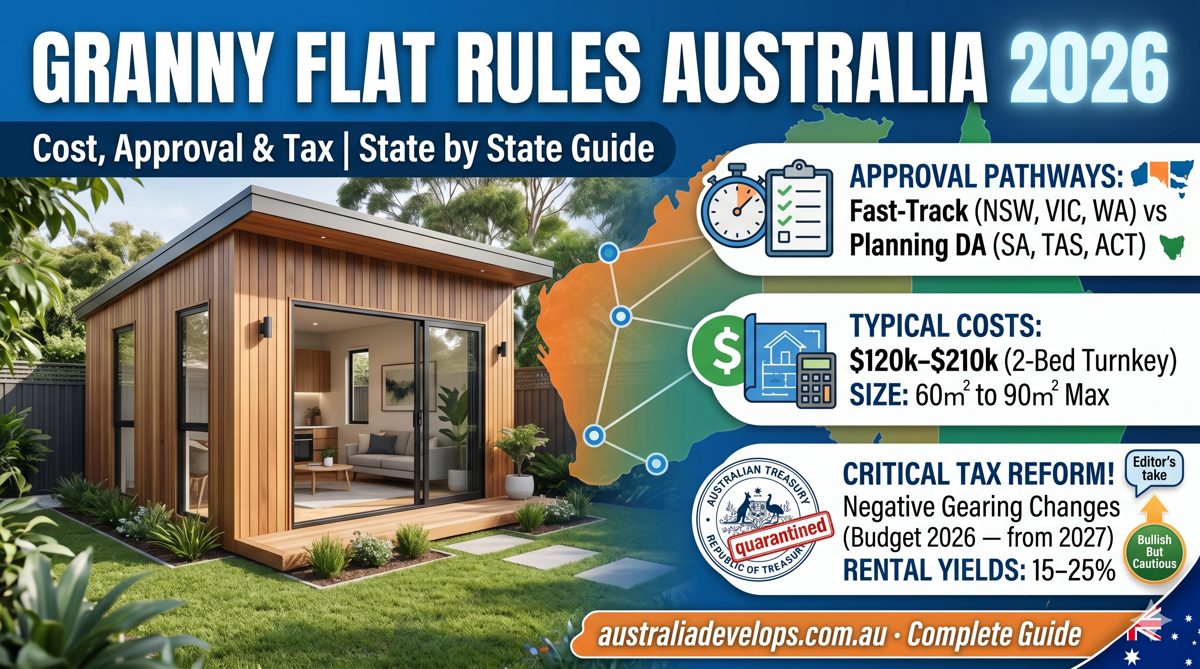
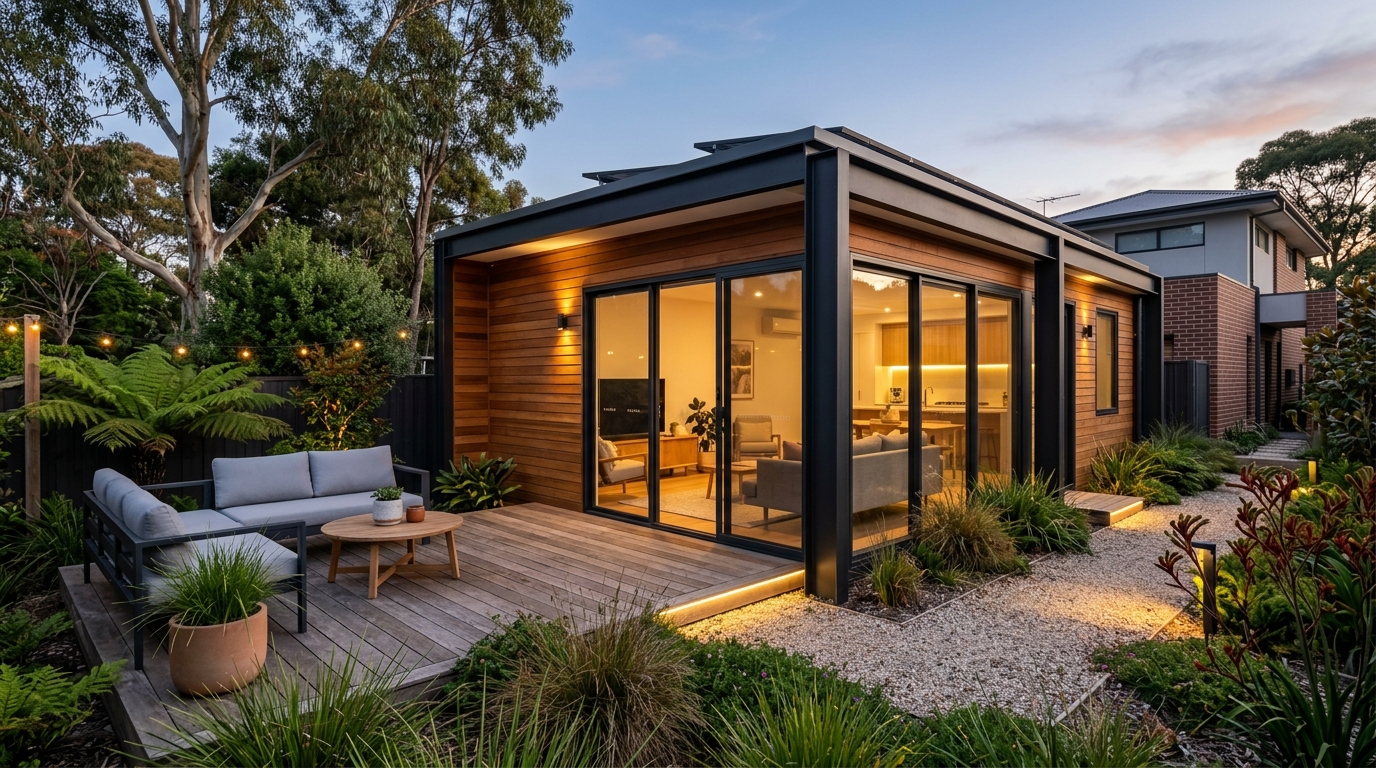
The granny flat rules Australia 2026 landscape has shifted fast, and mostly in the owner’s favour. Across the country, states are lifting size caps and scrapping approvals.
A backyard build is now one of the simplest ways to add rental income.
Two things changed the game in 2026. Firstly, searches for “granny flat”, “dual living”, and “self-contained” homes are all climbing sharply. Secondly, the 2026 Federal Budget reshaped the tax side, which this guide covers in full.
The rules are not national, either. Each state sets its own size cap, lot rule, and approval path. A 60m² flat that is permit-free in Victoria may need full approval in South Australia.
This guide breaks it down state by state — with costs, build standards, tax, and a few honest warnings.
THE QUICK COMPARISON — Granny Flat Rules by State (2026)
QUICK ANSWER — Granny flat size limits run from 60m² to 90m² across Australia. Approval is fastest in NSW, Victoria, and WA.
| State | Legal name | Max size | Min lot | Approval pathway | Rent to anyone? |
|---|---|---|---|---|---|
| NSW | Secondary Dwelling | 60 m² | 450 m² (CDC) | CDC fast-track (10–20 days) or DA | Yes |
| VIC | Small Second Dwelling | 60 m² | None (permit-free over 300 m²) | No planning permit; building permit only | Yes |
| QLD | Secondary Dwelling | ~80 m² (council-set) | Council-set | Often “accepted development” (building approval) | Yes |
| WA | Ancillary Dwelling | 70 m² | None | No planning approval if R-Code compliant | Yes |
| SA | Ancillary Accommodation | 60 m² | 600 m² | Development approval (PlanSA) + building | Yes |
| TAS | Secondary Residence | 60 m² (90 m² proposed) | Scheme-set | Planning + building approval | Yes |
| ACT | Secondary Residence | 90 m² | None (500 m² rule removed) | Approval required | Yes |
| NT | Dwelling-Independent | 75–80 m² | Scheme-set | Often no planning approval; building required | Yes |
One theme runs through every column. Every state now lets owners rent a granny flat to anyone, not just family. Queensland, South Australia, and others scrapped the old family-only rule between 2022 and 2025.
A second theme is speed. By contrast with the old system, NSW, Victoria, and WA now offer near-automatic approval for compliant builds. South Australia and Tasmania still route every project through a full assessment.
Analysis — The national loosening of granny flat rules is significant: Western Australia’s removal of its minimum lot size and Victoria’s permit-free pathway are substantial regulatory shifts. However, “no planning permit” does not mean “no approval” — a building permit is still required in every state, and this is where the new 7-Star energy rules and site costs often add unexpected expense. The building compliance side deserves as much scrutiny as the planning pathway.
A granny flat is not the only way to unlock a second income stream from an existing block.
For owners with a larger lot, full subdivision into two separate titles — dual occupancy — is the other major pathway, with its own approval process and cost structure.
The video below breaks down that alternative in detail, including DA versus CDC approval and real subdivision costs.
NSW — 60m², 450m² Block, CDC in 10–20 Days
QUICK ANSWER — In NSW, a granny flat can reach 60m² on a 450m² block. The CDC pathway can approve it in 10–20 business days.
| Factor | NSW rule |
|---|---|
| Max internal floor area | 60 m² |
| Min lot (CDC) | 450 m² |
| Approval | CDC (10–20 days) or DA |
| Governing instrument | Housing SEPP 2021, Schedule 1 |
NSW runs the country’s best-known fast-track. The NSW Planning Portal confirms a single CDC can approve both dwellings at once. Sydney searches for “CDC granny flat” lead the nation, reflecting that speed.
Around 80% of blocks qualify for CDC. Flood-prone, heritage, or high-bushfire sites must use a council DA instead. For NSW investors chasing specific corridors, the Leppington development pipeline shows where demand is concentrating.
VICTORIA — Up to 60m², No Planning Permit Over 300m²
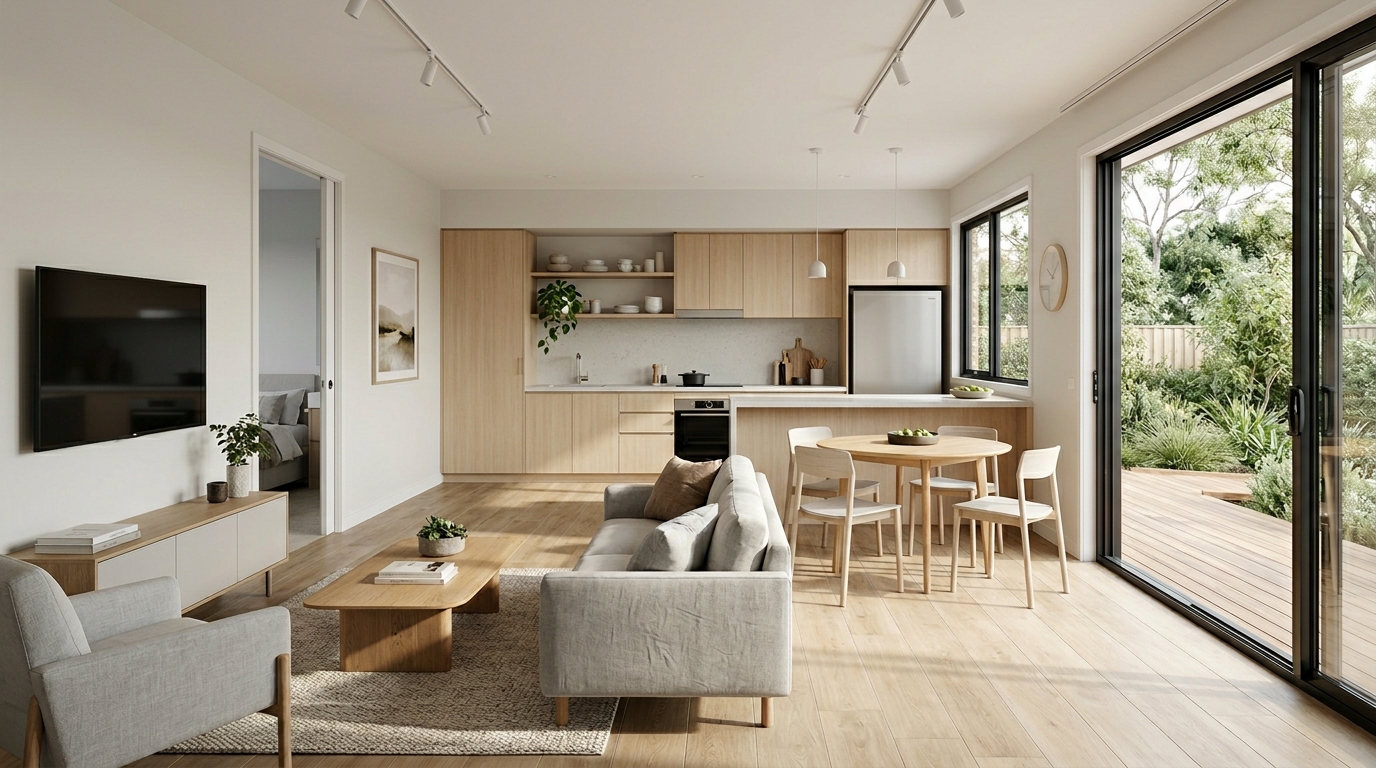
QUICK ANSWER — Victoria allows a 60m² small second dwelling with no planning permit on most lots above 300m².
| Factor | Victoria rule |
|---|---|
| Max floor area | 60 m² |
| Permit-free threshold | Lots over 300 m² (standard zones) |
| Building permit | Still required |
| Subdivide / sell separately | No |
Victoria’s December 2023 reform was a turning point. A compliant 60m² build now skips the planning permit in the General, Neighbourhood, and Residential Growth zones. Overlays such as heritage or bushfire remove that exemption.
Demand has followed the rule change. In particular, Melbourne searches for a “granny flat builder” have grown sharply year on year.
A building permit still applies, however, and the dwelling cannot connect to reticulated natural gas. Planning Victoria sets out the full siting standards.
QUEENSLAND — Up to 80m², Council-Led, Rent to Anyone
QUICK ANSWER — Queensland has no single statewide rule. Councils set the size, often up to 80m², and rent-to-anyone has applied since 2022.
| Factor | Queensland rule |
|---|---|
| Max size | ~80 m² (Brisbane); varies by council |
| Rule source | Local planning scheme |
| Rent to anyone | Yes (since 26 Sept 2022) |
| Approval | Often “accepted development” + building approval |
Queensland is the patchwork state. By contrast with NSW, size and setbacks come from each council scheme, not one policy. Brisbane permits roughly 80m², while Logan caps smaller lots at 70m².
The 2022 reform removed the family-only rule, but it changed planning only. Converting a granny flat to a rental is a use change under building rules. It can trigger interconnected photoelectric smoke alarms and added fire separation. Planning Queensland confirms the planning settings.
WESTERN AUSTRALIA — Up to 70m², No Minimum Lot Size
QUICK ANSWER — WA allows a 70m² ancillary dwelling on any-sized lot. R-Code-compliant builds need no planning approval.
| Factor | WA rule |
|---|---|
| Max size | 70 m² |
| Min lot | None (350 m² rule removed) |
| Approval | None if R-Code compliant |
| Building permit | Always required |
WA moved aggressively in 2024. From 10 April 2024, the state scrapped the 350m² minimum lot size entirely. R-Code-compliant ancillary dwellings are now allowed on residential land of any size, including strata lots.
Search demand reflects the reform. Perth searches for an “ancillary dwelling” jumped roughly 60% year on year. A building permit always applies, however, and setbacks must still be met. WA Planning publishes the ancillary dwelling standards in full.
SOUTH AUSTRALIA — Up to 60m², 600m² Block, Approval Required
QUICK ANSWER — South Australia allows a 60m² ancillary dwelling on a 600m² lot, but it needs development approval, not a fast-track.
| Factor | SA rule |
|---|---|
| Max size | 60 m² |
| Min lot | 600 m² |
| Approval | Development approval (PlanSA) + building |
| Rent to anyone | Yes (recent reform) |
South Australia is more restrictive on entry. The 600m² minimum lot rules out many smaller blocks. Self-contained dwellings with their own kitchen and bathroom are now allowed, however.
Adelaide demand still climbed about 24% year on year. By contrast with NSW or WA, though, there is no permit-free shortcut. Most “PlanSA granny flat” searches start at the PlanSA portal, which assesses every application.
TAS, ACT & NT — Smaller Markets, Bigger Size Limits
QUICK ANSWER — Tasmania allows 60m² (90m² proposed), the ACT 90m², and the NT 75–80m².
| Jurisdiction | Max size | Notes |
|---|---|---|
| TAS | 60 m² (90 m² proposed in 2026) | Must share services with main home |
| ACT | 90 m² | 500 m² min lot removed; one per block |
| NT | 75–80 m² | Often no planning approval; building required |
These three offer the most generous size caps. For example, the ACT already allows 90m² and has removed its 500m² minimum lot rule. Tasmania is consulting on a rise from 60m² to 90m², though that change is not yet law.
The Northern Territory uses the term dwelling-independent. Many NT builds need no planning approval under the NT Planning Scheme 2020. A building approval still applies in every case.
COST — What a Granny Flat Costs Across Australia (2026)
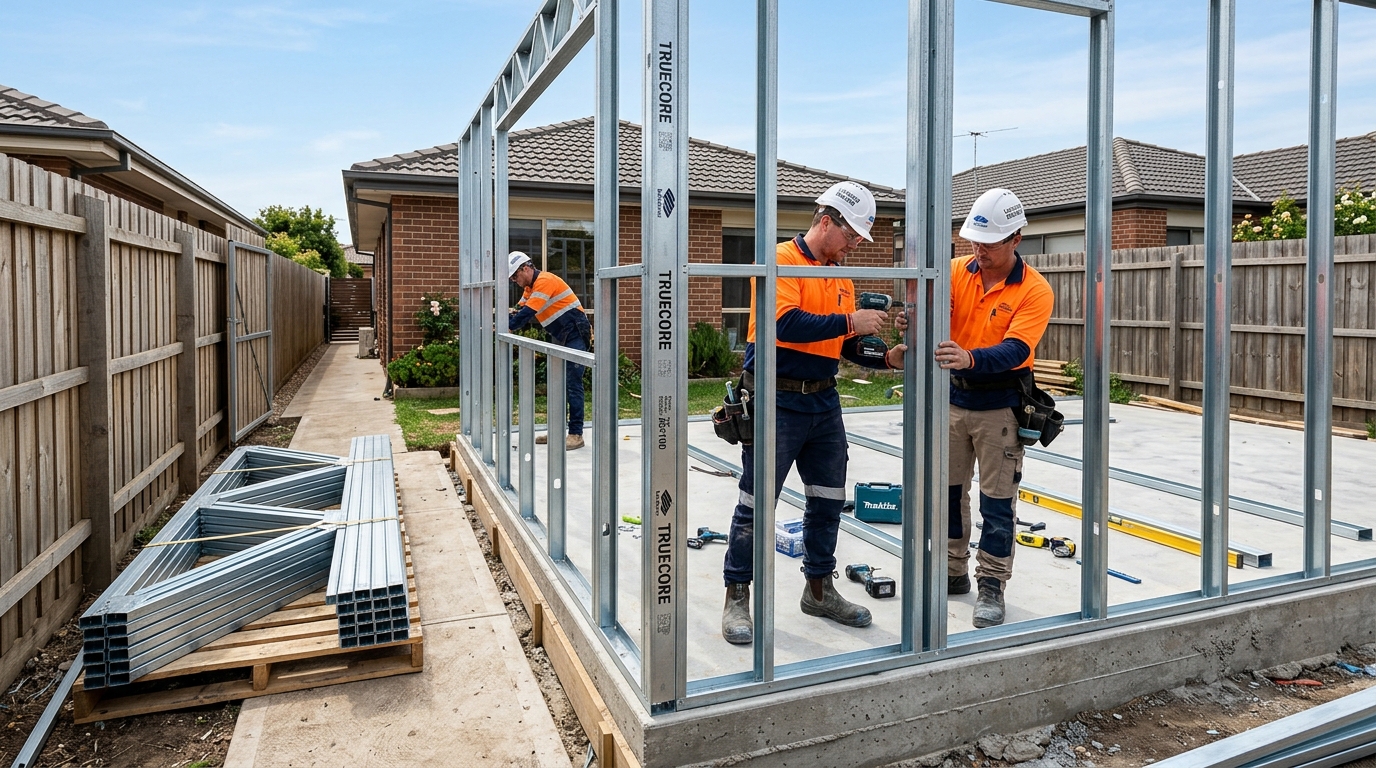
QUICK ANSWER — A turnkey granny flat in Australia typically costs $65,000 to $400,000+ in 2026, depending on size and spec.
| Cost component | Studio 25 m² | 2-Bed 60 m² | 3-Bed / Custom 90 m² |
|---|---|---|---|
| Steel-frame kit (supply) | $24,500–32,000 | $41,200–67,990 | $62,000–85,000 |
| Concrete slab (25 MPa) | $8,000–11,000 | $12,000–16,000 | $18,000–30,000 |
| Cladding & roof | $7,000–10,000 | $13,500–18,000 | $20,000–32,000 |
| Plumbing & electrical | $9,000–13,000 | $13,000–20,000 | $22,000–35,000 |
| Internal fit-out (kitchen/bath) | $10,000–15,000 | $21,000–35,000 | $35,000–60,000 |
| Approvals (BASIX / 7-Star) | $2,000–3,000 | $2,000–4,000 | $4,000–8,000 |
| Site works & soil test | $5,000–12,000 | $15,000–38,000 | $40,500–58,000 |
| Turnkey total | $65,000–95,000 | $120,000–210,000 | $250,000–400,000+ |
Location drives much of the spread. For instance, Sydney builds sit at the top end of each band. Brisbane, Perth, and Adelaide offer gentler entry points.
Site costs then swing the final figure. Sloping land, rock, and long service runs can add thousands. A granny flat also lifts property value by roughly 60–80% of its build cost.
Analysis — Caution is warranted here. The “$65k granny flat!” headlines typically quote a kit price, not a final invoice. Most cost blowouts come from site costs and vague contracts rather than the build itself. A reasonable approach: add 15–20% to any “from” price, insist on a fixed-price turnkey contract in writing, and check a builder’s recent local completed jobs before paying a deposit.
BUILD STANDARDS — NCC 7-Star Energy & Barrier-Free (2026)
QUICK ANSWER — A granny flat is a Class 1a home. In most states, a new build must now meet NCC 7-Star energy and Livable Housing standards.
| Standard | Requirement |
|---|---|
| Energy rating (NatHERS) | 7-Star minimum |
| Glazing | Double-glazed windows and doors |
| Insulation | High R-value walls and roof |
| Accessibility (Livable Housing) | Step-free entry, 870 mm doorways, zero-threshold shower |
These standards lift quality, but they also lift cost. Since NCC 2022 rolled out, a new granny flat is built as a Class 1a dwelling. It must hit the 7-Star NatHERS energy minimum to gain a building permit.
In practice, that means double glazing, thicker insulation, and thermal breaks. Livable Housing design adds step-free entry, wider 870mm doorways, and a zero-threshold shower. Older quotes that ignore these items will understate the real cost.
YIELDS — 15–25% Returns on Build Cost
QUICK ANSWER — Under current granny flat rules, Australia 2026 investors commonly see 15–25% returns on build cost, with weekly rents from $250 to $700 by location.
| Market | Weekly rent | Return on build cost |
|---|---|---|
| Western Sydney (2-bed) | $350 – $550 | 15 – 25% |
| Brisbane middle ring | $320 – $380 | 15 – 25% |
| Perth / Adelaide | $350 – $500 | 12 – 20% |
| Regional areas | $250 – $320 | 12 – 18% |
| Property value uplift | — | +60–80% of build cost |
The returns explain the national surge in interest; indeed, 15–25% on build cost far outpaces a separate investment property at current prices. A well-located build can therefore repay its cost within five to eight years of rent.
The wider backdrop adds context, too. In particular, softening commercial real estate yields have pushed many small investors toward residential add-ons. Steady institutional investment infrastructure spending reinforces that shift.
Rising Foreign Direct Investment (FDI) Australia in housing-adjacent assets points the same way. For owners weighing two income streams instead of one, the full dual occupancy and subdivision guide compares the alternative.
Analysis — The yields are real, but averages hide considerable variation. Early signs of oversupply are emerging in pockets where many owners built the same 2-bed layout simultaneously. Location and build quality still determine which properties command top rent and which owners are forced to discount to fill a vacancy. Proximity to transport and a genuinely private entrance typically outweigh the savings from a cheaper finish.
TAX — 2026 Budget Changes, Negative Gearing & CGT
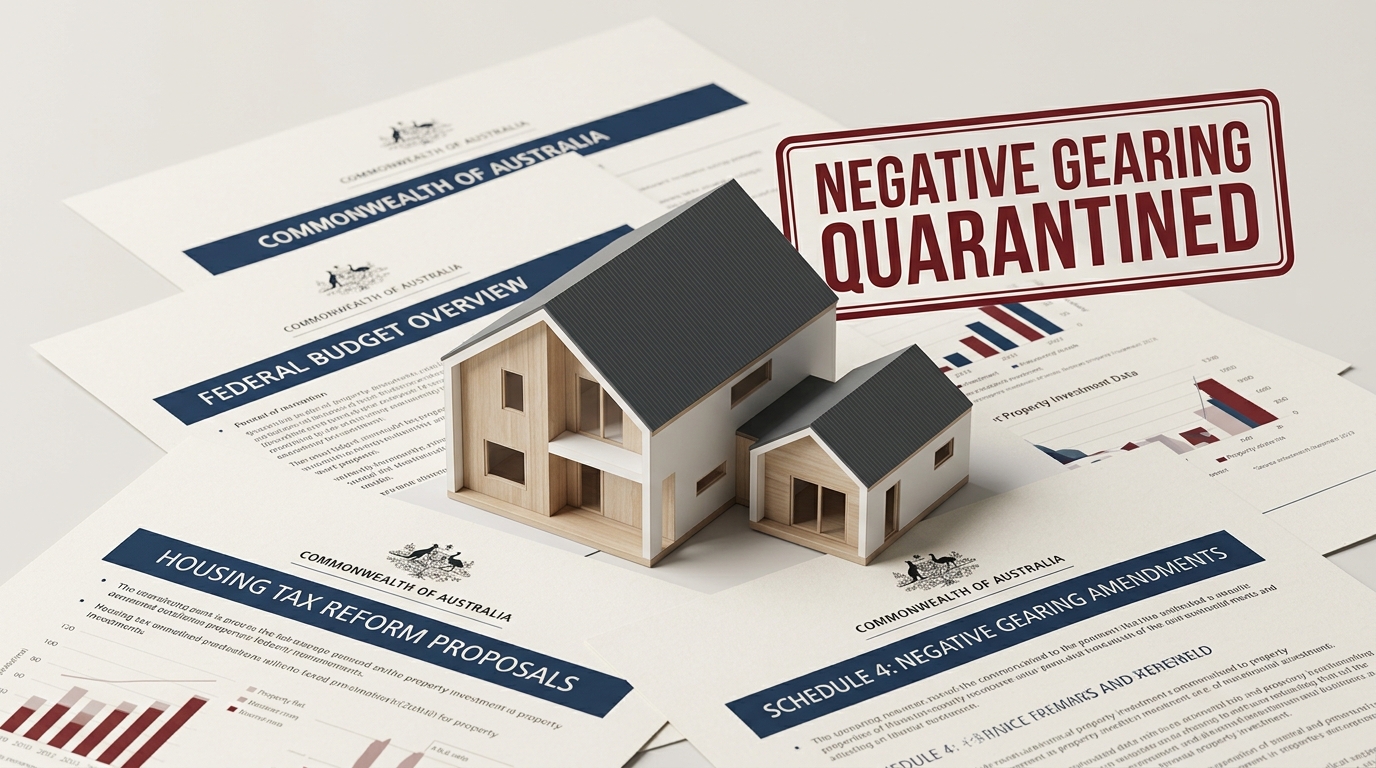
QUICK ANSWER — Under the granny flat rules Australia 2026 tax settings, negative gearing is limited to new builds from 1 July 2027. A granny flat on an existing home does not qualify.
| Tax factor | Position (2026 Budget — effective 1 July 2027) |
|---|---|
| Property held before 12 May 2026 | Grandfathered; current negative gearing rules continue |
| Established property bought after 12 May 2026, 7:30pm | Rental losses quarantined; cannot offset wages |
| Granny flat on an existing property | Not an eligible “new build”; excluded from the concession |
| CGT discount | 50% discount replaced by CPI indexation + minimum 30% tax |
| Depreciation | Still claimable on a rented granny flat |
| Main residence exemption | Partly reduced if the granny flat is rented |
The 2026 Federal Budget reshaped the investor maths. The Government announced these changes on Budget night, 12 May 2026. They take effect from 1 July 2027, so current rules still apply until then.
Negative gearing is the headline change. From 1 July 2027, it applies only to new builds. An established property bought after Budget night can no longer offset rental losses against wages.
The granny flat detail matters most here. A granny flat added to an existing home is not classed as an eligible new build. It does not unlock the new-build negative gearing concession.
Capital gains tax also shifts. The 50% CGT discount gives way to CPI indexation plus a minimum 30% rate on gains after 1 July 2027. Depreciation stays claimable, and renting still reduces the main residence exemption.
These rules are announced, not yet fully legislated. This report is general information only, not financial or legal advice. Owners should confirm their position with a registered tax agent.
The Budget 2026–27 tax reform page and the Australian Taxation Office set out the detail.
Analysis — This update shifts the calculus. Granny flats remain attractive for cash yield, but the 2026 Budget quietly removed a significant tax sweetener for investors. Owners who build on an established property purchased after Budget night should not assume the structure can be negative-geared against salary income. For owner-occupiers adding a flat to the family home, the rental return still stacks up favourably. Either way, a tax agent should be consulted before relying on projected deductions.
KEY DATA AT A GLANCE — Granny Flat Rules Australia 2026
| Factor | Figure (2026) |
|---|---|
| Size range across states | 60 m² – 90 m² |
| Fastest approval states | NSW, VIC, WA |
| Rent to anyone | Now allowed in every state |
| Build standard | NCC 7-Star energy + Livable Housing |
| Typical turnkey cost | $65,000 – $400,000+ (by size) |
| Weekly rent range | $250 – $700 |
| Return on build cost | 15 – 25% |
| Property value uplift | +60–80% of build cost |
| Negative gearing (from 1 July 2027) | New builds only; granny flats on existing homes excluded |
SUMMARY — Build Fast, But Read the Fine Print
The granny flat rules Australia 2026 settings reward owners who move fast but read the local detail. Size caps now reach 90m² in the ACT and Tasmania’s proposal.
NSW, Victoria, and WA offer the quickest path from plan to approval.
The upside is conditional everywhere. Site costs, 7-Star build standards, and the 2026 Budget tax changes all shape the real return. The smartest approach pairs a fast approval state with disciplined due diligence on the builder, block, and tax position.
The strongest overall approach still pairs a fast-approval state with a fixed-price contract, a suburb that is not already saturated, and a tax agent’s sign-off before committing.
This article is general information only and is not financial, legal or planning advice. See the Disclaimer for details.
Granny Flat Rules Australia 2026 — Frequently Asked Questions
How much does a granny flat cost in Australia in 2026?
Advertised granny flat kit prices typically start around $65,000, but this is a kit price, not a final invoice. Site costs, permits, and a fixed-price turnkey contract usually add another 15–20% on top.
Do I still need council approval if my state allows a permit-free granny flat?
Yes. States such as Victoria and Western Australia have removed the planning permit requirement for smaller granny flats, but a building permit confirming NCC 7-Star energy compliance is still required everywhere in Australia.
Can I rent a granny flat to anyone, or only family?
This depends on the state. Queensland allows granny flats to be rented to anyone on the open market, while several other states still restrict occupancy to family members unless a specific exemption applies.
Are granny flats still tax deductible after the 2026 Federal Budget?
The 2026 Budget removed a negative gearing tax sweetener for investors who build on an established property purchased after Budget night. Owner-occupiers adding a granny flat to their existing home are generally unaffected.
A tax agent should confirm the specific position before relying on any deduction.