Most of the rate commentary at the moment is about the RBA’s next move. The cash rate rose to 4.60% on 29 September, the fourth increase this year, and some economists expect another before Christmas. For anyone trying to work out how much they can borrow, I think that debate matters less than it looks.
The reason is the APRA serviceability buffer. APRA confirmed again in May 2026 that it is staying at 3 percentage points, and because it sits on top of whatever your rate is, a cut hands back far less borrowing power than the headline suggests. Here is how the buffer works and what it means in practice.
What the APRA Serviceability Buffer Is
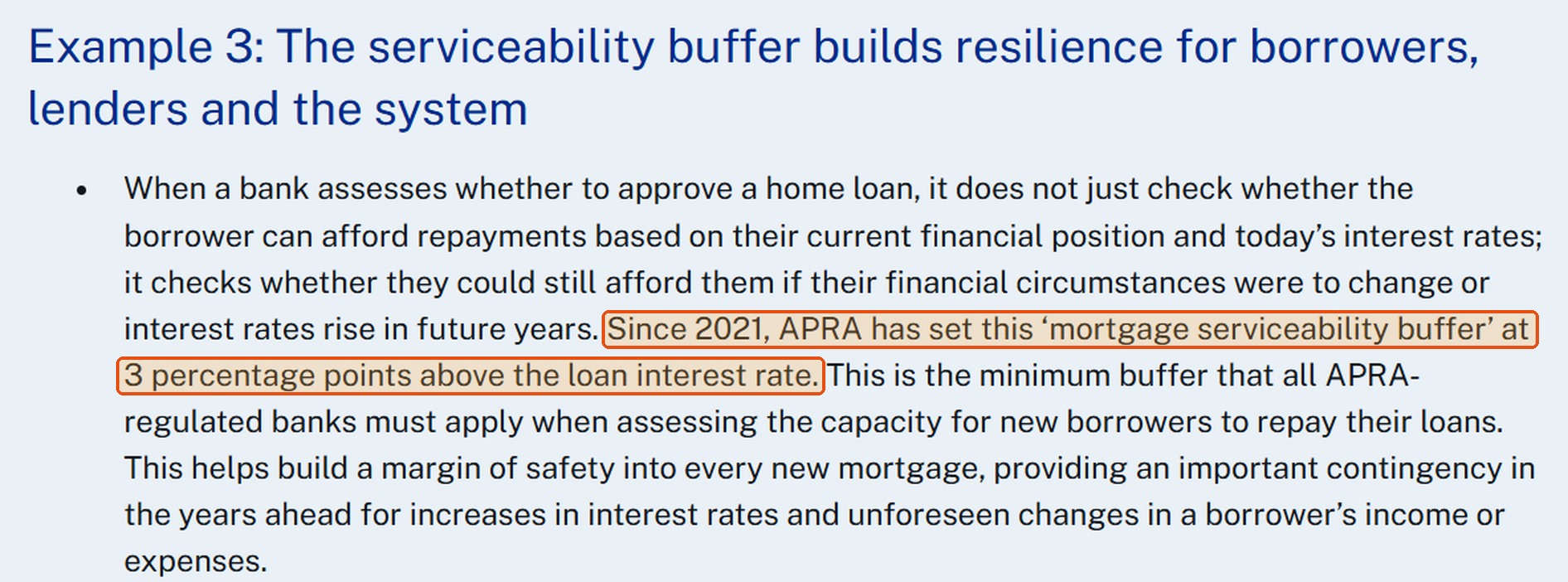
Under APRA’s prudential guidance for residential mortgage lending (APG 223), every bank and lender it regulates has to test whether you could still afford your repayments if your interest rate were 3 percentage points higher than what you’d pay. You’ll never pay that rate on day one, and it doesn’t matter — the test rate, not your real rate, is what caps how much you’re allowed to borrow.
The buffer sat at 2.5 percentage points for most of the 2010s. APRA lifted it to 3 points in October 2021, worried that ultra-low rates were pushing households to borrow more than they could safely service once rates normalised. Rates have since moved a long way from where they sat in 2021. APRA hasn’t touched the buffer itself since.
APRA Just Reconfirmed It — Here’s Why
APRA’s System Risk Outlook, published 21 May 2026, confirmed both the 3-point serviceability buffer and the 1% countercyclical capital buffer are staying exactly where they are. A week later, APRA’s broader macroprudential update made the same call explicit: no change to either setting.
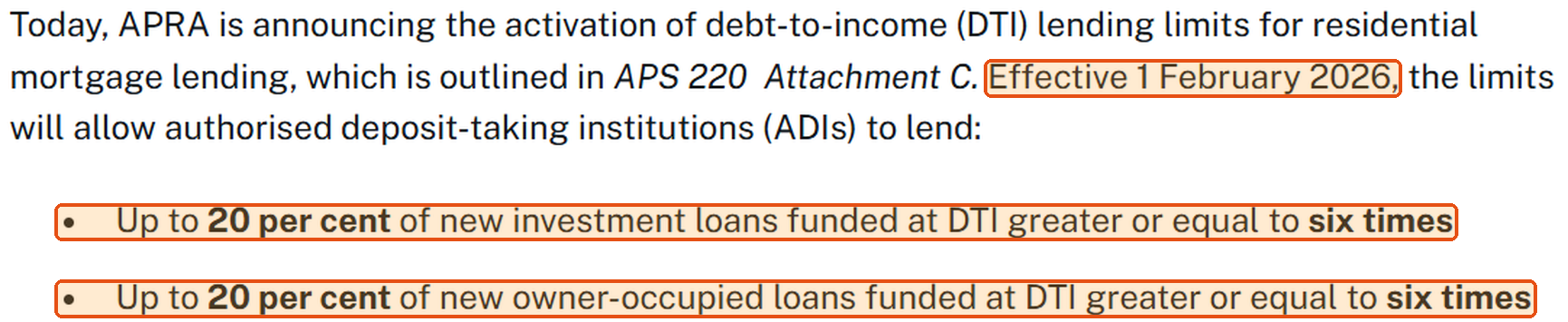
The regulator’s reasoning hasn’t shifted much from previous reviews. Household debt relative to disposable income sits at just under 180% — high by historical and international standards, even though it has eased from its peak. The debt-to-income lending limit that took effect on 1 February 2026 caps new lending at debt-to-income ratios of 6 times or more to 20% of a bank’s new loans. The latest quarterly data shows lending is still tracking comfortably under that ceiling. APRA reads that as evidence the current settings are working, not as a reason to loosen them. Non-performing loans have also ticked up slightly, and APRA flagged that as a reason for caution rather than confidence.
APRA’s Settings As At May 2026
Why a Rate Cut Won’t Give You Back What You’d Expect
The buffer is a fixed margin, not a fixed test rate. It sits on top of whatever your actual rate is, so when your rate moves, the test rate moves with it — but the gap between them never closes. That’s the part that trips people up: a rate cut does lift your borrowing capacity, but by a lot less than the size of the cut would suggest, because you’re still being tested 3 full points above wherever the new, lower rate lands.

Westpac’s forecast is the clearest live example. Before the September hike, it was the only major bank calling cuts at all, pencilling in two 0.25-point reductions across August and December 2027 that would have taken the cash rate half a point lower. If lenders passed that fully through to variable mortgage rates, the average owner-occupier rate would drift from around 6.62% to roughly 6.12%. The test rate lenders apply would fall in step, from about 9.62% to about 9.12%. That’s still a real increase in borrowing capacity. APRA’s own published modelling puts a half-point shift in the effective test rate at roughly a 5% change in a typical borrower’s maximum loan size. In other words, it’s a single-digit percentage gain stretched over roughly eighteen months of forecast cuts — not the kind of jump that turns a marginal borrower into a comfortable one.
My read: if your plan relies on rate cuts lifting your borrowing capacity, it relies on the one major bank calling cuts being right, and even then it buys you roughly 5%. I wouldn’t build a purchase timeline around that.
For context on where rates are likely headed before any of that plays out, see our full breakdown of the RBA’s next moves through 2027 — most banks are still calling a hike before they call a cut.
The Push To Cut The Buffer — And Why APRA Isn’t Budging
Industry groups have been lobbying for a lower buffer for years, and the numbers they cite are eye-catching. The Finance Brokers Association of Australia commissioned research in April 2025 arguing that cutting the buffer by just half a point, from 3% to 2.5%, could unlock around $276 billion in aggregate borrowing capacity across the market and let roughly 270,000 more people qualify for a median-priced loan. Treat that figure as an advocacy estimate, not an independent one — a group with an obvious interest in looser lending standards commissioned it.

APRA’s own position hasn’t moved. Chair John Lonsdale has previously said the current buffer level “has not been restrictive on new credit to the household sector.” The May 2026 review leaned on the same logic. Banks are lending well under the debt-to-income caps already in place, non-performing loans are still low but drifting up, and household debt remains high. Put together, APRA sees more downside in loosening the buffer than upside in freeing up extra borrowing capacity right now.
What This Means If You’re Trying to Buy Right Now
If you’re borrowing-constrained today, don’t bank on a future rate cut to fix it. Even Westpac’s own forecast, the most cut-friendly of the major banks, only gets you a modest lift in what you can borrow, and it doesn’t land until late 2027 at the earliest. If the buffer itself is what’s capping you — rather than the deposit you’ve got saved — the more useful levers are on the deposit side, where the policy settings have moved recently. Our guides to the 5% Deposit Scheme and Help to Buy shared equity scheme cover the two programs designed to get buyers in with less upfront. That’s a more useful lever right now than waiting on APRA to move a number it has just confirmed, twice in six months, that it isn’t planning to touch.
With the buffer holding borrowing power in place, timing becomes the bigger lever for most buyers. Our NSW property market: buy now or wait breakdown looks at that decision in detail.
General information only, not financial or lending advice. Based on APRA’s published guidance as at September 2026. Lenders apply serviceability differently, so check your own capacity with a broker or lender.