Where interest rates and property prices go from here matters a lot more than what already happened. The Reserve Bank has now held the cash rate at 4.35% for three meetings running, the big four banks can’t agree on what it does next, and the property market’s next chapter is splitting sharply by state. Here’s what the numbers actually say about the rest of 2026 and into 2027.
| Metric | Where It Stands Now |
|---|---|
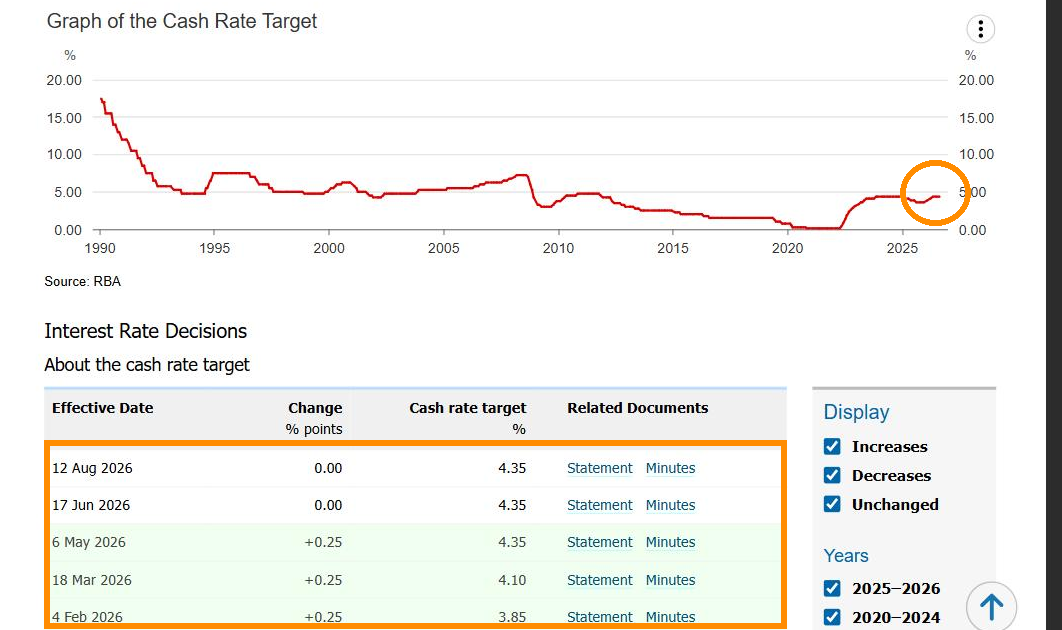
| Cash rate | 4.35%, on hold since May 2026 |
| Next RBA decision | 29 September 2026 — forecasts split between the big four |
| National dwelling values | -0.7% in July, the broadest monthly fall in almost four years |
| FY27 city forecasts | Split: Sydney & Melbourne falling, Perth/Adelaide/Brisbane forecast to rise (Domain) |
Where Interest Rates Actually Sit Right Now
Interest rates in Australia sit at 4.35% right now, reached through three separate 0.25 percentage point increases in February, March and May 2026 that undid the relief borrowers had banked from the 2024-25 cutting cycle. Since May, the Reserve Bank has held steady through three consecutive meetings. Governor Michele Bullock has been careful not to rule anything out, saying after the August decision that the board is “staying put, but staying put with a very clear focus on watching how the data come in,” and flagging that persistent inflation risk could still force another move.
The board only had a hold or a hike on the table in August, not a cut. On the Reserve Bank’s own official statement, this is a bank still worried about upside inflation risk, not one signalling an easing cycle.
The September Decision Nobody Agrees On
The next call lands on 29 September, and for the first time this cycle the major banks have genuinely split. NAB is calling a 25 basis point hike to 4.60% at that meeting. CBA and ANZ agree a hike is coming but push the timing to November instead. Westpac is the outlier, expecting the cash rate to stay at 4.35% for the rest of the year.
The disagreement comes down to how each bank reads July’s inflation data. Headline annual inflation eased to 3.5%, which looks like a green light to hold. But the trimmed mean, the Reserve Bank’s preferred measure of underlying inflation, stayed at 3.6%, still above the top of the target band. Banks weighting the headline number are calling a hold or a delayed hike; banks weighting the trimmed mean are calling a hike sooner.
What Another Interest Rate Move Actually Costs a Borrower
Each 0.25 percentage point move works out to roughly $75 to $80 a month in extra repayments on a $500,000 loan over 30 years, and closer to $115 to $120 a month on a $750,000 loan. That’s the same maths that made the 2024-25 rate cuts worth about $100 to $130 a month on a typical loan — run in reverse. If the NAB or CBA/ANZ calls play out, someone with an average-sized mortgage is looking at another $75 to $120 coming off their monthly budget between now and Christmas, on top of what the three 2026 hikes have already taken.

The Property Market Has Broadened Its Slowdown
The national Home Value Index fell 0.7% in July 2026, the largest single-month drop since December 2022, and for the first time this cycle the weakness has spread almost everywhere. More than three-quarters of capital city suburbs recorded value declines over the three months to July, according to the latest market update. Sydney (-1.4% in July, -5.3% since January) and Melbourne (-1.2%, an eighth straight monthly fall) are leading the retreat, and even Brisbane and Adelaide are now recording back-to-back monthly declines. Perth is barely positive at +0.1%, with listings up 28% year-on-year easing what had been the tightest market in the country. Only Darwin and Hobart are still holding firm.
None of this points to a crash. Low unemployment, ongoing population growth and a genuine shortage of new construction are all working against a sharp correction, and much of the current softness looks like sellers withdrawing rather than accepting discounts. But it does mean the growth-corridor markets that outperformed through 2024 and 2025, Perth and Adelaide especially, are no longer immune to what higher rates are doing to borrowing capacity.
Why the FY27 Forecasts Split So Sharply by State
Look past the current softness and the forecasts for the year to June 2027 diverge hard by state. Domain’s FY27 outlook has Sydney falling 3% to 7% and Melbourne falling 4% to 8%, while Brisbane (+3% to +7%), Adelaide (+4% to +8%) and Perth (+5% to +9%) are tipped to reach record highs. ANZ Research takes the opposite view, forecasting capital city declines across the board of 4.3% in 2026 and 3.4% in 2027, a peak-to-trough fall of roughly 10.6% nationally. When two credible forecasters land on opposite conclusions from the same data, the honest answer is that nobody actually knows yet.
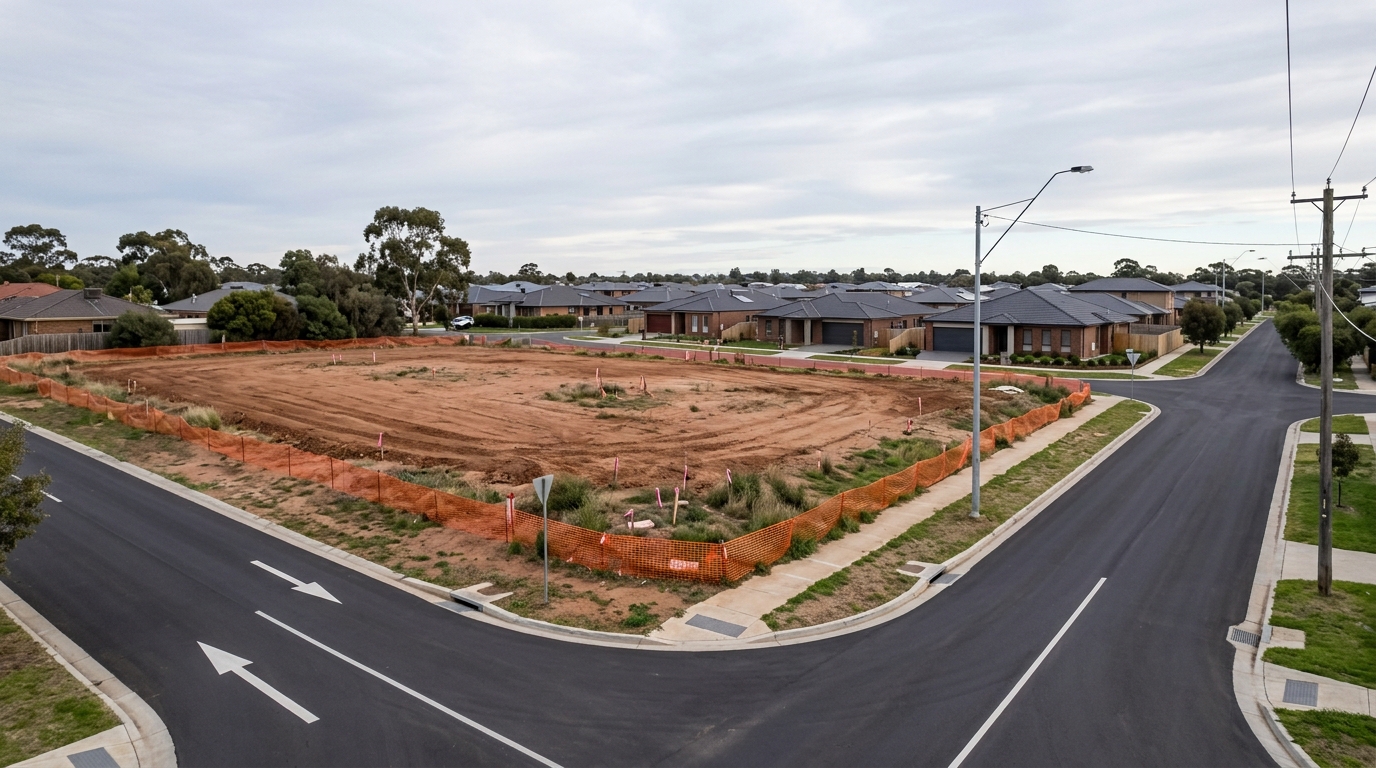
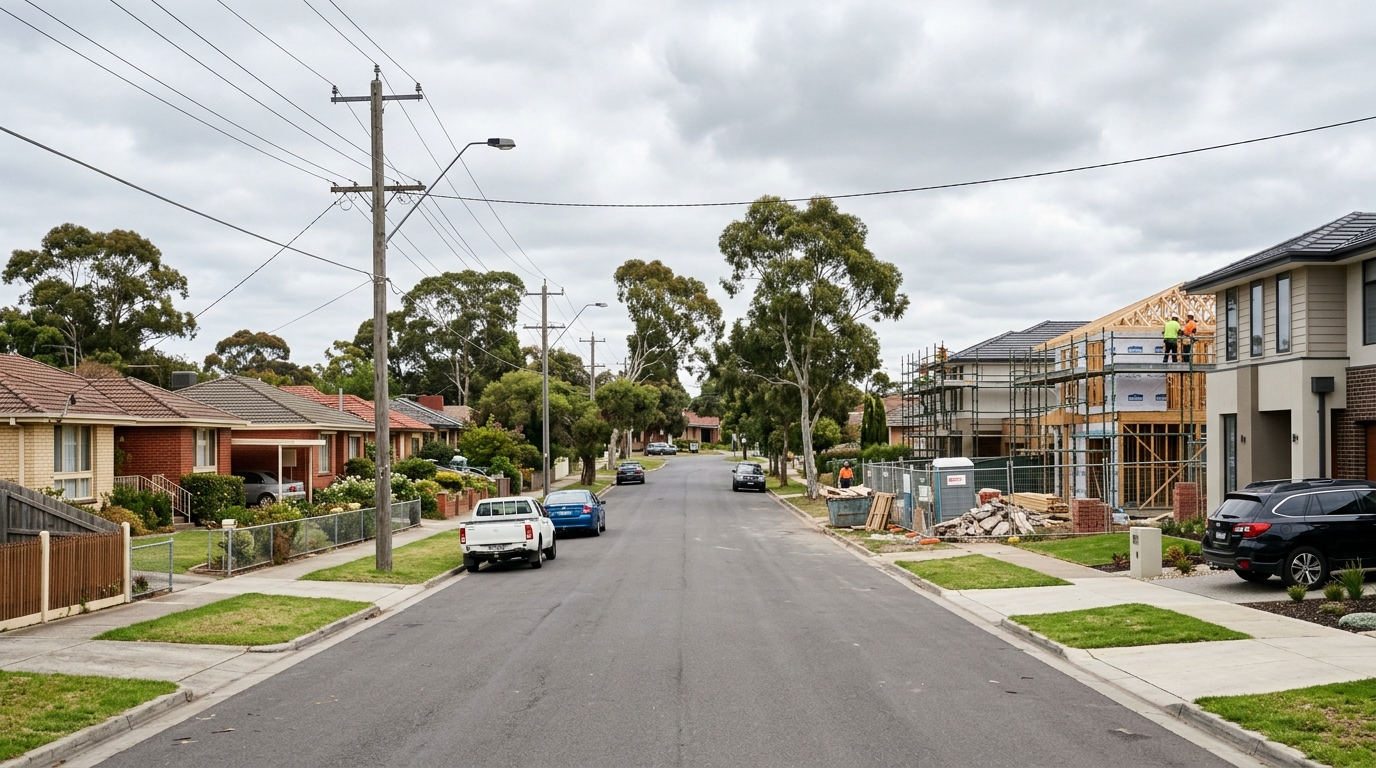
The case for the outperforming states rests on supply and affordability, not sentiment. Growth corridors like Alkimos in WA and Angle Vale in SA are selling new-build stock at price points Sydney and Melbourne buyers left behind years ago, which a rate hike bites into less. Queensland corridors such as Yarrabilba carry the same logic. Victoria is the exception worth flagging: Melbourne’s established market sits in Domain’s weakest bracket, but outer growth areas like Wyndham Vale run more on new-housing supply and population growth than the established-home price cycle, so one citywide forecast doesn’t necessarily apply to every suburb in it.
What This Actually Means If You’re Buying or Holding Now
If you’re weighing up a purchase in the next few months, the realistic near-term picture is more interest rate uncertainty, not less. That argues for less urgency in Sydney and Melbourne, where prices are still falling and a rushed purchase risks buying before the bottom. In the growth corridors tipped to outperform, the calculus is different: new-build stock at accessible price points tends to hold up better through a rate-driven slowdown, though July’s numbers are a reminder that even Perth and Adelaide aren’t immune to a genuinely tighter borrowing environment.
For anyone already holding a variable-rate mortgage, the practical move is to stress-test the budget against one more 0.25 percentage point rise rather than assume the pause is permanent. The Reserve Bank itself has said as much.
FAQ: Australian Interest Rates and Property Prices, Late 2026
Will the RBA raise interest rates again in 2026?
It’s genuinely split. NAB expects a hike to 4.60% at the 29 September meeting, CBA and ANZ expect the same rise but in November, and Westpac expects no further hikes this year. The Reserve Bank itself has said it is watching inflation data closely rather than signalling a fixed path.
When are interest rates expected to start falling?
Most forecasts point to 2027 at the earliest, and even that isn’t settled. Westpac has pencilled in two cuts during 2027 taking the cash rate to 3.85% by December, but other banks have pushed their own cut timing back as inflation data has come in hotter than expected.
Are Perth and Adelaide property prices still going to rise?
Most FY27 forecasts still have Perth (+5% to +9%) and Adelaide (+4% to +8%) among the strongest markets in the country, but July’s national data showed even these markets slowing to near-flat, so the strength is moderating rather than accelerating.
Is now a good time to buy an investment property?
That depends on your own finances, borrowing capacity and risk tolerance, and this isn’t financial advice. What the data shows is a market with genuine regional divergence: Sydney and Melbourne are still falling, while several growth corridors are forecast to keep rising, though more slowly than in 2024-25.
This article summarises publicly available forecasts from the Reserve Bank of Australia, the major banks and property data providers as at early September 2026. Interest rate and property price forecasts are inherently uncertain and can change quickly as new data arrives. This is general information, not personal financial or investment advice — speak to a licensed mortgage broker or financial adviser before making a decision.