The 5% deposit scheme, officially the First Home Guarantee, works differently than it did a year ago, and the difference matters if you’ve been putting off using it. Since October 2025 there’s no income cap, no annual place limit, and much higher price caps in every growth corridor this site covers. Here’s exactly how it works right now, what you can actually buy under it, and what it’s doing to prices at the entry level of the market.
| What You’re Asking | Where It Stands Now |
|---|---|
| Minimum deposit | 5%, with no Lenders Mortgage Insurance |
| Income cap | None — removed 1 October 2025 |
| Annual place limit | None — also removed 1 October 2025 |
| Uptake since the change | 22,921 guarantees in the first four months, up 75% on the prior four months |
How the Scheme Actually Works Right Now
The mechanics haven’t changed: you buy with as little as a 5% deposit, and the Government guarantees the bank up to 15% of the property’s value so you skip Lenders Mortgage Insurance entirely, an upfront saving that typically runs $15,000 to $35,000 on a metro purchase. What changed is who can get one. Housing Australia’s First Home Guarantee page confirms the scheme now has no income test and no cap on the number of guarantees issued in a year, both removed from 1 October 2025. Previously the scheme capped out at 35,000 places a year and excluded anyone earning over $125,000 solo or $200,000 as a couple; both of those limits are gone.
You still need to be a first home buyer or have had no property interest in the past ten years, intend to live in the property, and be an Australian citizen or permanent resident. You also still need to actually service the loan on a 5% deposit, which is a bigger loan and a bigger repayment than a 20% deposit buyer carries on the same property.

What You Can Actually Buy Under the Price Caps
Every price cap rose in October 2025, and in most growth corridors this site covers, the cap now sits well above what you’d actually pay. The full national table, from Housing Australia’s property price cap tool, looks like this:
| Location | Price Cap |
|---|---|
| NSW — Sydney, Illawarra, Newcastle, Lake Macquarie | $1,500,000 |
| NSW — other regions | $800,000 |
| VIC — Melbourne, Geelong | $950,000 |
| VIC — other regions | $650,000 |
| QLD — Brisbane, Gold Coast, Sunshine Coast | $1,000,000 |
| QLD — other regions | $700,000 |
| WA — Perth | $850,000 |
| WA — other regions | $600,000 |
| SA — Adelaide | $900,000 |
| SA — other regions | $500,000 |
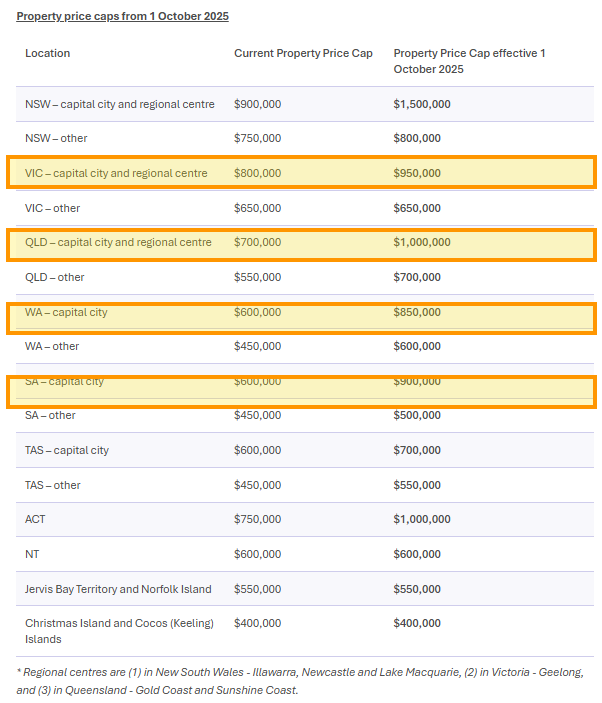
Set against the growth corridors this site tracks, that headroom is significant. Yarrabilba and Ripley Valley sit well under Brisbane’s $1,000,000 cap, Wyndham Vale sits under Melbourne’s $950,000, Alkimos sits under Perth’s $850,000, and Angle Vale sits under Adelaide’s $900,000. A new-build purchase in any of these corridors is realistically a 5% deposit purchase under this scheme, not a marginal case up against the ceiling.
Why Removing the Income Cap Changed Who Hits the Price Cap
Take away the income test and the annual cap, and the uptake numbers move fast. Housing Australia issued 22,921 guarantees in the four months after the October changes, against 13,105 in the four months before, a 75% jump. Roughly two-fifths of that group are under 30, more than 10,700 buyers are in regional areas, about 18% are key workers, and nearly two-thirds bought a house rather than a townhouse or apartment. This isn’t a scheme sitting unused waiting for eligible applicants anymore; it’s now the default entry point for a large share of first home buyers.
The Side Effect Nobody Fully Priced In
More buyers chasing the same entry-level stock has a predictable effect on entry-level prices. Cotality research found homes priced under the relevant cap rose 6.7% in the six months after the expansion, against 3.6% for higher-priced properties in the same markets, nearly double the growth rate. Sydney showed the widest gap: homes under the cap rose 4.1% while pricier properties actually fell 1.1%. Cotality’s research director Tim Lawless put it plainly: the scheme “works against the goal of improving housing affordability by boosting demand without addressing supply.”
That’s the trade-off worth understanding before you use it. The 5% deposit and skipped LMI are a genuine saving on the way in, but if you’re buying in a price bracket the scheme has made more competitive, some of that saving is being absorbed by faster price growth on the exact stock you’re competing for.
What This Means If You’re Buying Under the Price Cap
If you’re buying in a growth corridor comfortably under the local cap, the scheme is straightforwardly useful: it gets you in years earlier than saving a 20% deposit would, and the LMI saving alone is worth $15,000 to $35,000 depending on the loan size. The catch is competition, not eligibility. With income and place caps gone, more buyers at your price point are chasing the same new-release stock, so the advantage is real but it isn’t uncontested. Getting pre-approved and moving decisively on a release once you’ve done your research matters more than it used to.
If you’re closer to the price cap in your region, run the numbers on a 5% deposit loan specifically. A bigger loan means bigger repayments, and the interest rate environment right now (see our separate look at where interest rates are headed through 2027) makes that repayment stress test worth taking seriously before you commit.
FAQ: The 5% Deposit Scheme in 2026
Is there still an income cap on the First Home Guarantee?
No. The income test was removed from 1 October 2025, along with the previous 35,000-place annual limit. There’s no income cap and no cap on the number of guarantees issued.
What’s the price cap where I’m buying?
It depends on the region. Sydney, Illawarra, Newcastle and Lake Macquarie sit at $1,500,000; Melbourne and Geelong at $950,000; Brisbane, Gold Coast and Sunshine Coast at $1,000,000; Perth at $850,000; and Adelaide at $900,000, with lower caps for other regional areas in each state.
Does using the scheme mean I pay more for the property itself?
Not directly, but Cotality research shows entry-level prices (the segment this scheme targets) have grown faster than higher-priced properties since the scheme expanded, so competition at your price point may be stronger than before.
Do I still need Lenders Mortgage Insurance with a 5% deposit?
No. The Government guarantee covers up to 15% of the property’s value, which is what replaces the LMI a lender would otherwise require on a low-deposit loan.
This article summarises publicly available information from Housing Australia and property data providers as at early September 2026. Scheme rules, price caps and places can change — confirm current details with a participating lender or Housing Australia before relying on them. This is general information, not personal financial advice.