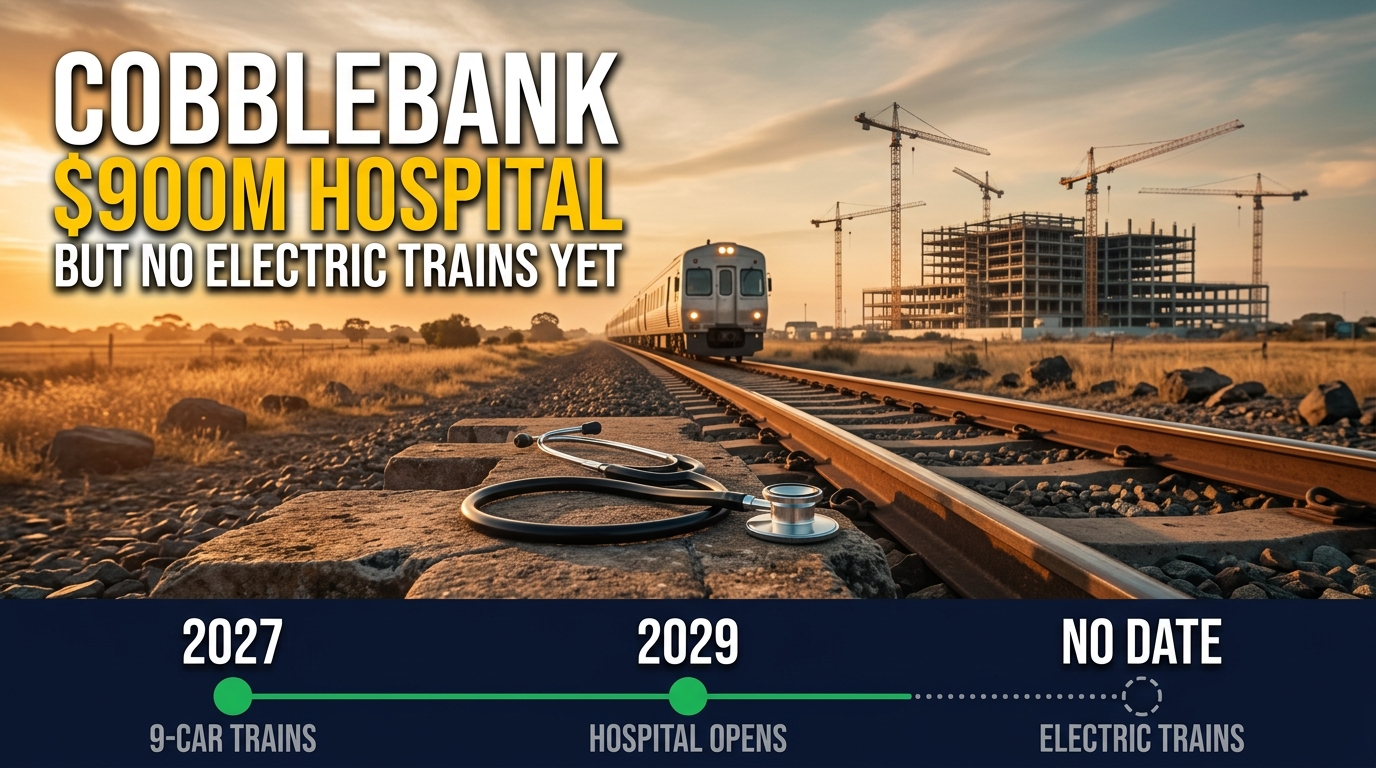
Cobblebank didn’t exist as a suburb until 2017. In 2021 it had 3,601 residents. Today it has a hospital rising out of the paddocks on Ferris Road. It also has a station on a line that’s about to get longer trains. On top of that, there’s a planned city centre designed for a catchment of up to 160,000 people. So here is what’s funded in Cobblebank and the wider City of Melton. I’ll then cover what’s due when, and what the council is still asking for.
Written by Daniel Whitfield, founder of Australia Develops. An accountant by background who has bought land and built a home himself, he researches property development and planning across Australia using council reports, planning records and government data.
Where Cobblebank is
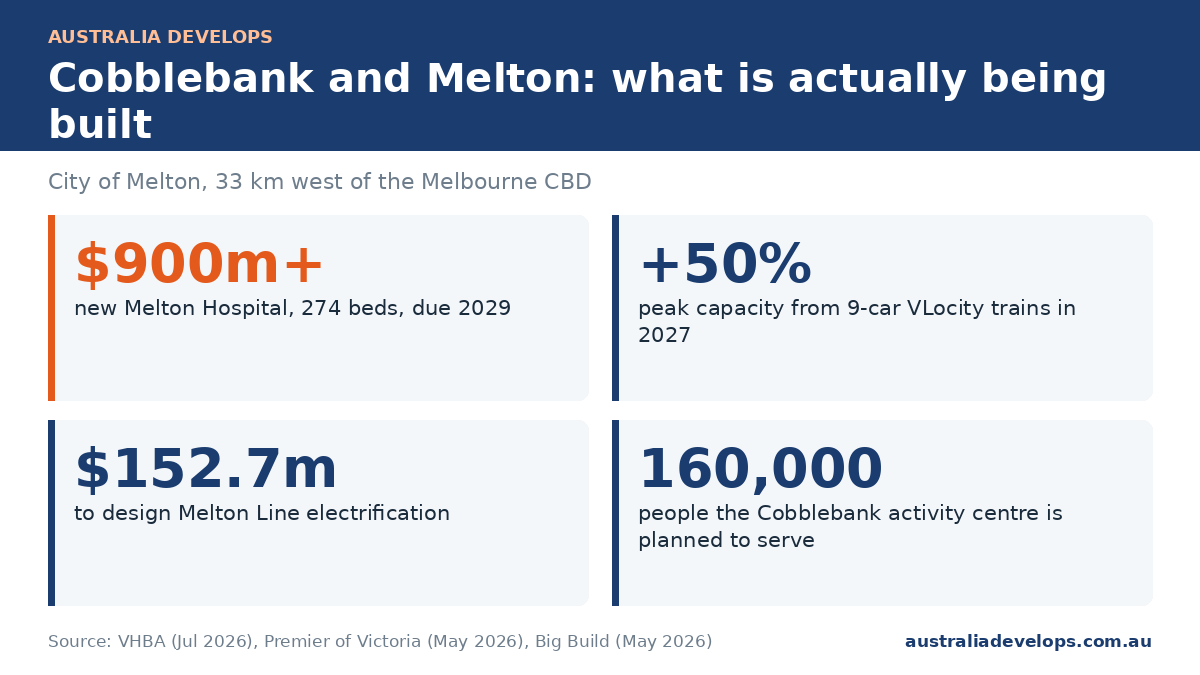
Cobblebank sits about 33 km west of the Melbourne CBD in the City of Melton. It lies between the old Melton township and Rockbank. The state gazetted it on 9 February 2017, carving it out of the Toolern growth area. Then its station opened on 1 December 2019. Coles Cobblebank, the Western BACE business hub, Cobblebank Stadium and the 100-hectare Toolern Park are already here. Still, most of the rest is farmland waiting for its turn.
Melton City Council calls the municipality Australia’s fastest-growing area. The council also says its population will almost double over the next 20 years. For housing, the Victorian Government’s target for Melton is 109,000 new homes by 2051.
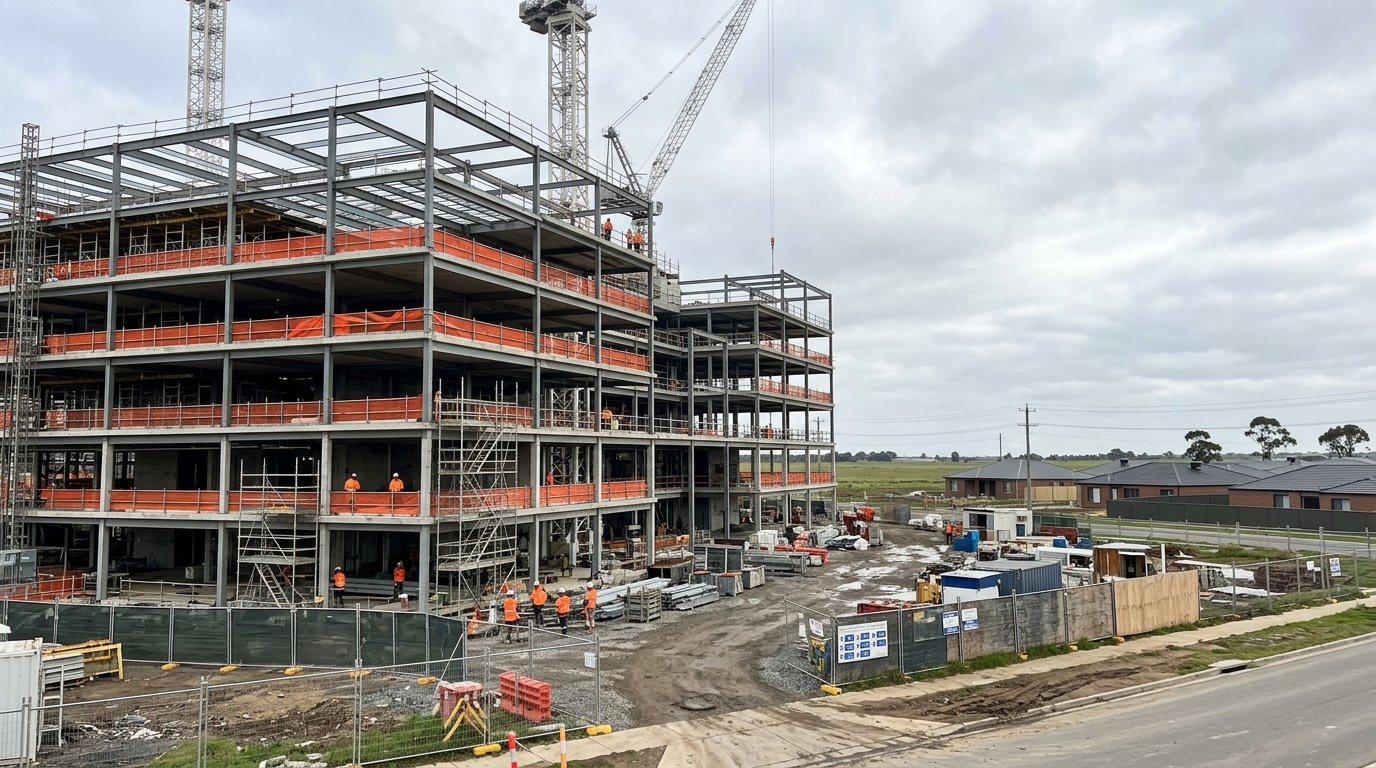
The new Melton Hospital in Cobblebank: $900 million, 274 beds
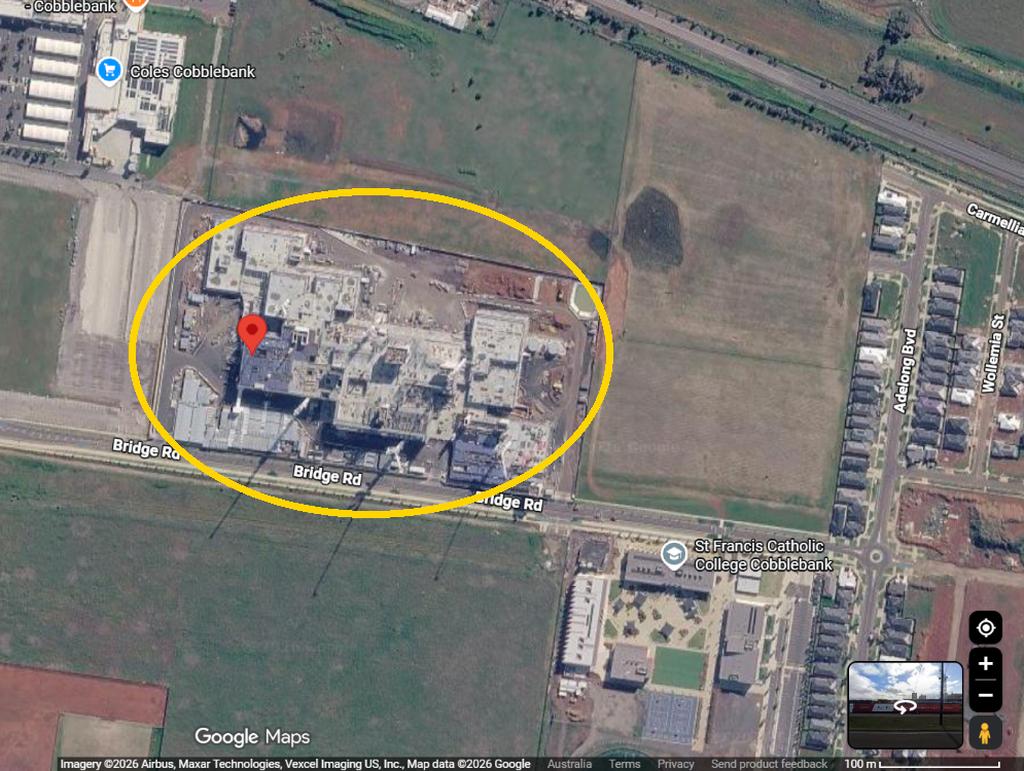
The biggest single project is the hospital at 245-267 Ferris Road, on the corner of Bridge Road. The state has committed more than $900 million. It will have 274 beds and a 24/7 emergency department. That department should see almost 60,000 presentations a year. The hospital will offer intensive care, operating theatres, maternity and neonatal services, mental health care, radiology and outpatients. In total it’s designed to treat 130,000 patients a year. On the energy side, it’ll be the first all-electric hospital in Victoria.
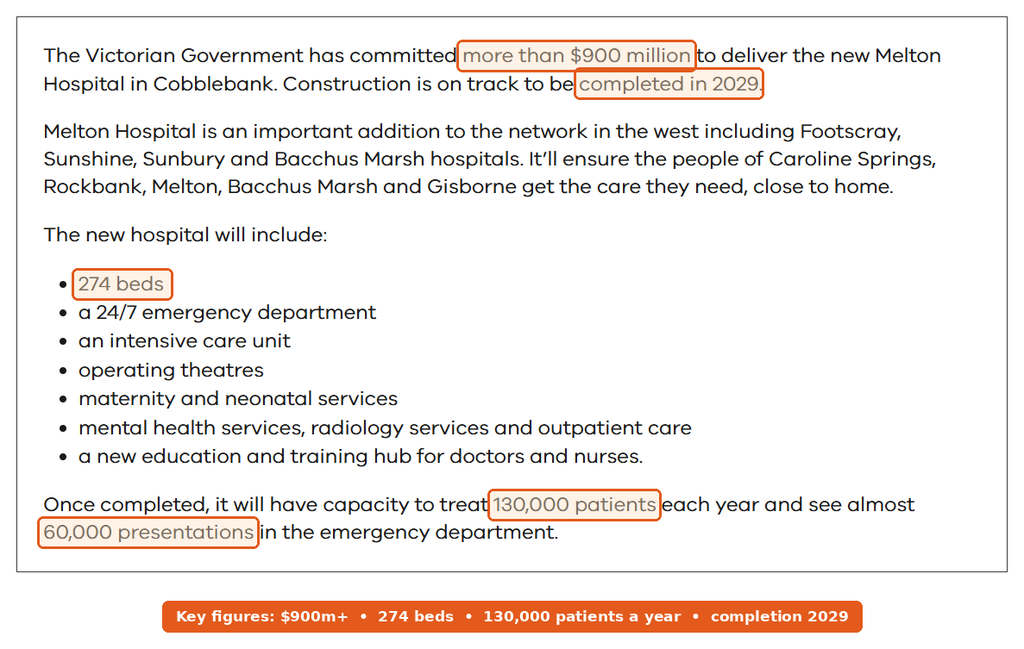
Exemplar Health won the contract in 2024, with Lendlease as construction partner. In its July 2026 newsletter, the building authority said major construction had been under way for 12 months. By then about 350 workers were on site each day, and six tower cranes were up. The target for completion is still 2029.
Right now the closest large hospitals for most Melton residents are at Sunshine and Footscray. So a full emergency department and maternity ward in Cobblebank fixes one of the biggest everyday complaints out here. It also brings jobs, because hospitals are among the largest employers in any growth corridor.
The Melton Line: longer trains in 2027, electrification still in design
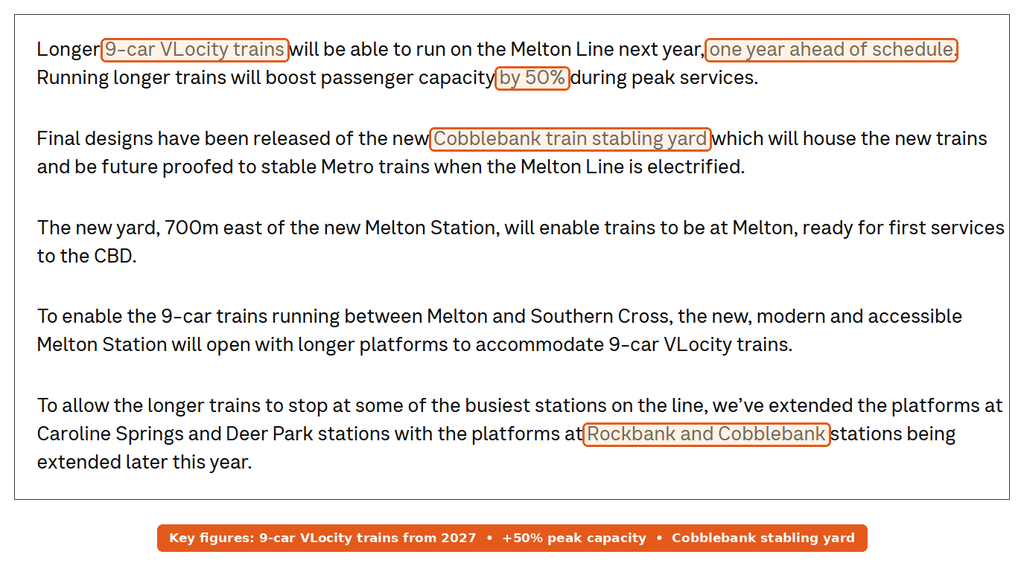
The second big item is the train. The Melton Line runs diesel VLocity trains to Southern Cross, and it’s crowded. Under the Melton Line Upgrade, nine-car VLocity trains will start running in 2027. That’s a year ahead of the original schedule, and it lifts peak capacity by 50%. To make that work, the state is building a new Melton Station with longer platforms. Crews have already extended the platforms at Caroline Springs and Deer Park. Then in 2026 they’re extending the Rockbank and Cobblebank platforms. The project is also adding a new train stabling yard at Cobblebank, about 700 m east of the new Melton Station.
Electrification is a different story. On 4 May 2026 the state and federal governments announced $152.7 million, split equally, for development work. That covers site investigations, environmental assessments, planning approvals, power supply, detailed design and costing. The work is due to finish around mid-2027. But it’s planning money, not construction money, and there’s no date yet for metro trains to Melton.
In July 2026 the council publicly pushed to electrify and duplicate the line by 2030, as Infrastructure Victoria has recommended. It wants new stations at Mt Atkinson, Thornhill Park and Calder Park too. However, none of those stations has funding.
The Cobblebank town centre
Cobblebank has metropolitan activity centre zoning, the same planning tier as places like Ringwood and Broadmeadows. The plan covers business, retail, civic, education, medical, housing, entertainment and recreation uses. Together they’d serve a catchment of up to 160,000 people. The hospital and the station are the anchors. But what’s on the ground today is still small. There’s a Coles-anchored neighbourhood centre, the stadium and a scattering of new schools. For example, St Francis Catholic College sits across Bridge Road from the hospital site.
What it means if you’re buying or renting
For owner-occupiers, the practical test is distance. A home within a short drive of Ferris Road and Cobblebank Station gets the hospital and the longer trains first. By contrast, estates further west toward Melton South, or north of the Western Freeway, face a different picture. They’ll lean on roads that the council itself describes as congested.
For investors, a 274-bed hospital needs nurses, doctors, cleaners and support staff, and many will want to rent close by. That’s a real source of demand. Still, it won’t fully arrive until the hospital opens in 2029. Until then, a lot of new house-and-land supply is competing for the same tenants.
How it compares with Wyndham Vale
Melbourne’s west has two big growth fronts, and we’ve already covered the other one. Wyndham Vale to the south-west has its own regional rail line. It also has the newly approved Wyndham Vale Jobs Hub, but no hospital of this scale. By contrast, Cobblebank’s edge is health infrastructure, which tends to attract medical suites, specialist rooms and key-worker rental demand around it. The weakness for both is the same: diesel trains that nobody designed for metropolitan crowds.
My read: the hospital is the most certain thing in this corridor. It has funding, it’s halfway through construction and it has a completion year. The nine-car trains are close behind. Electrification is where I’d be careful, because $152.7 million of design work doesn’t mean a construction budget will follow quickly. So if you’re looking at land or a house in Cobblebank, the hospital is a solid reason. But a metro train by 2030 isn’t something I’d price in yet.
Borrowing for a first home out here? Then check how the latest serviceability rules affect what a lender will give you before you commit to a build contract.
This article is general information based on Victorian Government, VHBA, Victoria’s Big Build and Melton City Council publications available at publication. It isn’t financial advice. Project timelines can change, so check current details with the relevant agency before making decisions.